

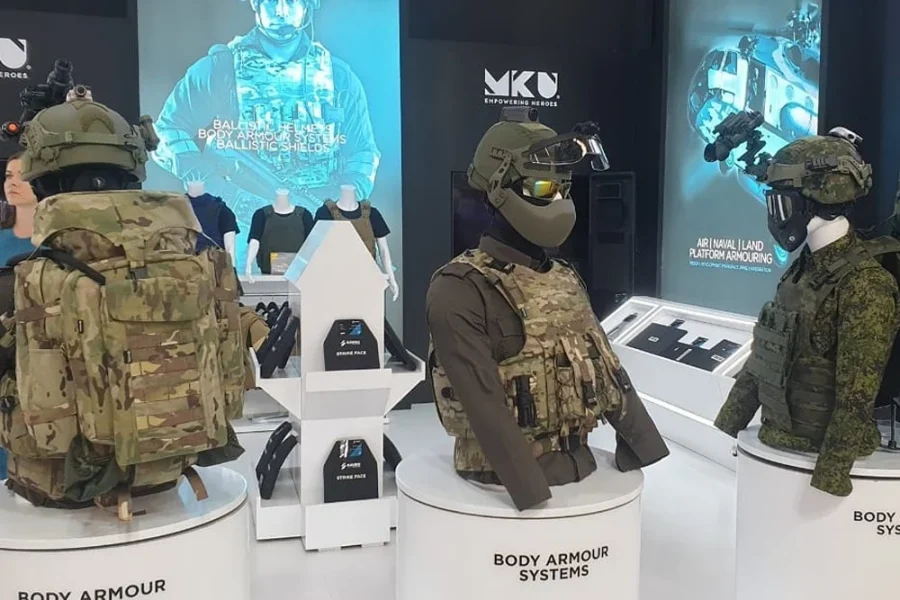
Indian defence company MKU plans to build a factory in Nouaceur to make military equipment locally, after five years of supplying the Royal Armed Forces. The factory will be located in the SGZID industrial zone near Casablanca. It will make optical and electronic systems used for surveillance and targeting, as well as body armour and other ballistic protection equipment.
MKU announced the project on 7 October. The company has not yet given the investment value, size of the factory, number of jobs or construction timetable.
The project will bring two of MKU’s main product lines to Morocco: Netro and Kavro.
Netro makes optronic equipment. This includes night-vision monoculars, weapon sights and multi-sensor systems used to detect, observe and identify targets.
Some of its night-vision systems, such as the NM-3000, use Generation-3 image intensifier technology and auto-gating, which protects the device from sudden bright light. The systems can run for up to 50 hours on standard CR123 or AA batteries and can be mounted on helmets, heads or weapons.
Netro also makes targeting systems such as the NW-3000. These can include infrared illuminators, adjustable reticles, diopter correction and built-in iron sights. They can be mounted on standard Picatinny rails and are designed to withstand heat, moisture, shock and other harsh conditions under MIL-STD-810G standards.
The company also makes multi-sensor thermal systems. These can combine thermal cameras, optical sensors and laser rangefinders to help users detect heat signatures through smoke, fog and vegetation.
Kavro focuses on ballistic protection.
Its products include advanced helmets such as the Kavro Doma 360. The helmet uses a boltless design and is built to reduce blunt-impact trauma. MKU says the helmet can protect against certain high-velocity rifle rounds, including 7.62×39mm mild-steel-core ammunition and 5.56×45mm NATO rounds.
Kavro also makes body armour and carrier systems. These use layered aramid composites and can be fitted with NIJ Level III and Level IV standalone ballistic plates. The systems include quick-release features and linings designed to manage moisture and resist fungal growth in hot conditions.
The company also produces armour for military platforms. Composite panels can be fitted to land vehicles, helicopters and naval vessels to protect against small-arms fire and shell fragments while limiting additional weight.
Local production could make it faster to supply replacement equipment and spare parts. It could also reduce delays linked to overseas shipping and customs.
The factory could allow MKU to adjust equipment for local needs, including body-armour designs, helmet sizes and optical mounts.
Technical work could also be done inside Morocco. Repairs, maintenance, thermal-optic recalibration and replacement of helmet components would not always require equipment to be sent abroad.
The project is also expected to create jobs for engineers, technicians and manufacturing workers. MKU plans to transfer production skills and technical knowledge to its Moroccan operations.
Karan Gupta, MKU’s vice-president of international sales, described the factory as a long-term step in the company’s relationship with the Royal Armed Forces.
“This factory transforms this relationship into a long-term commitment,” he said.
MKU has supplied the Royal Armed Forces for five years, mainly with optronic equipment and personal protection systems.
The new facility is also intended to serve markets outside Morocco. MKU plans to use Nouaceur as an export base for Africa and potentially for European customers.
The project fits into a wider effort to develop domestic defence manufacturing under Law No. 10-20, introduced in 2020. The law provides a framework for defence production, foreign investment, technology transfer and exports.
The project also fits the defence procurement policy of seeking more local industrial participation, including manufacturing, maintenance and technical skills.
Nouaceur is already a major aerospace and industrial centre. It is home to Mohammed V International Airport and the Midparc industrial zone, with companies such as Safran, Boeing, Airbus and Hexcel operating in the wider industrial cluster.
The new factory would give MKU its first manufacturing footprint in Africa. The company already has production facilities in India and Germany and supplies military and law-enforcement agencies in more than 100 countries, including NATO forces.
The company has not yet said how much it will invest, how large the facility will be, how many people it will employ or when production will begin. Further details are expected in a later announcement.


