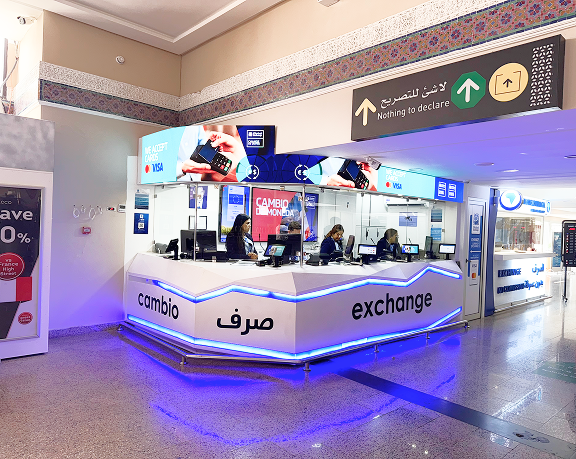
A traveller with 3,500 dirhams left in their wallet before a flight home may have to make a stop at a currency exchange office. Only 2,000 dirhams in Moroccan banknotes can be taken out of the country under rules reaffirmed by the Foreign Exchange Office. The limit means a traveller carrying 3,500 dirhams has 1,500 dirhams above the permitted amount. They must deal with the excess before leaving the country.
The restriction is set out in Article 42 of the General Instruction for Foreign Exchange Operations 2026 (IGOC 2026). The rules generally prohibit bringing Moroccan dirhams into or taking them out of the country, with an exception allowing travellers to carry up to 2,000 dirhams in banknotes.
The allowance is intended to make it easier for travellers to cover everyday expenses when they return to Morocco. It is not a general travel allowance.
What happens if you have more than 2,000 dirhams?
Travellers can ask a bank or an authorised currency exchange office whether they can exchange their remaining dirhams for euros, dollars, pounds or another foreign currency.
This process, known as reconversion, is not automatic. Banks and exchange operators may ask travellers to prove that they obtained the dirhams legally.
An original currency exchange receipt, known as a bordereau de change, or an ATM withdrawal slip may be required. Without the necessary documents, an exchange can be refused, potentially leaving travellers with cash above the permitted limit.
Travellers should check the requirements with an authorised operator before going to the airport. They should also keep receipts from currency transactions and count their dirham banknotes before reaching security.
The 2,000-dirham limit applies specifically to physical Moroccan banknotes. It is separate from the rules governing foreign currencies.
Foreign currency allowances are much higher
Residents can take considerably more money abroad in foreign currency, provided they meet the relevant conditions.
Under the 2026 rules, the annual personal travel allowance can reach 500,000 dirhams. It includes a basic allowance of 100,000 dirhams and an additional allowance of up to 400,000 dirhams, depending on the income tax paid.
The money can cross the border in foreign banknotes, on bank cards or through transfers. The allowance does not permit travellers to carry the same value in Moroccan dirhams.
Business travel allowances have also increased. Standard operators can receive up to 1m dirhams, while businesses classified as eligible for the higher allowance can receive up to 1.5m dirhams.
The annual e-commerce allowance for start-ups has doubled to 2m dirhams under the 2026 framework.
These changes form part of a wider effort to simplify foreign exchange rules while maintaining restrictions on the movement of the national currency.
New rules came into force in January
The Foreign Exchange Office published the General Instruction for Foreign Exchange Operations 2026 on 31 December 2025. It took effect on 1 January 2026.
The updated framework eased some restrictions affecting start-ups, e-commerce and business travel but kept the limit on physically exporting Moroccan banknotes at 2,000 dirhams.
The rules are administered by the Foreign Exchange Office, working with the Customs Administration, known by its French initials ADII. The system restricts the dirham’s convertibility and international circulation as part of broader controls on foreign exchange.
The latest framework also tightened documentation requirements for foreign currency purchases worth 100,000 dirhams or more. Buyers must present an original customs declaration, removing tolerances that existed under the 2024 rules.
Customs seized 181m dirhams in 2025
Customs authorities seized nearly 181m dirhams in undeclared or illegally transported currency at the country’s borders and airports during 2025, according to official figures released in May 2026.
The amount was up from 167m dirhams seized in 2024, an increase of 14m dirhams, or about 8.4%.
The figures highlight the financial scale of enforcement against currency violations.
In July 2026, the Foreign Exchange Office introduced SARF, a digital platform designed to modernise and monitor foreign exchange transactions. It connects banks, exchange offices and the regulator, allowing transactions to be tracked more closely and helping authorities detect attempts to bypass the rules or falsify exchange receipts.