

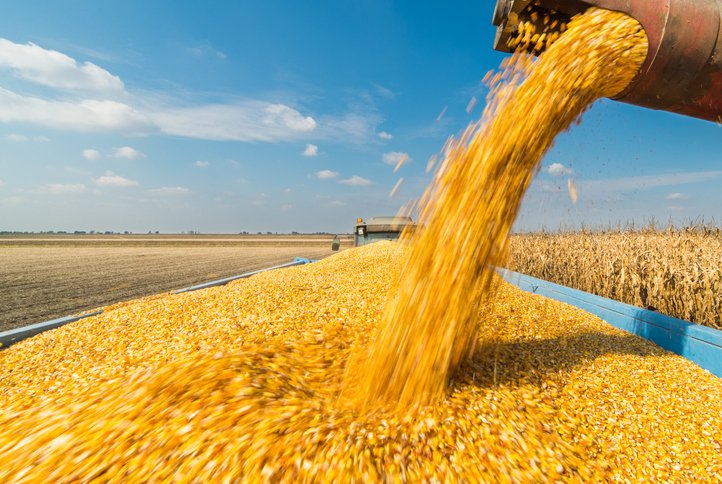
Morocco is set for a much bigger wheat harvest in the 2026-2027 season, with production expected to more than double after several years of poor harvests. The latest forecast from the US Department of Agriculture (USDA) puts wheat production at 7.5 million tonnes, up from 3.5 million tonnes last season and 2.46 million tonnes in 2024-2025. That is an increase of 4 million tonnes, or 114.3%.
More land is expected to be harvested and farms are also expected to produce more wheat per hectare. The harvested area is forecast to grow from 2.2 million hectares to 2.8 million hectares, while average yields are expected to rise to 2.68 tonnes per hectare, up from 1.59 tonnes last season and 1.12 tonnes two years ago. The USDA kept the figures unchanged from its June forecast.
Barley production is also expected to rise sharply to 2.4 million tonnes, compared with 950,000 tonnes last season and 660,000 tonnes in 2024-2025. That is an increase of 152.6%.
Barley fields are expected to expand from 800,000 hectares to 1.1 million hectares, while yields are forecast to increase from 1.19 tonnes per hectare to 2.18 tonnes per hectare.
Together, wheat and barley production is expected to reach 9.9 million tonnes, up from 4.45 million tonnes last season.
The forecast would make Morocco Africa’s second-largest wheat producer with 7.5 million tonnes, behind Egypt’s 10 million tonnes. Ethiopia is expected to produce 6.8 million tonnes, while Algeria is forecast at 4.1 million tonnes. Morocco is also expected to record the biggest year-on-year increase among the four countries.
The USDA kept forecasts for other Moroccan crops unchanged. Oat production remains at 10,000 tonnes from 20,000 hectares, with yields of 0.4 tonnes per hectare. Sunflower seed production stays at 30,000 tonnes from the same area, with yields of 1.17 tonnes per hectare.
The report does not explain what weather conditions led to the stronger cereal harvest. It also does not estimate how the larger crop could affect wheat imports.
The USDA bases its forecasts on official government data, field surveys carried out by its overseas agricultural offices, economic analysis and satellite imagery. The estimates are reviewed before being published in the monthly World Agricultural Supply and Demand Estimates (WASDE) report.
Global cereal production is forecast to fall to 2.949 billion tonnes in 2026-2027 from 3.014 billion tonnes the previous season. Wheat production is expected to decline from 843.8 million tonnes to 820 million tonnes, while coarse grains are forecast to drop from 1.624 billion tonnes to 1.592 billion tonnes. Milled rice is expected to fall from 545.7 million tonnes to 537.2 million tonnes, while oilseed production is forecast to rise from 700.7 million tonnes to 720 million tonnes.
France is expected to harvest 10 million tonnes of corn, down 26% from a year earlier and the country’s lowest crop since 1990-1991. Harvested area is forecast at 1.3 million hectares, the lowest since 1969-1970, while average yields are expected to fall to 7.63 tonnes per hectare because of “widespread drought and record heat.”
Argentina is on track for a record 63 million tonnes of corn, up 29% from a year earlier. Farmers are expected to harvest a record 8.2 million hectares, with yields of 7.68 tonnes per hectare.
Pakistan’s corn harvest is forecast at 8.8 million tonnes after flooding in summer 2025. The estimate is 10% lower than the previous forecast and 9% below the five-year average.
South Africa is expected to produce a record 18 million tonnes of corn, helped by “favorable La Niña seasonal rainfall.” Kenya, by contrast, is forecast to harvest 3 million tonnes after a “prolonged dry spell,” down 33% from the June forecast.
Russia’s wheat harvest is expected to reach 88.5 million tonnes, including 66 million tonnes of winter wheat and 22.5 million tonnes of spring wheat. Average yields are forecast at a record 3.53 tonnes per hectare, despite harvested area falling to 25.1 million hectares. Sunflower production is expected to rise 18% to a record 20.7 million tonnes from a record 12 million hectares.
Canada is forecast to produce a record 22 million tonnes of canola, 17% above the five-year average, from 9.4 million hectares. The USDA links the larger planted area to crop profitability and “demand for biofuel feedstocks.”
Brazil’s sorghum production is forecast at 6.2 million tonnes, while cotton production is expected to reach 18 million 480-pound bales, with a record yield of 1,960 kilograms per hectare.
The bigger harvest is also expected to support the wider economy. The High Commission for Planning (HCP) has raised its 2026 economic growth forecast to 4.8%, up from 4%, after forecasting a 19.1% increase in agricultural value added.
The government also introduced a 135% temporary tariff on wheat imports between June and July 2026 to protect local farmers during the harvest. Separate USDA and FAO forecasts suggest wheat imports could fall to 5 million tonnes in 2026-2027, around 15% below the five-year average.


