

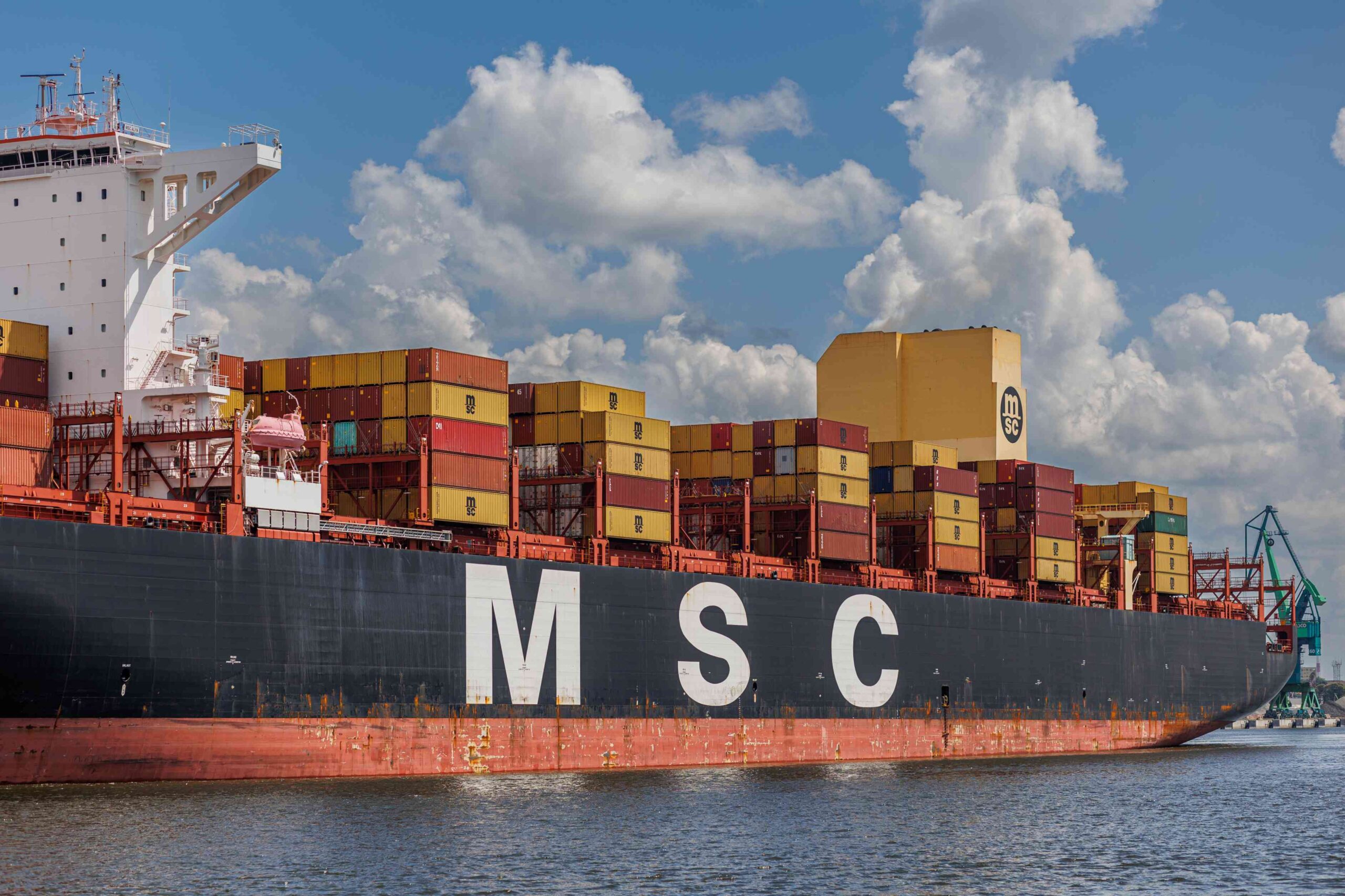
The new prices are lower than those MSC charged in August. A 20-foot container has fallen by $1,050, or 18.75%, from $5,600, while the rate for a 40-foot container has dropped by $2,200, or 28.57%, from $7,700.
But importers will still have to pay additional fees, including charges linked to maritime security, carbon emissions and port handling.
A second notice, published on 30 September, extended two security-related surcharges to shipments from Asia to Casablanca, Agadir and Nador. The charges are $55 per twenty-foot equivalent unit (TEU) for piracy risks and $36 per TEU for transit through the Suez Canal.
Together, they add $91 per TEU, or $91 for a 20-foot container and $182 for a 40-foot container.
MSC said the measures were linked to continuing security threats around the Arabian Peninsula, which have disrupted shipping routes and vessel schedules.
The same surcharges apply to several ports in Spain, France and Italy, including Barcelona, Valencia, Marseille-Fos, Genoa and Naples. The extension also covers port facilities in Algeria, Tunisia and Libya.
MSC has not published estimates of how many containers will be affected or how much revenue it expects to collect from the additional fees.
What importers will pay
The headline rates include two charges: a Global Fuel Option (GFO) surcharge of $253 per TEU, valid for October 2026, and a $15-per-TEU Emission Control Area (ECA) surcharge for Mediterranean destinations. Importers should not add these charges to the headline prices a second time.
Other fees remain payable. MSC applies a $20-per-TEU carbon mitigation contribution and a $128-per-TEU revision surcharge linked to the European Union’s Emissions Trading System (ETS).
A 40-foot container counts as two TEUs, so charges calculated per TEU double for that size.
Based on the published rates and additional charges, the estimated cost of shipping a 20-foot container to Casablanca is $4,789. The equivalent cost for a 40-foot container is $5,978.
These totals include the security, carbon mitigation and ETS charges but exclude terminal handling charges (THC), local fees and any additional costs for feeder services. The final bill will also depend on the shipper’s contract and charges at the ports of departure and arrival.
The September 28 notice initially linked the security surcharges to services travelling through the Suez Canal. The 30 September update explicitly extended them to additional Mediterranean and North African destinations.
The charges come as security concerns around the Red Sea and the Bab-el-Mandeb Strait have led some shipping companies to divert vessels around the Cape of Good Hope. Such diversions can lengthen journeys and increase operating and insurance costs.
Casablanca rates below those for Algeria and Tunisia
MSC’s latest price list puts Casablanca below several other North African destinations.
A 20-foot container costs $5,550 to Algeria and Tunisia and $5,500 to Libya. The corresponding rates for 40-foot containers are $6,900 to Algeria, $6,500 to Tunisia and $6,500 to Libya.
Casablanca’s rate is therefore $1,000 lower than Algeria’s and Tunisia’s for a 20-foot container, and $1,400 lower than Algeria’s rate for a 40-foot container.
The carrier’s rates for the Western Mediterranean are lower still, at $3,750 for a 20-foot container and $4,500 for a 40-foot container. These are $800 and $1,000 below the respective Casablanca rates.
MSC also lists rates of $3,150 for a 20-foot container and $4,800 for a 40-foot container to northern Europe. For the Black Sea, the rates are $3,900 and $5,600 respectively.
These figures are commercial freight rates, not a direct measure of port efficiency. Shipping costs vary according to vessel routes, transshipment requirements, the frequency of port calls, operating costs and contractual terms. Terminal handling, customs clearance, inland transport and feeder services can also affect the final cost of imported goods.
What the rates cover
The new prices apply to dry cargo shipped from all Far Eastern ports served by MSC, including ports in China, Japan, South Korea and Southeast Asia.
They cover port-to-port ocean freight and distinguish between standard 20-foot containers and 40-foot containers, including high-cube models. Dangerous goods classified by the International Maritime Organization and high-value cargo are excluded.
Casablanca is a major gateway for domestic imports, including general cargo and goods destined for the retail market. Tanger Med, by contrast, operates mainly as an international transshipment hub. Agadir serves an important agricultural trade area, while Nador serves northeastern Morocco. Cargo destined for secondary ports may require feeder services through regional hubs such as Tanger Med or Algeciras.
Most goods shipped from Asia to Casablanca travel through regional shipping networks, either on direct services or through transshipment near the Strait of Gibraltar.
The September 28 rate notice also covers the Adriatic Sea, the eastern Mediterranean and the Black Sea. MSC said the rates taking effect on 19 October would remain valid until further notice, but no later than 31 October under the published terms. The company may revise them before that deadline.
A changing global shipping market
The latest reductions follow higher rates in August and come amid a reported easing in container spot prices across major east-west trade routes in early October. The decline follows a mid-summer peak associated with early preparations for the holiday shopping season.
The reductions to Casablanca are consistent with the wider pattern of changing freight prices tracked by the Shanghai Containerized Freight Index and Drewry’s World Container Index. However, the two MSC price schedules cover separate tariff periods and do not show the exact path of prices between August and October.
Shipping companies often publish freight rates for short periods, giving them room to adjust prices as market conditions change. MSC’s deadline of 31 October leaves scope for further revisions in November, including possible peak-season surcharges or general rate increases, although the company has not confirmed that it will introduce them.
The additional carbon charges reflect regulatory costs associated with the EU Emissions Trading System, which requires shipping companies to account for emissions covered by the scheme on relevant voyages. Security surcharges reflect the costs and risks associated with disrupted maritime routes.
MSC is headquartered in Geneva, Switzerland, and is privately owned by the Aponte family. It is the world’s largest container shipping line by operated capacity, with more than 850 vessels and capacity exceeding 6 million TEUs. The company accounts for more than 19% to 20% of global container fleet capacity.
MSC has also been operating independently of the 2M shipping alliance with Maersk, following the alliance’s end in 2025. Its Asia-to-Mediterranean services therefore form part of its own shipping network.
For importers, the headline price cuts offer a reduction in the cost of moving goods from Asia. But the additional security and emissions fees, along with local handling and transport costs, mean that the published ocean freight rate is only part of the final bill.


