

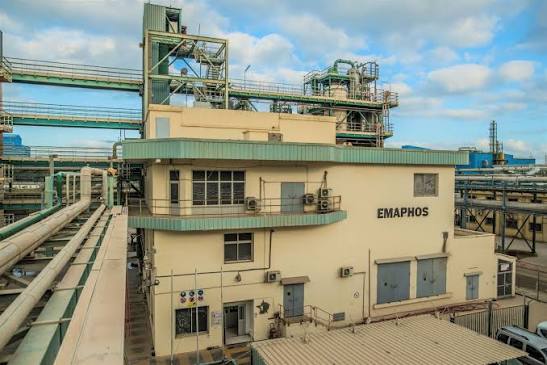
A phosphate plant in Morocco that supplies industries ranging from food production to battery manufacturing is set to come under the full ownership of OCP Group, as the company expands its business beyond conventional fertilisers. OCP plans to buy the remaining shares in Euro Maroc Phosphore (EMAPHOS) from its two partners, Belgium’s Prayon S.A. and Germany’s Chemische Fabrik Budenheim KG. The deal is expected to be completed in early 2027, subject to regulatory approval and other closing conditions.
The acquisition will be carried out through OCP Specialty Products & Solutions (SPS), a wholly owned OCP subsidiary that focuses on specialised phosphate products.
Both Prayon and Budenheim are expected to remain commercial partners after the sale, maintaining their existing supply-chain relationships with the company.
EMAPHOS was established in 1996 at the Jorf Lasfar industrial complex near El Jadida, on Morocco’s Atlantic coast. It began commercial operations in January 1998 as an equal partnership between OCP, Prayon and Budenheim, with each company holding a one-third stake.
Its annual production capacity has more than doubled, rising from 140,000 tonnes when operations began to about 300,000 tonnes in 2023. An expansion project launched in August 2020 aimed to increase capacity to between 280,000 and 300,000 tonnes a year.
EMAPHOS produces purified phosphoric acid (PPA), a high-purity chemical used in food processing, pharmaceuticals, specialised fertilisers and energy technologies.
Unlike standard phosphoric acid, which is mainly used to make bulk agricultural fertilisers, PPA undergoes additional processing to remove impurities. This makes it suitable for products that require higher levels of purity.
In the food industry, it is used as the additive E338, which helps give drinks and processed foods their acidity. It also has applications in pharmaceuticals, oral care and dental products.
PPA is also a key starting material for lithium iron phosphate (LFP) batteries. These batteries are used in electric vehicles and large-scale energy storage systems, making purified phosphate an important material for parts of the energy transition.
OCP says the acquisition will strengthen its position in specialised phosphate products, improve the integration of its industrial operations and preserve EMAPHOS’s existing commercial relationships and international markets.
The move is part of a broader strategy to expand into higher-value products rather than rely mainly on conventional fertilisers. OCP’s $13bn green investment programme for 2023–2027 also includes plans to expand industrial capacity and increase the use of renewable energy.
OCP already owns 50% of Prayon, a Belgian phosphate chemicals group. However, the proposed transaction would give OCP full ownership of EMAPHOS, with Prayon and Budenheim shifting from shareholders to strategic commercial partners.
The transaction is not expected to change EMAPHOS’s current annual production capacity of about 300,000 tonnes. Instead, the existing industrial platform would provide a base for further expansion in specialised phosphate products and their applications.


