

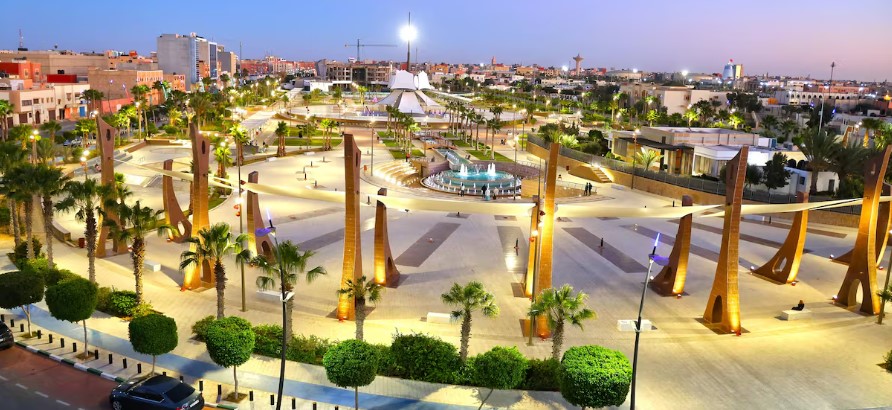
Morocco’s economy grew in every region in 2024, but the south recorded the fastest growth, according to new figures from the High Commission for Planning (HCP). Eight of the country’s 12 regions grew faster than the national average of 4.4%.
Laâyoune-Sakia El Hamra led the country with growth of 7.6%, followed by Dakhla-Oued Eddahab at 7%, Souss-Massa at 6.8%, Drâa-Tafilalet at 6.2%, the Oriental at 5.9%, Marrakech-Safi at 5.1%, Tangier-Tetouan-Al Hoceima at 4.9%, and Guelmim-Oued Noun at 4.6%.
The HCP said non-market services and maritime fishing helped drive growth in Laâyoune-Sakia El Hamra. In Dakhla-Oued Eddahab, growth came from maritime fishing, construction, and public works.
Agriculture and services were the main drivers in Souss-Massa, while construction boosted Drâa-Tafilalet. The Oriental region benefited from stronger industrial activity and services.
In Marrakech-Safi, hotels and restaurants helped support growth as tourism continued to recover. Tangier-Tetouan-Al Hoceima benefited from manufacturing and services, while Guelmim-Oued Noun grew thanks to primary industries and services.
The other four regions also expanded, but at a slower pace than the national average. Casablanca-Settat grew by 4.3%, Rabat-Salé-Kénitra by 3.5%, Béni Mellal-Khénifra by 2.1%, and Fès-Meknès by 1.6%.
Morocco’s GDP reached MAD 1,550.45 billion in 2024 at constant prices, growing by 4.4%. At current prices, GDP stood at MAD 1,614.57 billion, up 8.7% from 2023.
The figures show that Morocco’s fastest-growing regions are no longer only around Casablanca and Rabat. The South is growing quickly, helped by major government investment and improvements in key industries.
Fishing remains one of the biggest growth drivers in Laâyoune and Dakhla. The regions are home to much of Morocco’s fishing industry, and new processing plants have increased local production instead of exporting raw products.
Construction has also picked up because of major projects, including the Dakhla Atlantic Port and work linked to the Tiznit Dakhla motorway.
The two southern regions have also attracted investment in renewable energy, with large wind and solar projects expanding in recent years.
Tourism gave Marrakech-Safi another boost in 2024 as hotels and restaurants welcomed more visitors. In Souss-Massa, agriculture remained strong, supported by exports of fruit and vegetables.
Tangier-Tetouan-Al Hoceima continued to benefit from its manufacturing sector and logistics industry centred around Tanger Med Port and the automotive industry.
Although Casablanca-Settat and Rabat-Salé-Kénitra grew more slowly than the national average, they remain Morocco’s two biggest economic regions and still produce more than half of the country’s wealth.
Meanwhile, Béni Mellal-Khénifra and Fès-Meknès recorded the weakest growth. Both regions depend heavily on rain-fed farming, and years of drought continued to affect crop and livestock production in 2024.
The gap between real GDP growth of 4.4% and nominal growth of 8.7% also shows that prices continued to rise during the year, although inflation eased compared with 2023.


