

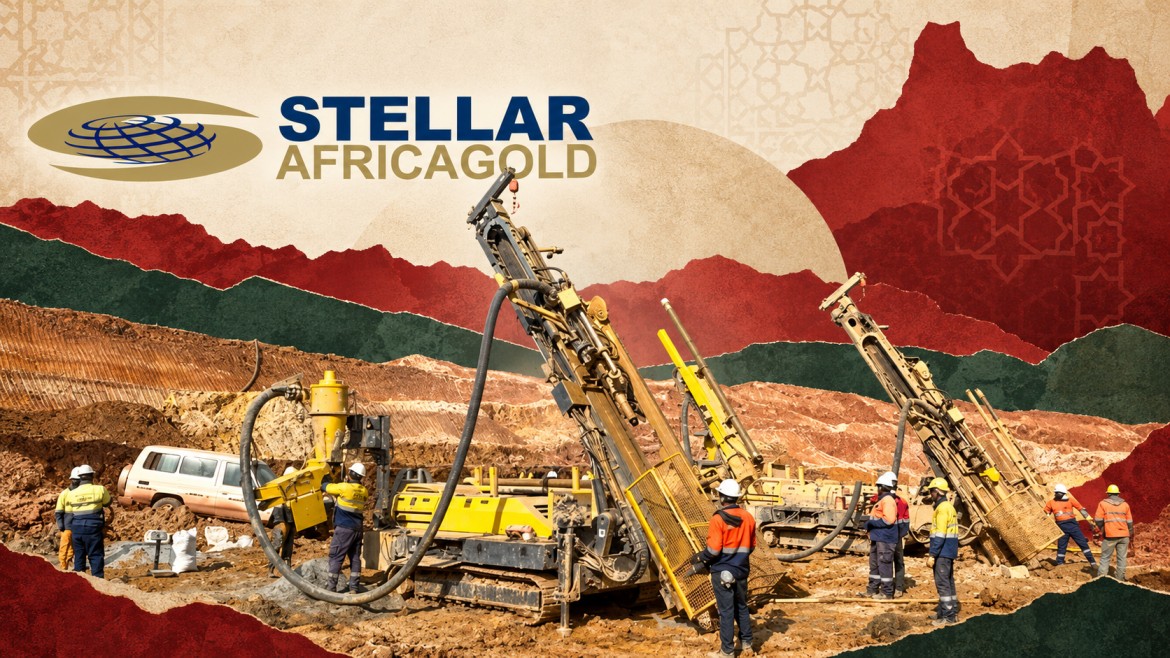
Canadian mining company Stellar AfricaGold has completed trenching at a new exploration target at its Tichka Est gold project in Morocco and is preparing to start a 5,000-metre drilling programme later this month. The new target is called Zone D. The company identified it through a 2026 satellite study, geological mapping of dykes and rock samples that showed unusual mineral results.
Zone D is the fourth target identified at Tichka Est, after Zones A, B and C.
Stellar AfricaGold completed seven mechanical trenches in Zone D in less than two weeks. The work focused on four dioritic dykes, known as Dykes 1 to 4. Two other dykes, Dykes 5 and 6, have been mapped but have not yet been tested.
The company initially said the trenches covered 84 metres. Project data also gives a cumulative excavation range of up to 217 metres across the target area.
Samples from the trenches have been sent to a laboratory. The results will help the company decide where to place five planned drill holes in Zone D and determine their direction.
The company has not yet confirmed gold mineralisation in Zone D. Trench TR1-D-26 did show quartz veins containing visible semi-massive arsenopyrite. Laboratory testing is needed to establish whether the material contains significant gold.
“The completion of the trenching program on a brand-new target in under two weeks, with samples already sent to the lab, illustrates the operational pace we intend to maintain throughout the autumn,” said J. François Lalonde, President and CEO of Stellar AfricaGold.
Stellar AfricaGold plans to start its second drilling phase in the second half of October, subject to final permits. The programme will cover 5,000 metres and is planned across 24 diamond drill holes.
Zone B will be the first priority. Zone D is planned for drilling in the fourth quarter of 2026.
The company awarded the drilling contract to local contractor CMFM after a competitive tender process known as AO 01-2026. The contract includes technical requirements such as minimum core recovery in mineralised areas, regular downhole deviation surveys and oriented core drilling.
The Phase II programme will test the depth and length of known mineralisation, while also testing new targets.
Zone B is currently the most advanced area at Tichka Est. Earlier drilling produced one of the project’s strongest results from hole TCK-001. The hole returned 12 metres grading 6.62 grams of gold per tonne, including two metres grading 22.28 grams per tonne.
Gold mineralisation has been identified so far in Zones A, B and C. Zone D remains unconfirmed until laboratory results and future drilling provide further evidence.
Zone A contains a north-west trending shear structure that extends about 450 metres. The structure lies at a contact between dolerite and schist and contains quartz-ankerite veins.
Zone B is about 3km north of Analghi village. It contains an east-north-east to west-south-west trending brecciated fault zone, iron-carbonate alteration, quartz-carbonate veins and disseminated to semi-massive pyrite and arsenopyrite.
Zone C contains an east-west trending structure that extends for more than 2km within a strongly deformed schist unit.
Zone D was identified through satellite remote sensing, structural mapping and surface rock sampling. The company is now testing whether the geological structures and possible mineralisation extend into this new corridor.
A drone magnetic survey is also planned across Zones A, B and C. The survey will cover about 144 line-km.
PROGREM SARL has been contracted to carry out the survey. It will use a Geometrics MagArrow magnetometer mounted on a DJI Matrice 350 RTK drone.
The drone will fly at about 60 metres above the ground, with flight lines spaced 50 metres apart. The survey will produce high-resolution magnetic data and 3D magnetic inversions to help map underground diorite sill structures.
The detailed flight plan and required documents were submitted on 28 September 2026. Flight approval was obtained on 1 October, and the survey team is due to start mobilising on 20 October.
The magnetic survey will also cover Zone D. The data should help improve the company’s understanding of the structure before drilling begins.
“With the drilling rig and team ready to mobilize as soon as the final permits are granted, alongside the scheduled magnetic survey, Tichka Est is entering the most active period in its history, from which we also expect the most results. Exploration results will be published as soon as possible,” Lalonde said.
Tichka Est covers 82 sq km in the High Atlas mountains, about 90km south of Marrakech. The project includes five research permits and one mining licence.
The exploration area reaches elevations of up to 2,500 metres. The terrain requires diamond drilling equipment suited to mountain conditions.
Stellar AfricaGold launched work at Tichka Est in August 2020 under an agreement with Morocco’s state-owned Office National des Hydrocarbures et des Mines (ONHYM).
A renewed research agreement allows Stellar AfricaGold to earn up to an 85% participating interest in the project. The company must spend US$2.39m on exploration over a three-year period to earn that interest.
The project aims to define the size, continuity and potential of the gold mineralisation already identified and to test additional targets.
Technical information about the project is overseen by Qualified Person M. Yassine Belkabir, who holds MScDIC, CEng and MIMMM qualifications. The technical work follows international reporting standards, including NI 43-101.
Stellar AfricaGold is listed on the TSX Venture Exchange under the ticker SPX and on the OTC market under STLXF.


