

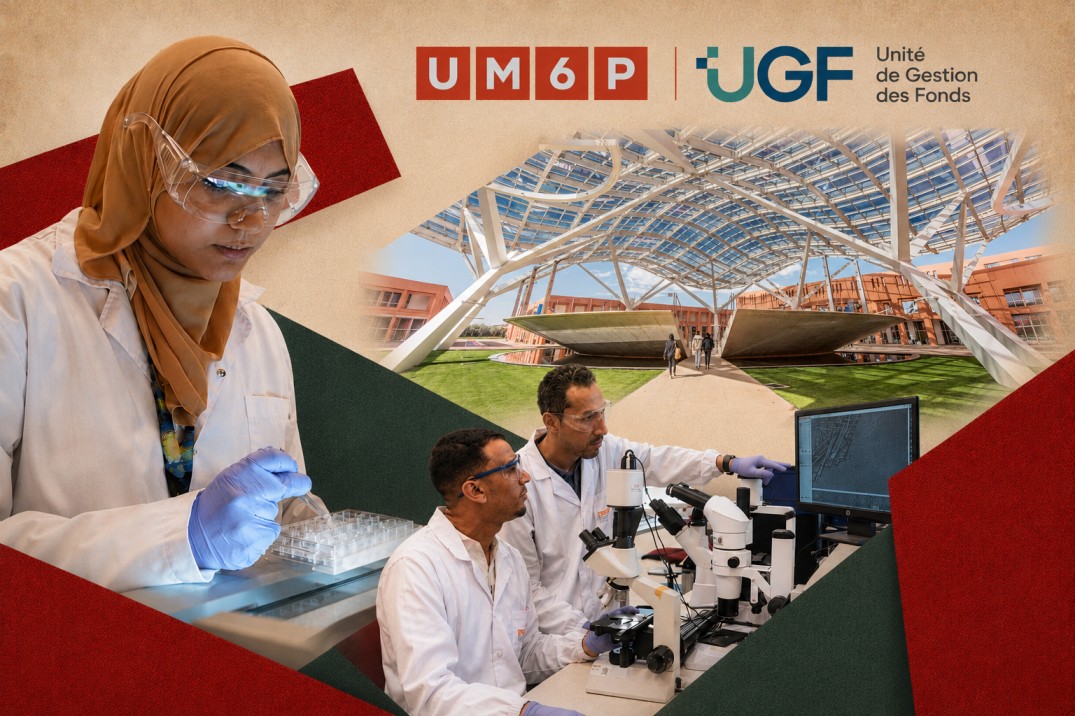
The Fund Management Unit (UGF) at Mohammed VI Polytechnic University (UM6P) has supported more than 150 research and innovation projects since 2020, helping fund work in areas such as agriculture, health, energy, water and artificial intelligence.
Its first five-year report shows the unit has launched more than 25 research programmes, bringing together over 1,500 researchers, a network of more than 1,000 national and international experts, 11 public universities and several research institutions.
The unit was set up to improve the way research funding is managed. It now oversees the whole process, from identifying research priorities and launching funding calls to evaluating projects, signing contracts, tracking progress and measuring results.
The report says the UGF has also introduced common standards for selecting, monitoring and evaluating projects to make research funding more transparent and focused on real-world impact.
Projects backed by the unit have helped train more than 390 PhD students and involved more than 210 postdoctoral researchers and research engineers. They have produced more than 236 papers published in top-ranked international scientific journals and supported more than 25 technologies and prototypes as they moved towards commercialisation and patent applications.
The UGF also received ISO 9001:2015 certification, an international quality management standard that recognises its management processes.
“At UM6P, we consider that the impact of research is prepared long before its results appear. It begins with how projects are designed, evaluated, funded, supported and monitored. In five years, the UGF helped establish this culture of high standards, where governance quality becomes a condition for scientific quality,” said Ryad Mouline, Head of the Fund Management Unit.
The report comes as the UGF takes on a bigger national role through the National Programme for Support to Research, Development and Innovation (PNARDI), launched with the Ministry of Higher Education, Scientific Research and Innovation and the OCP Foundation.
The programme makes the UGF responsible for managing research funding across public universities and national research institutions. It will use the same system for evaluating projects, signing contracts, monitoring progress and measuring impact.
PNARDI is part of a national research programme worth one billion Moroccan dirhams. It includes three funding calls. The Ibn Albanna call supports large research projects in areas such as water, energy and artificial intelligence. The Nefzaouia call focuses on technology transfer and prototype development. The Ibn Battouta call supports PhD students, postdoctoral researchers and early-career scientists.
Research funded through the UGF focuses on practical solutions to national and regional challenges.
Agriculture projects include custom bio-fertilisers based on soil microbiome analysis and AI-powered smart fertigation systems. These systems use sensors to monitor soil moisture, nitrate levels and electrical conductivity in real time. The goal is to cut water use by up to 30% while increasing crop yields by up to 20%.
Artificial intelligence and advanced computing projects rely on the Toubkal supercomputer, which delivers more than 3.15 petaflops of computing power. Researchers use it for climate modelling, genomics, advanced physics and AI models that analyse satellite and drone images to detect crop diseases, predict droughts and forecast harvests.
Water research includes solar-powered reverse osmosis desalination systems for remote areas and Zero Liquid Discharge (ZLD) technology. The system recovers minerals such as calcium, magnesium and salts from desalination waste while producing fresh water and reducing wastewater.
Energy projects include green hydrogen and green ammonia pilot projects, as well as thermal energy storage systems that store excess solar and industrial heat using phase-change materials and locally sourced minerals.
The report says more than 25 research projects have already moved into technology maturation programmes, helping turn laboratory research into commercial products and future patents.


