

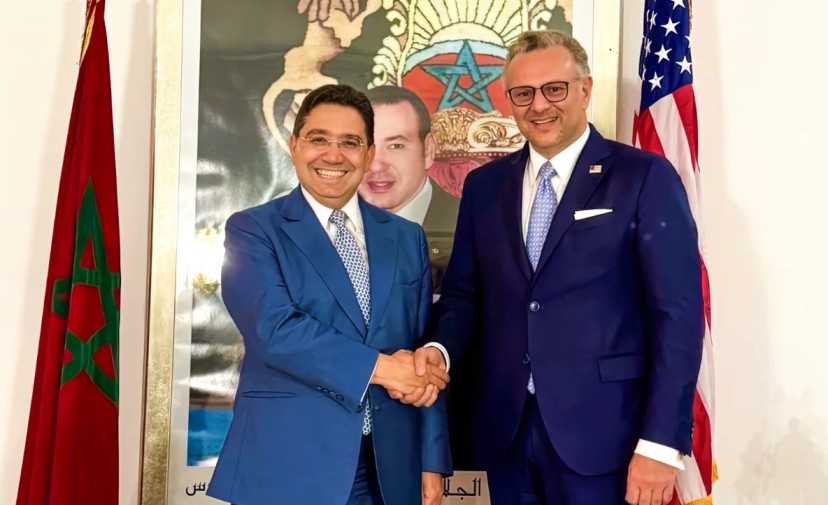
The United States has again said it supports a political solution to the Western Sahara dispute based on Morocco’s autonomy plan, after talks held in Madrid.
Massad Boulos, a senior adviser to US President Donald Trump on Africa and the Middle East, said Washington remains committed to a fair and lasting solution accepted by all sides.
Writing on X, Mr Boulos said the US position follows the approach set by President Trump and supports serious efforts to end the long-running conflict. His comments came after meetings in Madrid involving Morocco, Algeria, Mauritania and the Polisario Front.
The talks were held at the US embassy in Madrid and were overseen by the United States and the United Nations. They were part of efforts to apply UN Security Council Resolution 2797, adopted in October 2025, which extended the UN mission in Western Sahara for one more year.
Mr Boulos said the meetings aim to restart the political process and support long-term peace in the region.
He said the US position on Western Sahara is clear and unchanged. Washington backs a realistic and lasting political solution based on Morocco’s autonomy plan, first put forward in 2007. The plan would give the region local self-rule while remaining under Moroccan control.
Several countries, including Spain, France and Germany, now see this plan as the most serious and workable option.
In a recent interview with the Lebanese newspaper An-Nahar, Mr Boulos said progress on the issue and new momentum at the UN are the result of close cooperation between the United States and Morocco.
The United Nations has not shared details of the Madrid talks. At a daily briefing, UN spokesman Stéphane Dujarric said no further information would be released for now.
The US mission to the UN said the meetings brought together all sides named in Resolution 2797, including Morocco, Algeria, Mauritania and the Polisario Front.
The resolution calls for a political and lasting solution and says Morocco’s autonomy plan is the most realistic basis for talks. Recent UN decisions have moved away from the idea of a referendum and now focus on talks between all parties.
The current US position goes back to December 2020, when President Trump recognised Morocco’s sovereignty over Western Sahara. This marked a major change in US policy.
Spain’s role as host also matters. Since 2022, Spain has shifted its position to support Morocco’s autonomy plan.
Morocco’s foreign minister, Nasser Bourita, attended the Madrid talks along with officials from Algeria and Mauritania and a representative of the Polisario Front. Morocco presented an expanded version of its autonomy plan in an effort to move the process forward.
King Mohammed VI has said Morocco is preparing an updated and more detailed version of the plan to submit to the United Nations, following talks with political parties in late 2025.


