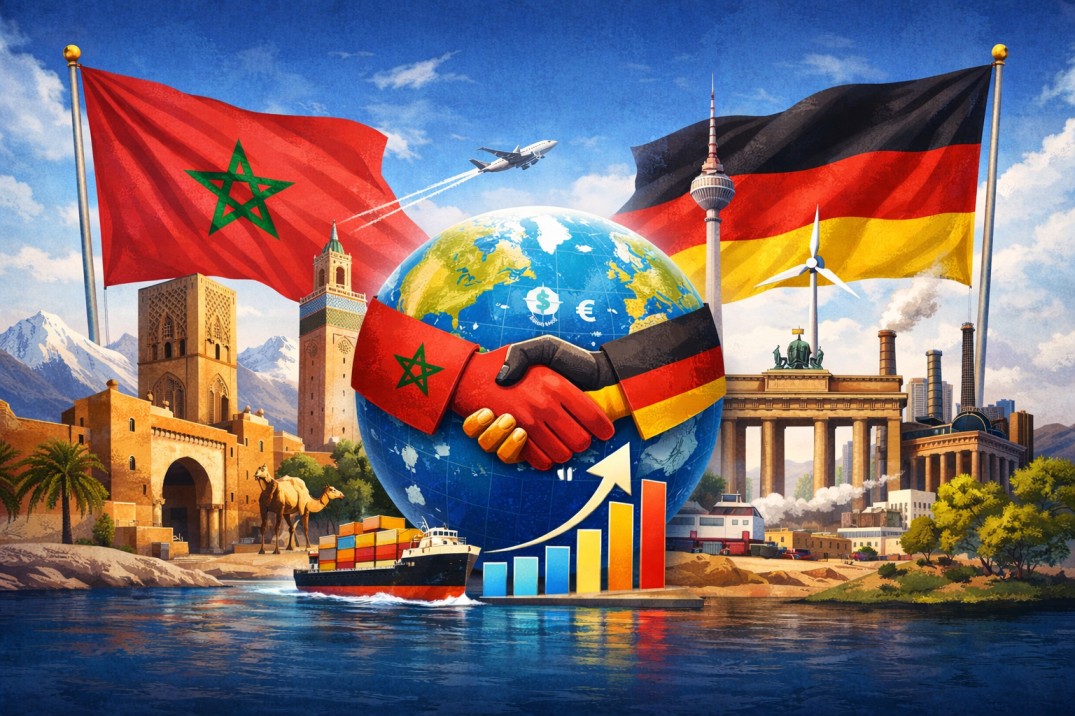
Trade between Morocco and Germany reached 7.37 billion euros in 2025, according to preliminary data from the German statistics office.
The numbers, released by Statistisches Bundesamt, show Morocco ranked 49th among Germany’s trading partners worldwide.
Most of Germany’s exports to Morocco are industrial goods. These include machinery, factory equipment, electrical devices, car parts and specialised chemicals. These products help support Morocco’s factories, especially in the car industry and electronics.
In the other direction, Morocco sends industrial parts to Germany, many of which are used again in European production lines. These include wiring systems, vehicle components and technical parts. Textile and food products are still part of the trade, but industry now plays the biggest role.
This pattern shows that the relationship is no longer based on simple buying and selling of finished goods. Instead, both countries are increasingly linked through shared production chains, especially within the wider market of the European Union.
In Africa, Morocco is now Germany’s third-largest trading partner, after South Africa and Egypt. South Africa’s trade is strongly linked to its car and mining industries. Egypt’s trade focuses more on energy and large infrastructure projects. Morocco stands out for its growing role in manufacturing and industrial components.
Germany is one of the world’s biggest trading countries, with most of its trade concentrated among large industrial economies. Against that backdrop, Morocco’s position inside the top 50 shows steady progress rather than small-scale exchange.
The partnership is also expanding into new areas. Energy cooperation is becoming more important, especially around green hydrogen.
“Morocco is a partner of first rank for Germany. Green hydrogen is not only an energy resource, it is the new cement of an industrial alliance that is redefining our trade corridor for decades to come,” Annalena Baerbock, Germany’s foreign minister.
In the car industry, cooperation has deepened as Morocco moves towards more advanced production. Morocco’s minister of industry and trade, Ryad Mezzour, said: “The passage from simple cable harnesses to complex mechatronics reflects the maturity of the Moroccan ecosystem. For German manufacturers, the Kingdom has become a natural and decarbonised extension of their own assembly lines.”
Business groups also point to Morocco’s location and stability as key strengths. A representative of the German Chamber of Commerce and Industry in Morocco said: “The stability and proximity of Morocco offer the German Mittelstand a concrete response to global uncertainties. In 2025, trading with Morocco is no longer an option of relocation, it is a strategy of logistical resilience.”
An analyst at Destatis added: “Reaching 7.37 billion euros is only a step. The figure illustrates a profound transition: we are moving from a trade in goods to technological and environmental integration without precedent in Africa.”
Key sectors driving the trade include electric mobility, chemicals and fertilisers, irrigation technology, and growing IT services.