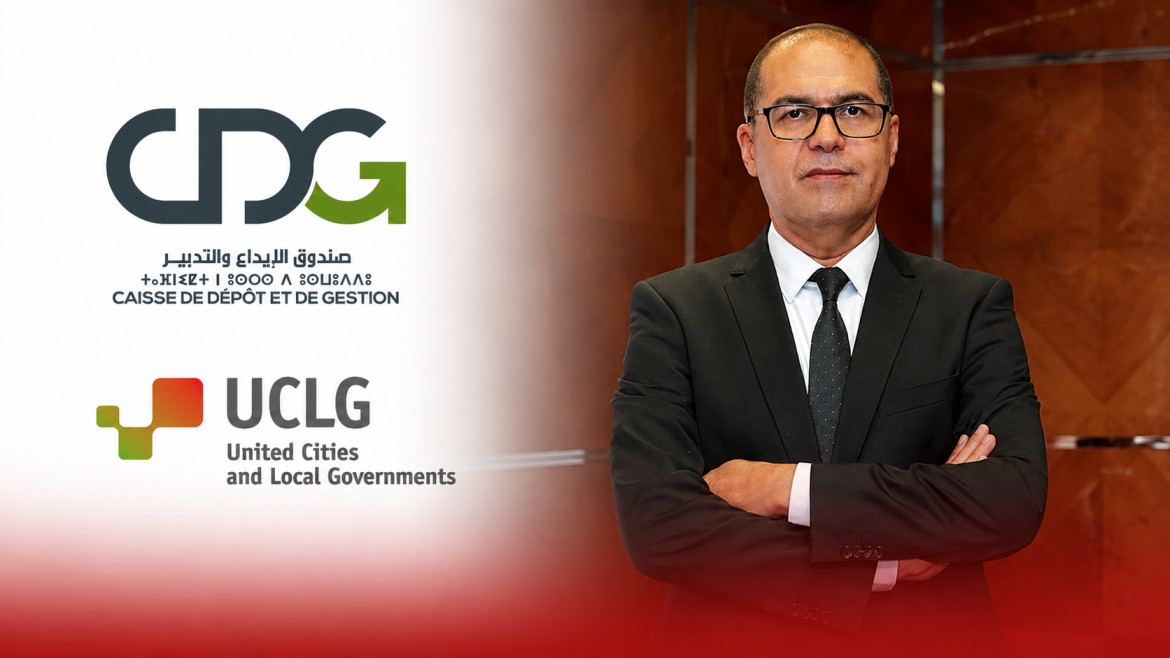
Climate change is already affecting people’s daily lives through droughts, floods and rising temperatures. According to Khalid Safir, Director General of Morocco’s Caisse de Dépôt et de Gestion (CDG), that means the green transition can no longer be managed only from national capitals or global financial centres.
Speaking at the 8th United Cities and Local Governments summit during a panel on green finance, Safir said cities, regions and local communities must play a bigger role in tackling climate challenges and attracting investment.
“The debate is no longer only about multilateral banks or national policies. The real challenge is how to bring finance closer to territories where climate impacts are being felt and where solutions are being implemented,” he said.
Safir said climate change is hitting local communities first. Cities produce more than 70% of global greenhouse gas emissions and are increasingly exposed to heatwaves, flooding and rising sea levels. In Morocco, coastal cities such as Tangier and Casablanca face growing risks.
He said the current financial system needs to change to help local authorities access funding more easily. According to UN estimates, the world needs between $4.5 trillion and $5 trillion every year to build sustainable infrastructure, with around 70% of that investment needed at local and regional levels.
Governments alone cannot pay for the green transition, Safir said.
“The question is how to channel private capital towards projects that serve the public interest while generating economic, social and environmental value.”
The challenge is especially important in Africa, where private investors provide less than 15% of climate finance. In other developing regions, that figure is more than 40%.
To attract investors, institutions such as CDG use blended finance models that combine public and private money. These projects include public transport, waste management and water treatment facilities.
Safir said the aim is for every dollar of public funding to attract four to five dollars of private investment.
He pointed to Morocco’s Advanced Regionalisation policy as an example of giving local authorities more responsibility and financial independence.
Under Moroccan law, regions and communes are responsible for preparing Regional Development Plans. These plans increasingly include climate and sustainability goals.
The issue has become more urgent as Morocco continues to face severe drought conditions. Regional authorities are helping deliver projects such as desalination plants, wastewater recycling facilities and modern irrigation systems.
These local investments also support Morocco’s target of generating 52% of its electricity from renewable energy sources.
Safir also said CDG’s involvement in international initiatives that connect global finance with local projects.
One example is the Finance in Common Summit, which brings together more than 500 public development banks managing over $23 trillion in assets. Through the network, CDG works to align Moroccan projects with international funding requirements.
The institution is also active in the Network of African National Finance Institutions for Domestic Resource Mobilisation (NAFAD), which aims to use African savings to finance African infrastructure projects.
“As a long-term investor, our role is to support projects that may take 15 to 30 years to mature and generate returns,” Safir said.
In Morocco, CDG supports local authorities through the Fonds d’Équipement Communal (FEC), which finances projects such as energy-efficient street lighting, environmentally friendly transport systems and modern waste management facilities.
The group also provides technical support to help municipalities prepare projects that meet international environmental and financial standards.
According to Safir, one of the biggest barriers to attracting investors is the lack of projects that are ready for financing.
Many municipalities do not have the expertise needed to prepare projects in a way that international investors can easily assess. CDG helps solve this by grouping smaller projects into larger investment programmes.
Safir said international partnerships also help CDG secure financing from organisations such as the French Development Agency, Germany’s KfW and the European Investment Bank at lower borrowing costs.
He added that these partnerships help Morocco adopt international standards for measuring climate impact, carbon emissions and environmental performance.