
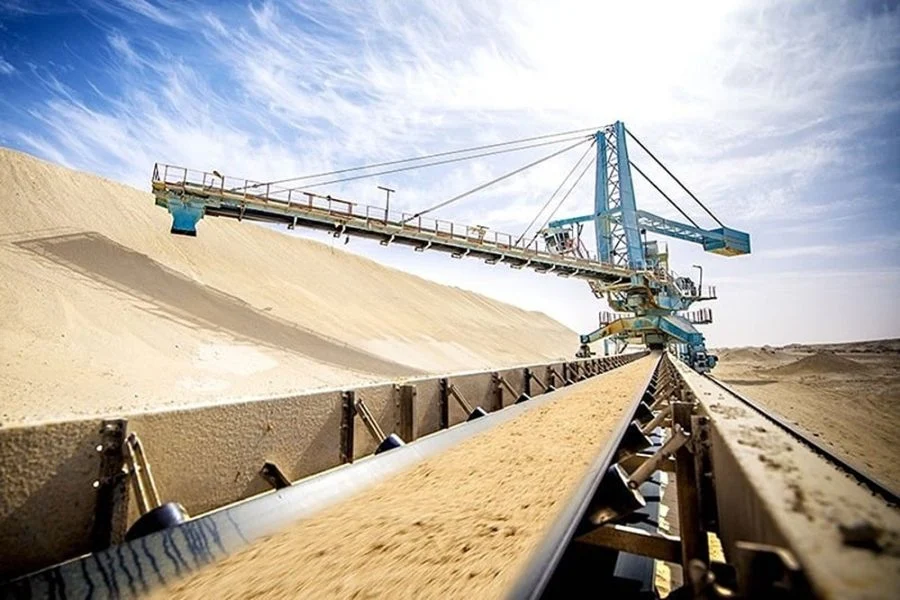
Morocco remains the European Union’s biggest supplier of phosphate rock, providing more than a quarter of the bloc’s imports, according to a new Italian report. The 2026 report by the Circular Economy Network (CEN), produced with the Italian National Agency for New Technologies, Energy and Sustainable Economic Development (ENEA), says Morocco supplied 27% of the EU’s phosphate rock imports.
Russia came second with 24%, mainly exporting phosphate fertilisers and related products. Algeria accounted for 10% of supplies, while Israel provided 7%.
The figures show Europe’s heavy reliance on imported phosphorus, a raw material that is vital for fertilisers, agriculture and food production.
The European Commission has listed phosphate rock as a critical raw material since 2014 and elemental phosphorus since 2017.
The report says the EU imports 82% of the phosphate rock it uses and relies entirely on imports for elemental phosphorus.
China is the world’s biggest producer of phosphate rock, accounting for 44% of global production. Morocco ranks second with 14%. Finland is the EU’s largest producer, making up 18% of the bloc’s output.
Phosphorus prices have remained largely stable, although they can fluctuate because of national or international events, the report says.
Around 15% of phosphorus used in Europe is lost through sewage sludge, livestock manure, slaughterhouse waste and organic waste. The report says these waste streams offer the biggest opportunity to recover and reuse the material.
Research by the Interuniversity Research Centre in Territorial Economics (CRIET) and the Italian National Institute of Statistics (ISTAT) found Italy imported more than €37.6bn worth of non-energy raw materials in 2023.
Almost 88% of that total came from just 10 materials. Copper was the largest import at €7.5bn, followed by bauxite and aluminium at €7.2bn.
Italy depended on imports for 46.6% of its raw material needs in 2024, compared with the EU average of 22.4%, according to Eurostat data cited in the report.
Despite that, Italy ranked as the EU’s second most circular economy after the Netherlands.
The Netherlands topped the Circular Economy Network’s index with 69.3 points, followed by Italy on 65. Belgium ranked third with 59.6 points, ahead of Germany with 58.8, France with 57.9 and Spain, which placed tenth with 54.
Italy recycled 85.6% of all treated waste in 2022, more than double the EU average of 41.2%.
Its circular material use rate reached 21.6% in 2024, compared with 17.8% in France, 14.8% in Germany and the EU average of 12.2%.
The report says Europe is not moving fast enough to meet the European Commission’s target of raising the circular material use rate to 24% by 2030.
It says the EU would need to increase the rate by about two percentage points every year, roughly twice the pace seen over the past decade.
The report calls for the proposed Circular Economy Act, expected by the end of 2026, to create a single market for secondary raw materials. It also recommends harmonised waste rules across the EU, lower VAT on repair and reuse services, and trade agreements that include rules on secondary raw materials and the supply of critical and strategic materials.