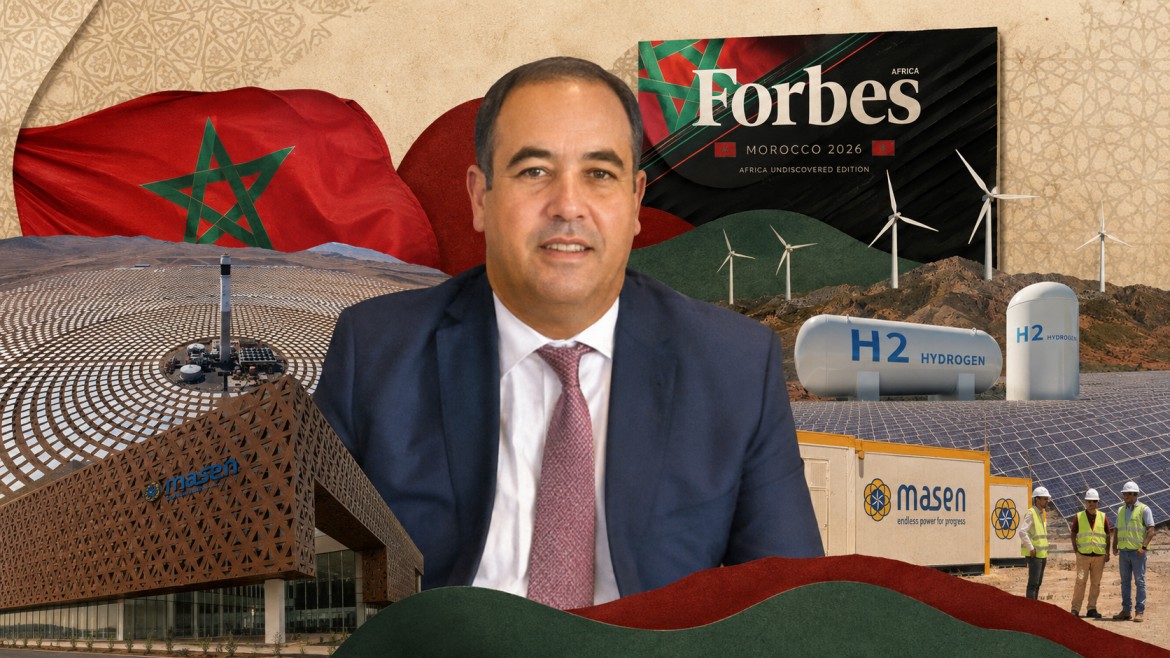
Morocco is expanding its renewable energy projects as it tries to reduce its reliance on fossil fuels and improve energy security. That is the focus of a recent Forbes Africa feature published in the August/September 2026 special issue, Morocco 2026: Africa Undiscovered Edition. The feature, titled “A Bold Drive For Energy Transition,” includes an interview with Tarik Ameziane Moufaddal, chairman and CEO of the Moroccan Agency for Sustainable Energy (MASEN).
Moufaddal said clean energy is now linked to economic growth, energy security and the country’s plans to cut emissions.
Morocco wants renewables to make up more than 52% of its total installed electricity capacity by 2030.
Renewable sources accounted for about 45.3% of the country’s installed capacity at the end of 2024, with total capacity reaching around 12,016 MW.
Coal still plays a major role in electricity generation, accounting for about 60%. The country has also set a target to phase out coal by 2040.
Noor shows how the model works
The Noor Ouarzazate solar complex is one of the main projects highlighted in the interview.
The complex has a capacity of around 580-600 MW and covers more than 3,000 hectares. It can provide electricity for about two million people and avoid around 900,000 tonnes of CO2 emissions each year.
Moufaddal described the project model as “plug-and-play.”
The government takes care of land, roads, grid connections, water infrastructure and other early requirements. Private companies then focus on financing, building and running the projects.
The Noor complex includes concentrated solar power and photovoltaic plants. Investment in the project has exceeded MAD 25bn ($2.5bn).
The World Bank, KfW and the European Investment Bank have also helped reduce financial risks linked to the projects.
Renewable energy is also creating jobs
MASEN’s projects are not only about producing electricity.
Local industrial integration in the solar sector has passed 40%, according to the Forbes Africa feature.
About 60% of workers at some construction sites are local, while around 85% of project sourcing comes from within the country.
More than 180 community projects have benefited over 110,000 people since 2010.
The Noor site also has a 200-hectare research and development platform. Researchers use it to test solar technologies in desert conditions.
More than 1,000 engineers, technicians and other specialists have also received training linked to the renewable energy sector.
Bigger projects are coming
MASEN is now moving towards larger projects.
Its next wave of solar and wind projects is expected to reach nearly 4.5 GW under the Noor and Nassim programmes.
The wider national plan calls for about 12 GW of new electricity capacity by 2030.
New projects are also combining different technologies. The Noor Midelt complex, for example, brings together solar photovoltaic, concentrated solar power and battery storage.
Wind power capacity reached about 2,390 MW at the end of 2024.
Green hydrogen is another major part of the strategy.
MASEN is the national focal point for the Morocco Green Hydrogen Offer, which is designed to attract investors and develop large-scale hydrogen projects.
Seven integrated projects have been selected in the southern provinces.
The government has allocated one million hectares of public land for green hydrogen projects. An initial 300,000 hectares has been made available to early investors.
The first projects involve more than MAD 319bn ($32bn) in planned investment, with green ammonia among the products being developed for export to Europe.
Moufaddal summed up MASEN’s approach with a simple line: “Ambition meets action and renewable energy powers sustainable growth and shared value.”