
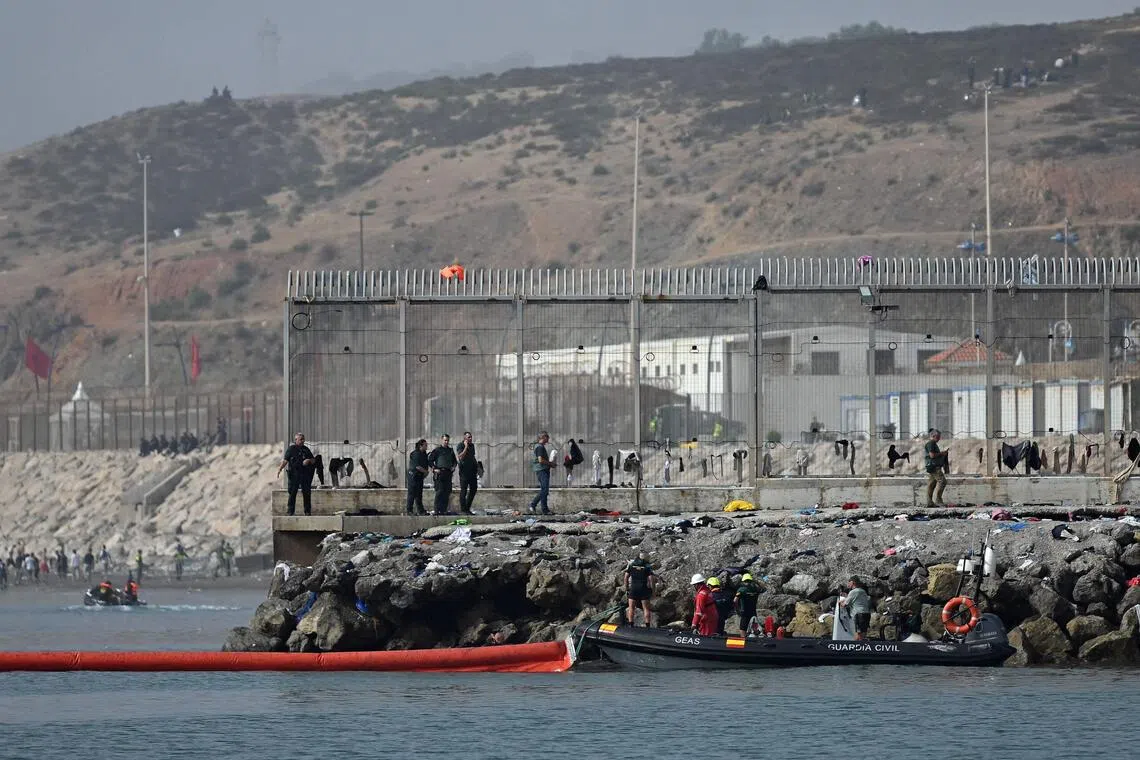
The European Union is giving Spain €114.7m in emergency funding after about 72,000 people crossed from Morocco into Ceuta over two days in late July. The money will help Spain strengthen border surveillance, increase migrant reception capacity and fund returns, the European Commission said on Wednesday. The crossings took place on 30 and 31 July. Spanish authorities had initially expected a much smaller movement.
Of the EU package, €82.7m will come from the Asylum, Migration and Integration Fund, while €32m will come from the Border Management and Visa Instrument.
Some of the money will pay for new surveillance equipment, including thermal cameras, floating barriers and underwater drones. Screening facilities and additional staff will also be funded.
The EU said the support would also help Spain deal with migrants who remain in Ceuta without permission to stay, as well as expand accommodation for unaccompanied minors.
Henna Virkkunen, the European Commission’s executive vice-president for tech sovereignty, security and democracy, said: “The situation in Ceuta has put pressure on our external borders. Our message remains clear: we are committed to combat illegal migration and ensure the swift return of those who remain illegally in Ceuta. With today’s financial support, we stand with Spain to address this challenge.”
EU Commissioner for Internal Affairs and Migration Magnus Brunner said the crisis had tested Europe’s external borders.
“The situation in Ceuta was a test of our European resilience and of the security of our external borders,” he said. “From day one, the Commission has stood firmly behind the Spanish authorities in managing the situation and has offered support.”
He added: “Our priority remains clear: those who have no right to stay must be returned.”
The EU’s border agency Frontex, Europol and the European Union Agency for Asylum will also increase their operational support. Spain submitted a further request for assistance on 28 August.
Frontex will provide officers and support for joint border operations, while Europol will focus on organised migrant-smuggling networks. The asylum agency will help with asylum applications, interviews and translation.
The Spanish government has also increased security measures around Ceuta, including the use of military resources.
Prime Minister Pedro Sánchez told parliament on 3 September that intelligence reports before the crossings had not predicted their scale.
“I can assure you that none of them [intelligence reports] went any further than a description of the data or routine reporting, and that absolutely none of them predicted the probability or the scale of what ended up occurring,” he said.
He added: “We aren’t going to guarantee that these borders are 100% secure, because behind them lie inequality and a search for opportunity, and no matter how high that border wall is, this is always going to be the case.”
Ceuta’s president, Juan Jesús Vivas, has described the situation as exceptional and warned that the city was close to breaking point.
“The city has lost its way of life and tranquillity… Ceuta is facing an exceptional situation and is close to breaking point,” he said.
The Spanish enclave covers just 18.5 sq km and has a population of about 80,000. The latest arrivals have placed additional pressure on its reception and accommodation facilities.