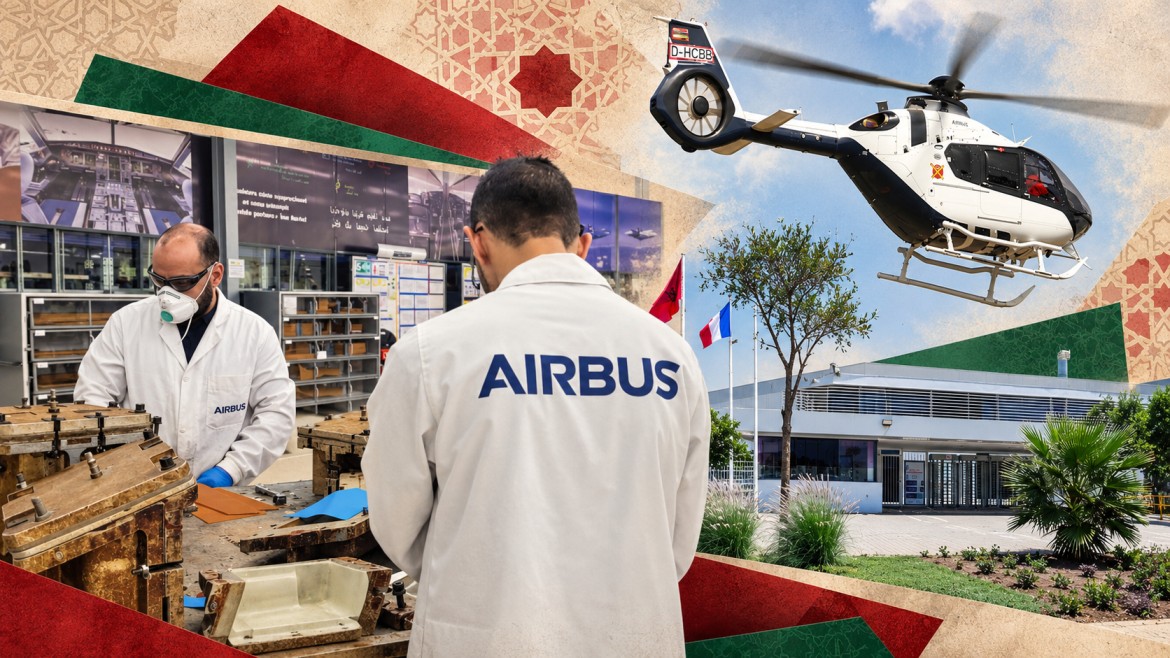
More than 1,300 people already work at Airbus’s two factories in Morocco. The European aircraft maker now plans to build a third plant and open a helicopter maintenance centre, in a move that would expand its facilities in the country by 30%. The proposed factory would cover 6,900 square metres and handle several stages of aircraft production, from designing parts to assembling them. The helicopter centre would repair and maintain aircraft for Moroccan operators and customers across West Africa.
Mickaël Bertrand, Airbus’s representative in Morocco, outlined the plans in an interview with Asharq Business. The company is expected to announce more details in the coming months, but has not yet set a construction timetable for either project.
The expansion comes as the country’s aerospace industry reports strong growth. Aircraft and aerospace exports reached 22.969 billion dirhams, or about $2.25bn, in the first eight months of 2026, a 21.5% increase on the same period last year, according to figures reported by Asharq Business.
Airbus’s two existing sites are supported by a network of about 100 local suppliers. Around 2,000 jobs are linked to the company’s wider activities in the country, including its industrial supply chain.
The proposed helicopter centre would mark a change in the company’s local operations. Airbus already makes aircraft components in Morocco, but the new facility would add maintenance, repair and overhaul services, known as MRO.
Those services would support operators at home and in several West African markets, extending the company’s work beyond manufacturing.
The existing factories produce parts for several aircraft programmes, including the Airbus A320 family and ATR turboprop aircraft.
Their output includes cockpit equipment, fuselage structural parts, floor components and cabin fittings. The sites also make metal assemblies and precision components used in aircraft structures.
Through Airbus Atlantic Maroc Composites, the company manufactures composite materials — lightweight materials designed to provide strength — for Airbus and ATR programmes. These include aircraft interior components, structural parts and other fittings.
The wider production network also supports work on the A220, A330 and A350 aircraft families. The Moroccan facilities focus on components and sub-assemblies rather than building complete aircraft.
Parts produced locally are supplied to the wider manufacturing network, including Airbus final assembly lines in Toulouse and Hamburg, France and Germany respectively, as well as programmes involving ATR.
Around 100 Moroccan suppliers provide services and materials such as precision machining, surface treatment, electrical wiring systems and raw materials.
The Moroccan Aerospace Industries Association, known as GIMAS, represents nearly 160 companies in the sector. They work across aircraft structures, wiring, machining, composite materials and engine maintenance.
Airbus has previously signalled interest in expanding its industrial presence in Morocco. At the Paris Air Show in June 2025, Wouter van Wersch, the company’s executive vice-president for international affairs, pointed to the opportunities created by the growth of the country’s aerospace industry.
At the time, Airbus referred to nearly 2,000 jobs linked to its activities in the country as an agreement concerning the acquisition of Spirit AeroSystems’ facility in Casablanca was taking shape.
The deal formed part of a wider effort by Airbus to bring key Spirit AeroSystems assets into its operations. The Casablanca facility was relevant to its aircraft structures supply chain.
Moroccan authorities want to increase the amount of aircraft manufacturing carried out locally, with a longer-term ambition of attracting a final assembly line for commercial aircraft.
The proposed third factory and helicopter maintenance centre could help broaden the industry’s capabilities. However, Airbus has not said whether either project is directly linked to the goal of assembling complete commercial aircraft in the country.
The company has yet to disclose the investment value, construction dates or detailed operating plans for the two proposed facilities. Further announcements are expected in the coming months.