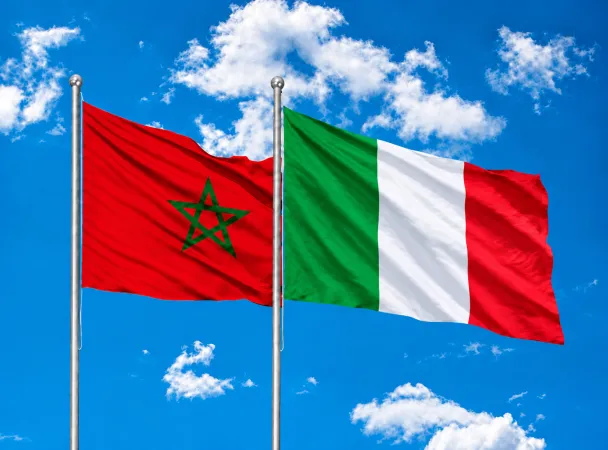
Thousands of Moroccan entrepreneurs run shops and other small businesses across Italy, making them the country’s largest group of foreign sole-proprietor business owners, new figures show. There are 53,364 registered Moroccan owners, slightly more than the 52,541 Romanians and 50,166 Chinese nationals recorded in Italy’s Business Register.
Together, the three groups account for 32.4% of all foreign sole proprietors in the country.
The figures were released on 9 October by Unioncamere, Italy’s Union of Chambers of Commerce, and InfoCamere, its digital data arm. They are based on the national Business Register as of 30 June 2026 and were compiled under Futurae, a project supported by Italy’s Ministry of Labour and Social Policies and Unioncamere.
Italy had 677,188 businesses led by foreign nationals at the end of June, equivalent to about 12% of all businesses registered in the country. Nearly four in five were owned by people from outside the European Union.
Foreign entrepreneurs started 37,140 businesses in the first six months of 2026, while 21,043 closed. That left a net increase of 16,097 businesses.
Sole proprietorships — businesses owned by one person — remain the main route into business for foreign entrepreneurs, accounting for about 70% of foreign-led businesses.
But larger business structures are also growing. The number of foreign-led companies operating as limited liability companies rose by 11% in a year to more than 160,000.
Moroccan entrepreneurs are particularly active in wholesale and retail trade. Their businesses are concentrated in Catanzaro and Reggio Calabria in southern Italy, and Messina in Sicily.
Romanian business owners are more closely associated with construction, with notable concentrations in Viterbo, Turin and Cremona.
Chinese entrepreneurs are prominent in manufacturing and recreational services. In Prato, a textile manufacturing centre in Tuscany, Chinese nationals account for 67.2% of all foreign sole proprietors.
Other communities also make up a significant share of foreign-owned businesses. Albanian, Bangladeshi and Pakistani nationals together account for about 20% of foreign sole proprietors, while Egyptian, Nigerian and Senegalese owners represent a further 10.5%.
Foreign-led businesses are not growing at the same rate across Italy.
The North-West accounts for 32.7% of all foreign-led businesses and recorded annual growth of 1.5%. In parts of the south, including Calabria and Campania, the number of foreign-led businesses fell by 3.6%.
The figures also suggest that many migrant-owned businesses have become established parts of the Italian economy. More than 35% of foreign-led businesses have been operating continuously for over 10 years.
Futurae is a national initiative designed to support migrant entrepreneurship through training, help with setting up businesses and data monitoring.
InfoCamere uses Italy’s official Business Register to compile the figures. Sole proprietorships allow the nationality of an owner to be identified directly, while companies with multiple shareholders can require more detailed checks to establish who owns them.
The ranking covers sole proprietors, not every type of company in Italy. It therefore offers a picture of one important part of foreign entrepreneurship rather than a complete ranking of all businesses owned by foreign nationals.