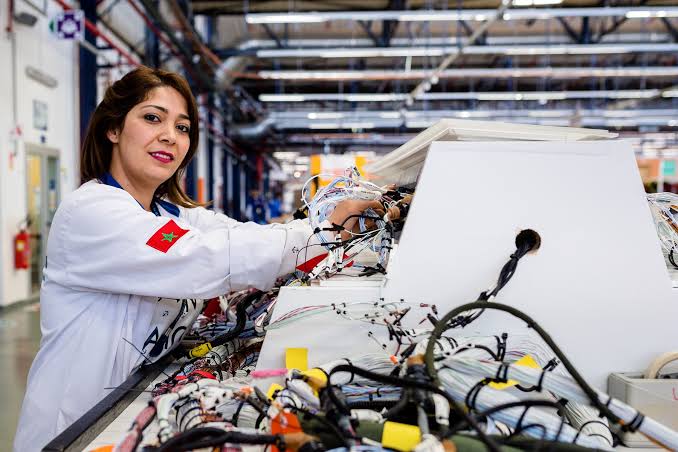
More than 400 new jobs are expected at an aircraft wiring plant near Temara after French aerospace group Safran expanded its factory to meet growing demand from the aviation industry. The company inaugurated an additional 5,700 square metres at its Aïn Atiq site on Tuesday, 13 October, bringing the plant’s total area to 31,400 square metres. The ceremony was attended by Ryad Mezzour, the Minister of Industry and Trade.
The expansion is expected to increase the workforce from 1,610 to about 2,010 employees. Women make up 87% of the current workforce, or nearly nine in every 10 employees.
The plant, run by Safran Electrical & Power, makes electrical wiring systems that connect aircraft components. It supplies programmes for major international aircraft manufacturers, including Airbus and Boeing, and is among the world’s largest facilities of its kind.
The company expects the plant to approach two million production hours in 2026. These are the hours spent working on manufacturing, rather than the number of hours aircraft spend flying.
The expansion comes as Safran marks 20 years of industrial operations in Morocco. Over that period, the group has built up activities in several areas of the aerospace industry.
Its operations in Casablanca include electric motors, landing and braking systems, and electromechanical equipment. The group also has activities in aircraft nacelle manufacturing, engine maintenance and engineering services.
Bruno Bellanger, president and chief executive of Safran Electrical & Power, said electrical technologies were important to the company’s efforts to cut aviation emissions.
The aviation industry aims to reach net-zero carbon emissions by 2050. Reaching that goal will depend on more efficient engines, greater use of sustainable aviation fuels and the development of aircraft propulsion systems that use electricity.
Leïla El Ghrib, president of Safran Electrical & Power Morocco, said links with universities and training institutions were helping the company prepare workers for new programmes and meet its recruitment needs.
The expansion will require workers with the technical skills needed to handle new production programmes. Safran also aims to build on the experience its Moroccan teams have gained over the past two decades.
Mezzour welcomed the investment and pointed to the progress made at the Aïn Atiq plant since it was established. He said its development reflected broader advances in the country’s industrial sector over the past 20 years.
Morocco’s aerospace industry has grown around Casablanca and the Rabat-Salé-Temara corridor, where more than 140 aerospace companies operate. The sector supplies international manufacturers, with wiring systems forming an important part of exports to assembly plants in Europe and North America.