
Farmers in Morocco are preparing for another date season as the country steps up efforts to grow more dates at home, attract investment and reduce its reliance on imports. The country produced a record 160,000 tonnes of dates during the 2025-2026 agricultural season, a 55% increase on the previous year, Agriculture Minister Ahmed El Bouari said. Officials expect Morocco to meet all its domestic demand for dates within the next four to five years.
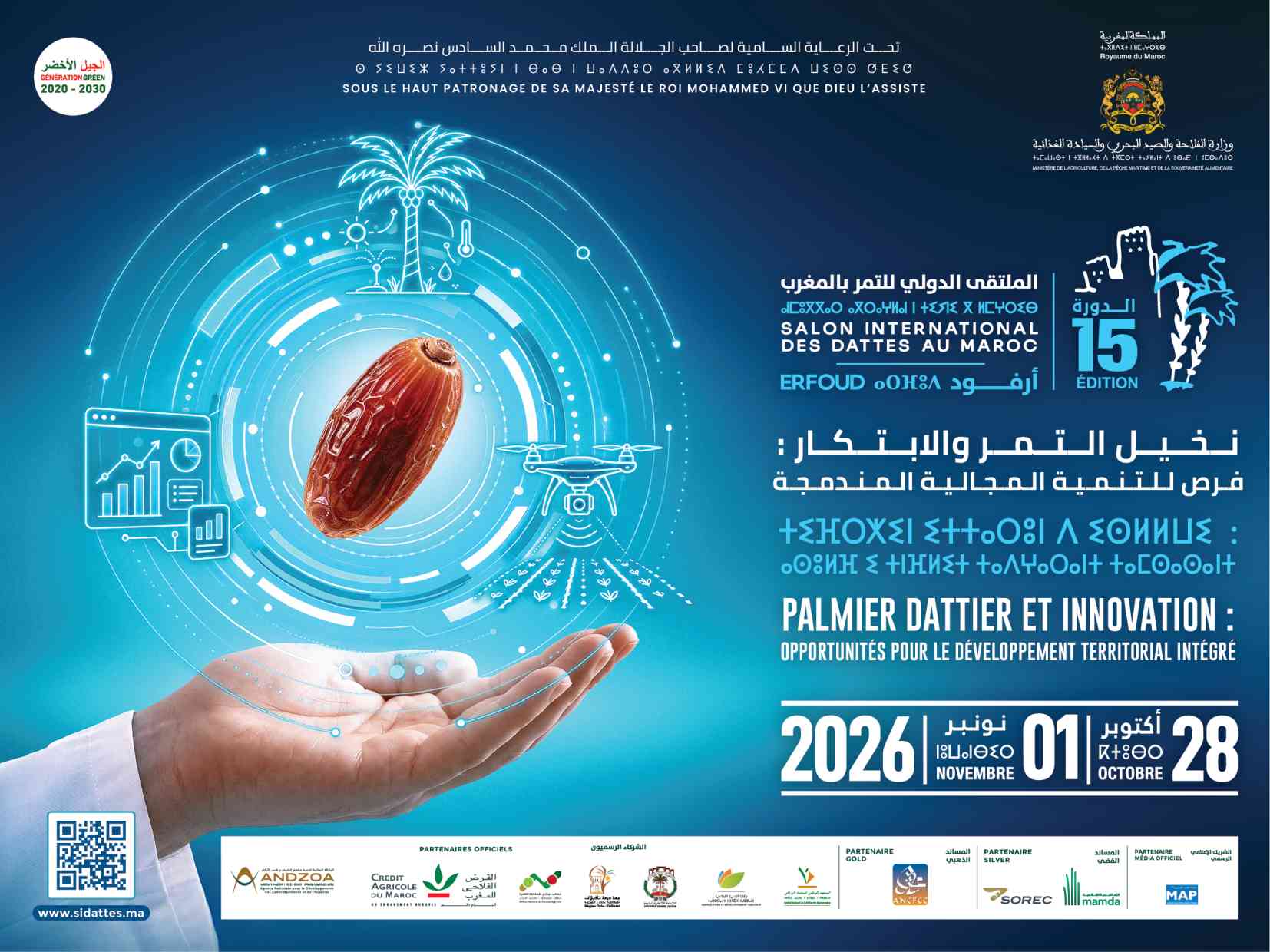
The next International Date Exhibition, known as SIDATTES, will bring farmers, researchers, businesses and investors together in Erfoud from 28 October to 1 November 2026 to support that effort.
Held under the patronage of King Mohammed VI, the 15th edition is expected to attract more than 100,000 visitors to a 40,000-square-metre venue. Its theme is “Date palm and innovation: opportunities for integrated territorial development”.
The exhibition comes as the government seeks to modernise date farming, expand exports and strengthen the economies of oasis communities, where date palms provide jobs and support local livelihoods.
Date palms covered more than 69,400 hectares of land across Morocco in 2025, compared with 50,900 hectares in 2008. The Drâa-Tafilalet region produces most of the country’s dates.
Under the Generation Green strategy, which runs from 2020 to 2030, the government plans to plant five million additional date palms by the end of the decade.
Agricultural authorities announced in March 2026 that the country expected to become self-sufficient in date production within four to five years.
Morocco also wants to reduce its dependence on imported food as pressure on its trade balance grows. National imports rose by nearly 16% by mid-2026, making lower food imports a government priority.
The country currently imports large quantities of cheaper dates from countries including Egypt and the United Arab Emirates to meet domestic demand. At the same time, it is targeting higher-paying foreign markets with premium varieties such as Medjool.
Exports to Germany have grown sharply. Between July 2025 and May 2026, Morocco shipped 714 tonnes of dates to the country, generating more than €4.2m in revenue. That volume was 22 times higher than in the previous season.
The Erfoud exhibition aims to connect farmers with investors and researchers who can help modernise the industry.
The event is organised by the Association of the International Date Exhibition in Morocco under the aegis of the Ministry of Agriculture, Maritime Fisheries and Food Sovereignty. The National Agency for the Development of Oasis Zones and the Argan Tree (ANDZOA) supports the exhibition.
Its programme will include areas for date-producing regions, public institutions and sponsors, international participants, local products, agricultural supplies and machinery, livestock breeding and the Date Rahba, a marketplace dedicated to dates.
Scientific and professional meetings will focus on research, new technologies, farming methods and investment opportunities. Discussions will also cover improvements to irrigation networks and the use of in vitro propagation to produce resilient varieties of date palms.
Agricultural advice and plant health protection will feature prominently, alongside efforts to improve the quality and value of Moroccan dates and protect oasis environments over the long term.
Organisers say the meetings will help farmers and young entrepreneurs find practical solutions, expertise and services for their projects.
The programme will also include cultural activities and competitions centred on date products, highlighting the heritage, skills and variety of products linked to date palms.