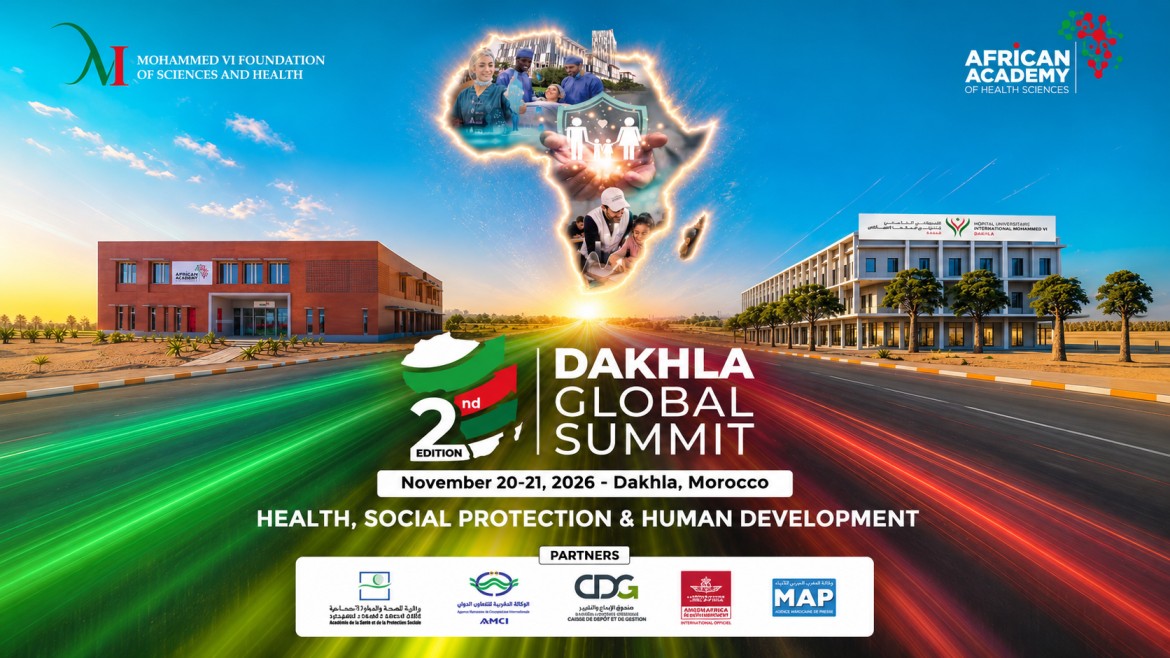
Building stronger health systems means more than building hospitals. It also means training doctors, funding research and making sure people can get the care they need. These issues will be at the centre of a major African health summit in Dakhla, southern Morocco, on 20 and 21 November. The second Dakhla Global Summit will bring together political leaders, health officials and leading scientists to discuss how African countries can become more self-reliant in meeting their healthcare needs.
The meeting, organised by the Mohammed VI Foundation for Science and Health (FM6SS) and its academic arm, the African Academy of Health Sciences (AAHS), will focus on “Health, Social Protection and Human Development”.
Former Senegalese president and former African Union chair Macky Sall will deliver the opening address on African health sovereignty. He will be joined by Health and Social Protection Minister Professor Youns Bjijou and Higher Education, Scientific Research and Innovation Minister Professor Azzedine El Midaoui.
Professor Lahcen Belyamani, chief executive of the FM6SS and president of the AAHS, will also address the gathering.
Other expected guests include Catherine Samba-Panza, former transitional president of the Central African Republic, and Congolese scientist Professor Jean-Jacques Muyembe, whose research contributed to the discovery of the Ebola virus.
The scientific delegation will include Professor Agnès Binagwaho, Rwanda’s former health minister; Professor Najat Mokhtar, deputy director general of the International Atomic Energy Agency (IAEA); Professor Wafaie W. Fawzi of Harvard’s T.H. Chan School of Public Health; and Professor Mike English of the University of Oxford, who specialises in international child health.
Members of the AAHS board and academics from Mohammed VI University of Science and Health (UM6SS) will also attend.
The summit follows its first edition in 2025, which resulted in the Dakhla Declaration and a roadmap covering 2026 to 2030.
The new meeting aims to turn that plan into practical partnerships between governments, universities, hospitals, research institutions and African development partners.
Organisers have identified three main priorities: improving access to healthcare, strengthening social protection and investing in human development through education, research and innovation.
A meeting of ministers will examine public health policies and ways to finance them.
Seven scientific sessions will cover healthcare funding, metabolic diseases such as diabetes, cancer prevention and screening, infectious disease monitoring, patient care, treatment guidelines and regional centres of medical excellence.
“The first edition of the Dakhla Global Summit laid the foundations for a shared ambition for African health sovereignty. This second edition must mark the shift from commitments to action by accelerating cooperation and investment in human capital, research and access to healthcare,” Professor Belyamani said.
“Our ambition is to help build more resilient, equitable and sustainable health systems that serve the development of our continent,” he added.
Why Dakhla?
The choice of Dakhla reflects a wider vision of closer African cooperation, built around partnerships between countries in the Global South, solidarity and shared development.
The city is also part of the development of Morocco’s southern provinces and their growing role in connecting the kingdom with other African countries.
The FM6SS has established a hospital-university complex and a medical school in Dakhla. The facilities are intended to train medical professionals, support research and expand healthcare services in the region.
The organisations behind the summit
The African Academy of Health Sciences is a scientific organisation that brings together researchers from across Africa. It promotes cooperation between African countries, scientific excellence and fairer access to healthcare.
Its work includes tackling public health challenges, advising governments and public institutions at national and international levels, and publishing medical research and recommendations on healthcare practices.
The Mohammed VI Foundation for Science and Health is a non-profit organisation established at the initiative of King Mohammed VI. Its work combines healthcare, education and scientific research.
The foundation operates university hospitals in Rabat, Bouskoura and Dakhla. Hospitals are also being developed in Marrakech and Agadir.
Its wider network includes the Cheikh Khalifa Hospital in Casablanca, Mohammed VI University of Science and Health, which operates across five campuses, the Precision Medicine Hub and the Mohammed VI Centre for Research and Innovation.