Morocco’s weather service is looking for suppliers for MAD 9.5m ($960,000) of cloud-seeding equipment, as it expands a decades-old programme to squeeze more rain from the sky. The General Directorate of Meteorology (DGM) has launched two tenders: one for seeding cartridges, and another for automated ground systems in six areas of the country. Neither contract has been awarded yet.
The move comes after an exceptionally wet winter left Morocco with its best water reserves in a decade, following years of drought. Reservoirs were 66.3% full in late October, against 31.5% a year earlier.
The contracts
The first tender, published on 12 October, covers moisture-attracting and ice-forming cartridges for ground-based seeding sites. It is valued at MAD 2.82m ($280,000), and bids closed on Monday.
The second, published on 26 October, is for the supply, installation and maintenance of automated “cartridge tree” launchers. It is estimated at MAD 6.7m ($670,000), with bids due by 7 December.
Those systems will go to Azilal, El Hajeb, Sefrou, Ouezzane and Khénifra, and to the Hay Hassani district of Casablanca.
Decades of seeding
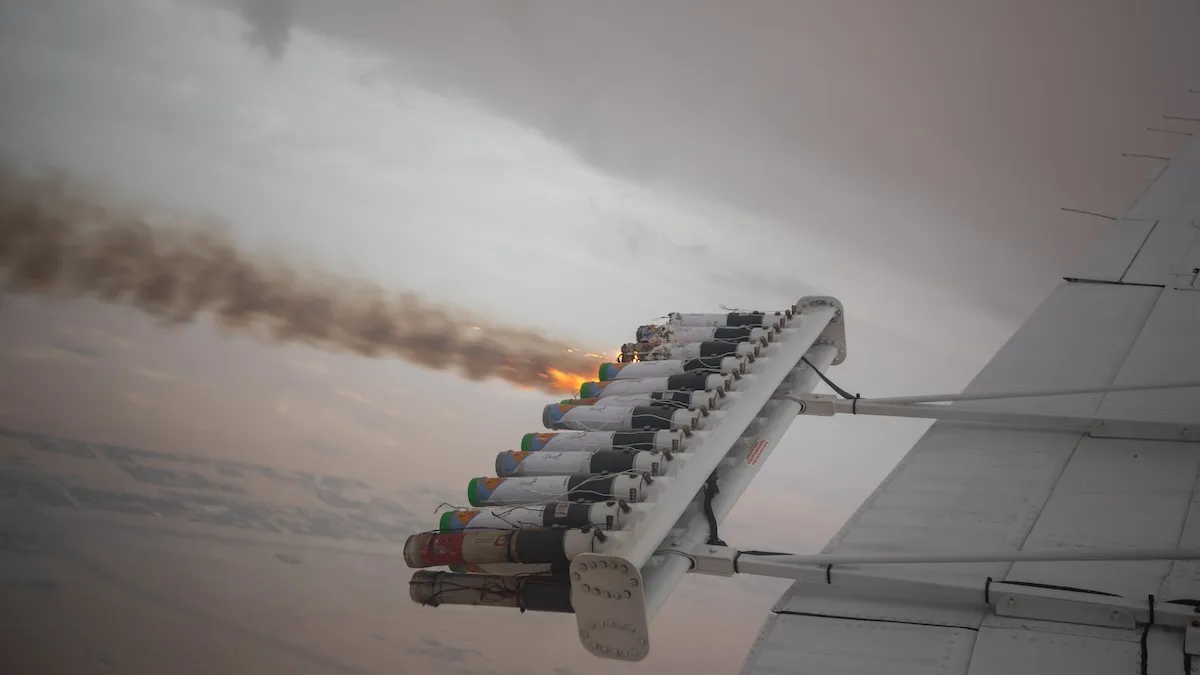
Cloud seeding involves releasing particles such as salts or ice-forming compounds into clouds, to help water droplets or ice crystals grow large enough to fall. It cannot create rain clouds where none exist.
Morocco has used the technique since 1984, when it launched the Al Ghaith programme with the US Agency for International Development after a severe drought.
Officials say evaluations in the 1980s showed rain and snowfall in target areas rose by 14% to 17%. In 2024 its ground equipment was based at 20 sites around Beni Mellal, Azilal and El Hajeb.
The programme has stepped up sharply as drought took hold. Morocco carried out 70 operations in the first 10 months of 2024, against an average of 23 a year between 2020 and 2023. The water ministry spent MAD 160m ($16m) on it between 2021 and 2023.
Mixed evidence
Scientists remain divided over how well cloud seeding works. The World Meteorological Organization says it neither promotes nor discourages the practice, and that success is “often difficult to establish with sufficient confidence”.
Some Moroccan experts are sceptical. Climate specialist Mustapha El Issat has argued that seeding has repeatedly proved ineffective and is no answer to the country’s water shortage.
The programme has also fuelled rumours. After deadly floods in 2024, some Moroccans blamed seeding, which officials denied.
“We don’t seed when there’s already rain in the forecast,” said Abderrahim Moujane, a meteorologist at the DGM, in an interview with Revolve.
The effort has drawn attention across the Strait of Gibraltar, too. In 2024, Spain’s government asked Morocco for more information amid fears among some meteorologists that it could affect rainfall in Spain.