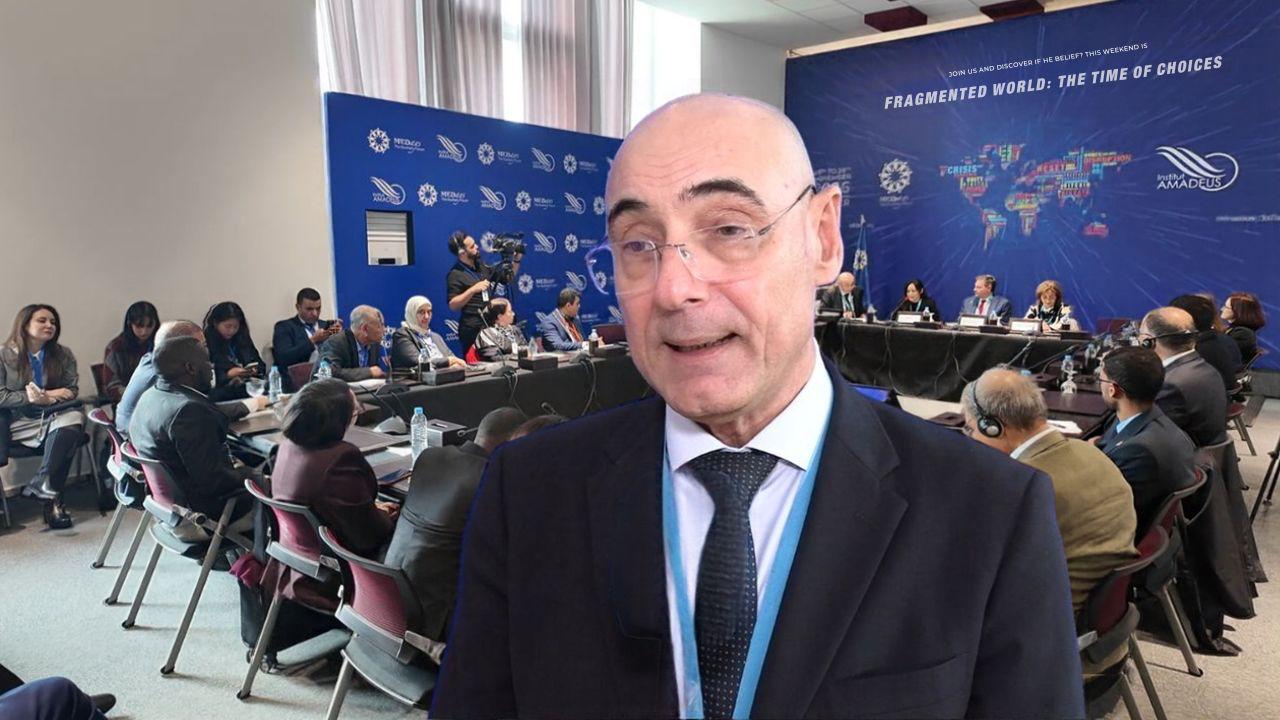
China’s grip on clean energy technology gives Morocco a chance to become a key manufacturing and export hub, according to one of the country’s renewable energy pioneers. Khalid Benhamou, head of Sahara Wind, said the world was entering a new era in which China would play the role in renewables that the US once played in oil.
“We are at the twilight of a fossil era,” he said in an interview on the sidelines of the MEDays 2026 conference, whose opening roundtable was on energy sovereignty.
Mr Benhamou, who put up Morocco’s first experimental wind turbine on the Saharan coast in 1995, said China dominates the manufacture of wind turbines, solar panels and batteries. It also controls most of the world’s mining and refining of rare earths, which are vital to the energy transition.
Replacing that supply would take about a decade, he argued. In the meantime, he said, China cannot be “the factory of the world” from home alone, and needs reliable partners abroad.
Chinese factories
Morocco is already drawing that investment. Chinese firm Aeolon opened a wind turbine blade factory near the Nador West Med port last year, its first outside China, which is expected to create more than 3,000 jobs.
Battery maker Gotion is building what it calls Africa’s first electric vehicle battery gigafactory near Kenitra, under a MAD 65bn ($6.5bn) investment deal with the government.
Mr Benhamou put the pipeline of clean-energy industrial projects at MAD 200bn-300bn ($20bn-30bn). He said Morocco’s raw materials, including phosphate, iron and lithium, and the know-how built up in its car industry make it highly competitive.
He said its trade policy is a big draw. “We are a neutral platform,” he said, pointing to free trade deals with the US, the EU and some 50 countries in total.
Wind for AI
Mr Benhamou’s biggest claim is about wind. He said the Sahara holds 6,000 gigawatts of wind potential, with turbines able to run 60% to 70% of the time.
By his estimate, that is about six times Europe’s entire electricity-generating capacity, at highly competitive prices, about 1,000km from its border.
He said that resource could power data centres for artificial intelligence, where access to electricity is becoming the main constraint, as well as the production of green hydrogen.
He said the International Energy Agency’s latest outlook saw Morocco as having the solution for green hydrogen, but warned that it would need very large investment. Market demand has yet to materialise, he said. “If you want to invest, we are ready.”
Ports and pipelines
Mr Benhamou also pointed to Nador West Med, a new port on the Mediterranean coast. He said a planned fuel hub there to supply Africa, proposed by Emirati investors, could be worth MAD 100bn ($10bn) to the Moroccan economy.
He also backed the planned Nigeria-Morocco gas pipeline, first raised in 2016, which would run along Africa’s Atlantic coast through 13 countries and link up with European markets.
The war in Ukraine showed the danger of one-to-one energy deals, he argued, citing Germany’s reliance on Russian gas. Tying many countries into one network makes supply harder to cut off.
“What we have done in Morocco, we can very well do in these 13 countries,” he said.