

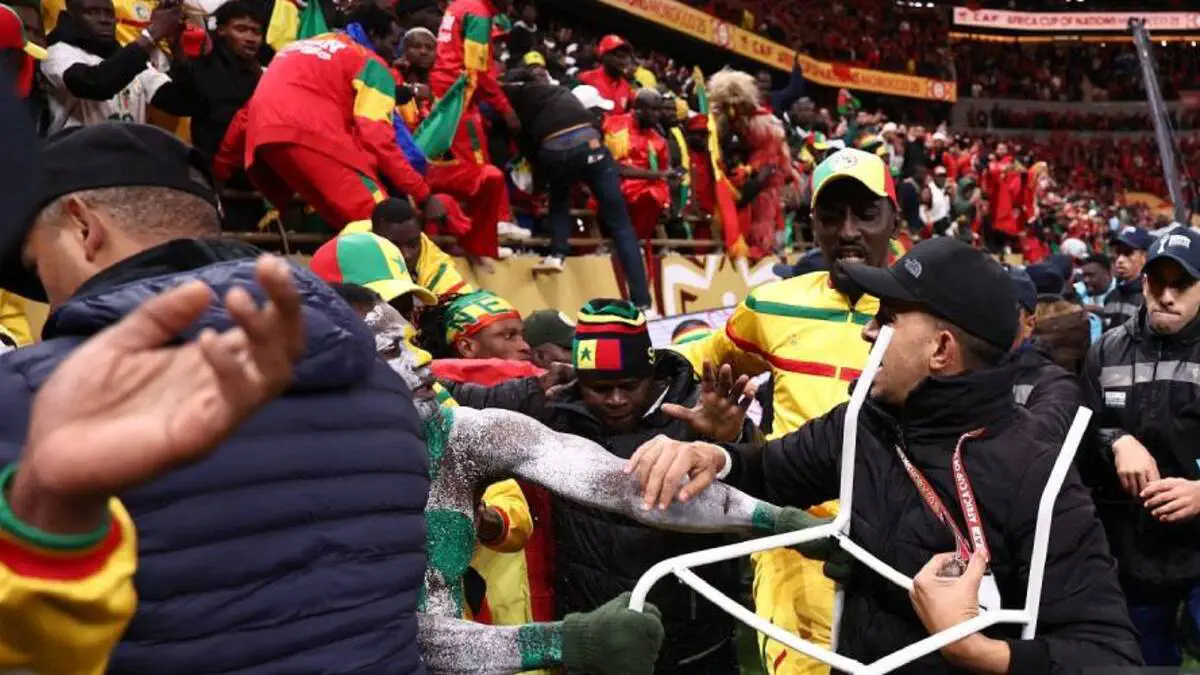
Eleven days after the chaotic end to the 2025 Africa Cup of Nations final in Rabat, the long-awaited verdict from the Confederation of African Football (CAF) has finally been delivered. And for many, particularly in Morocco, it’s nothing short of a disappointment. What was expected to be a firm and transparent response to a final marred by disorder has instead become a case study in weak leadership, selective accountability, and glaring inconsistencies. The outcome reads like a checklist of contradictions, more concerned with appearances than justice.
In its late-night statement, CAF laid out a set of disciplinary measures against both the Moroccan and Senegalese federations, as well as several players and technical staff. The charges referenced breaches of discipline, fair play, and disrespect toward match officials. But what truly stands out is not what was punished; it’s what was quietly swept under the rug.
On the Senegalese side, head coach Pape Bouna Thiaw was handed a five-match suspension for what CAF described as unsportsmanlike conduct, along with a $100,000 fine. Two players, Iliman Ndiaye and Ismaïla Sarr, received two-match bans for confrontational behavior toward the referee. The Senegalese Football Federation was fined $300,000 for the conduct of its fans, another $300,000 for actions by its players and staff, and an additional $15,000 for collective disciplinary offenses.
Morocco didn’t escape punishment either. Star defender Achraf Hakimi was suspended for two matches, one of which is conditional. Ismaël Saibari received a three-match ban and a $100,000 fine. The Moroccan FA was fined $200,000 over incidents involving ball boys, $100,000 for staff entering the VAR zone, and another $15,000 due to fans using laser pointers.
The disciplinary committee also rejected a formal complaint from the Royal Moroccan Football Federation (FRMF), which had accused the Senegalese side of multiple violations. CAF dismissed the appeal outright, claiming no breach of the regulations.
This is where the outrage begins. Across Moroccan media and social platforms, the reaction has been fierce and nearly unanimous: CAF’s decision reeks of bias. Many argue that Morocco received harsher penalties for comparatively minor offenses, while far more serious actions from the Senegalese side were treated with inexplicable leniency. At the heart of the frustration is the memory of Senegal’s players walking off the pitch during the final — a rare and serious act in professional football. CAF’s statement doesn’t even acknowledge this incident, let alone sanction it.
By failing to call that moment what it was (a de facto abandonment of play) CAF has created a dangerous precedent. It sends a signal to other teams that walking off the field during a high-stakes match might not only go unpunished but could still lead to lifting a trophy. This isn’t a minor oversight. It’s a failure of governance, a decision that damages the credibility of the very institution meant to uphold the rules of African football.
In the eyes of many, the governing body has once again lived up to its reputation for political maneuvering, selective justice, and opaque processes. The phrase circulating in Moroccan commentary is blunt and telling: a mountain of scandal, a mouse of a verdict. CAF had the opportunity to show that discipline and fairness still matter in African football. Instead, it backed away from the hard choices, clinging to balance on paper rather than balance in principle.
For Morocco, which successfully hosted the tournament and ensured its smooth execution despite high pressure, this outcome is not just a slap in the face, it’s a warning. It shows that even excellence in organization cannot shield a federation from being cast as the villain if the narrative suits larger interests.
Whether an appeal is filed or not, the damage is already done. The 2025 Africa Cup of Nations ends not with celebration but with a bitter aftertaste. And once again, the credibility of CAF hangs in the balance, questioned by those it claims to represent.