

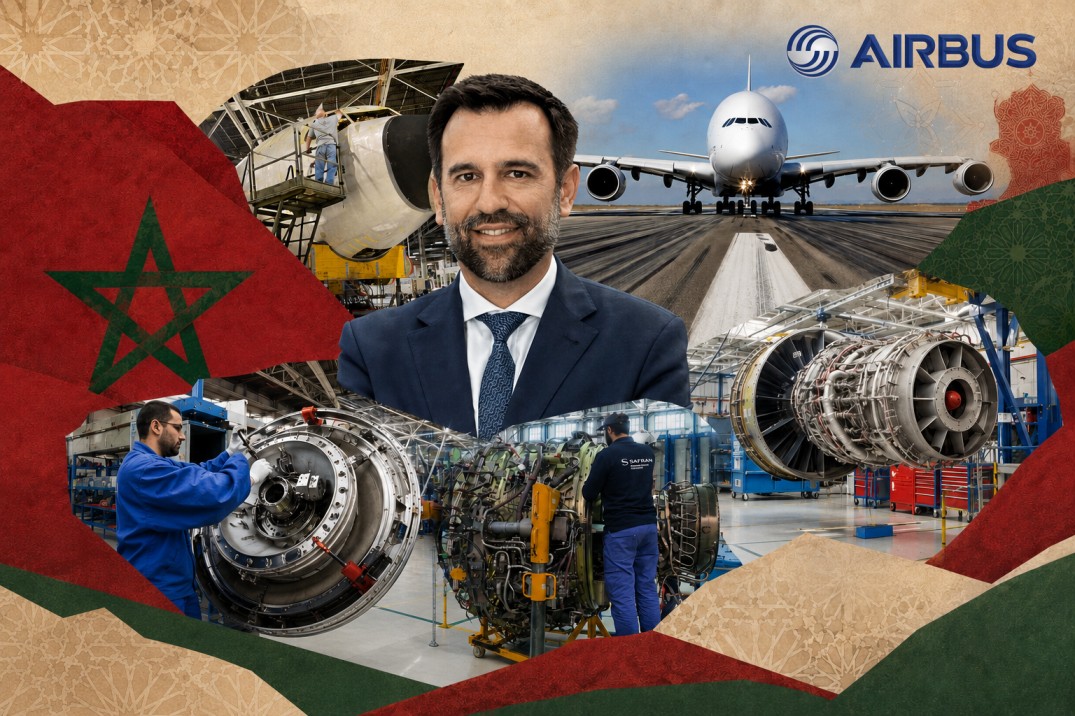
Morocco has grown into a high-tech manufacturing hub for the automotive and aerospace industries over the past two decades, according to Gabriel Semelas, President of Airbus Africa and the Middle East.
Speaking ahead of Throne Day, Semelas said the country’s long-term industrial strategy, political stability and investment in infrastructure have helped attract global manufacturers and build a competitive aerospace sector.
He said Morocco has gone through a “historic turning point” under King Mohammed VI, with a deep transformation of its economy and industry.
Industrial acceleration plans helped build specialised ecosystems for aircraft wiring and cabling, composite materials and maintenance. Semelas said this long-term vision is especially important for companies such as Airbus, whose investments are planned years in advance.
“For an industrial group such as Airbus, whose investment cycles extend over the long term, this vision and this stability are essential assets,” he said.
Industrial zones such as Midparc in Casablanca have also strengthened the sector by bringing manufacturers and suppliers together in one place, making production more competitive.
Semelas also highlighted investment in transport infrastructure. He pointed to the expansion of Tanger Med port and the modernisation of airports across the country. Airport capacity is expected to reach 80 million passengers by 2030, helping prepare for the 2030 FIFA World Cup and growing tourism.
He said these projects are strengthening the country’s position as an air transport hub linking Europe, Africa and the Americas while improving logistics for global supply chains.
A large network of international suppliers and local small and medium-sized companies has also helped strengthen the aerospace industry.
“This integration and this flexibility now allow Morocco’s value chain to meet the most demanding quality standards in our sector,” he said.
Semelas described the business climate in one word: “trust”. He credited stable regulations and industry incentives for giving manufacturers the confidence to invest over the long term.
He also said skilled workers are one of the country’s biggest advantages. Institutions such as the Institute for Aeronautics Trades and universities are training engineers and technicians who meet the aerospace industry’s needs.
“The role of local professionals goes beyond assembly. They also contribute to developing complex technological solutions and advanced engineering,” he said. “This culture of excellence allows components manufactured in Casablanca to meet the standards applied across Airbus’s global sites.”
Semelas said the country’s location gives it another advantage. Its proximity to Europe helps secure supply chains, improve efficiency and reduce transport distances, while its position as a gateway to Africa makes it a good base for developing the aerospace industry across the continent.
He said the country has also moved beyond being only a manufacturing base.
“Morocco is no longer just a production base. It is now establishing itself as one of the three main pillars of the future of aviation,” he said.
Semelas identified those pillars as resilience, decarbonisation and high-value activities. He said recent global crises showed the strength of the country’s industrial base. Investment in renewable energy and the potential to produce sustainable aviation fuel support efforts to cut carbon emissions, while engineering, research and development, and industrial digitalisation are becoming increasingly important.
“Under the leadership of King Mohammed VI, Morocco is anticipating the transformations taking place in the aerospace industry and, together with Airbus, is actively helping turn them into reality,” he said.


