

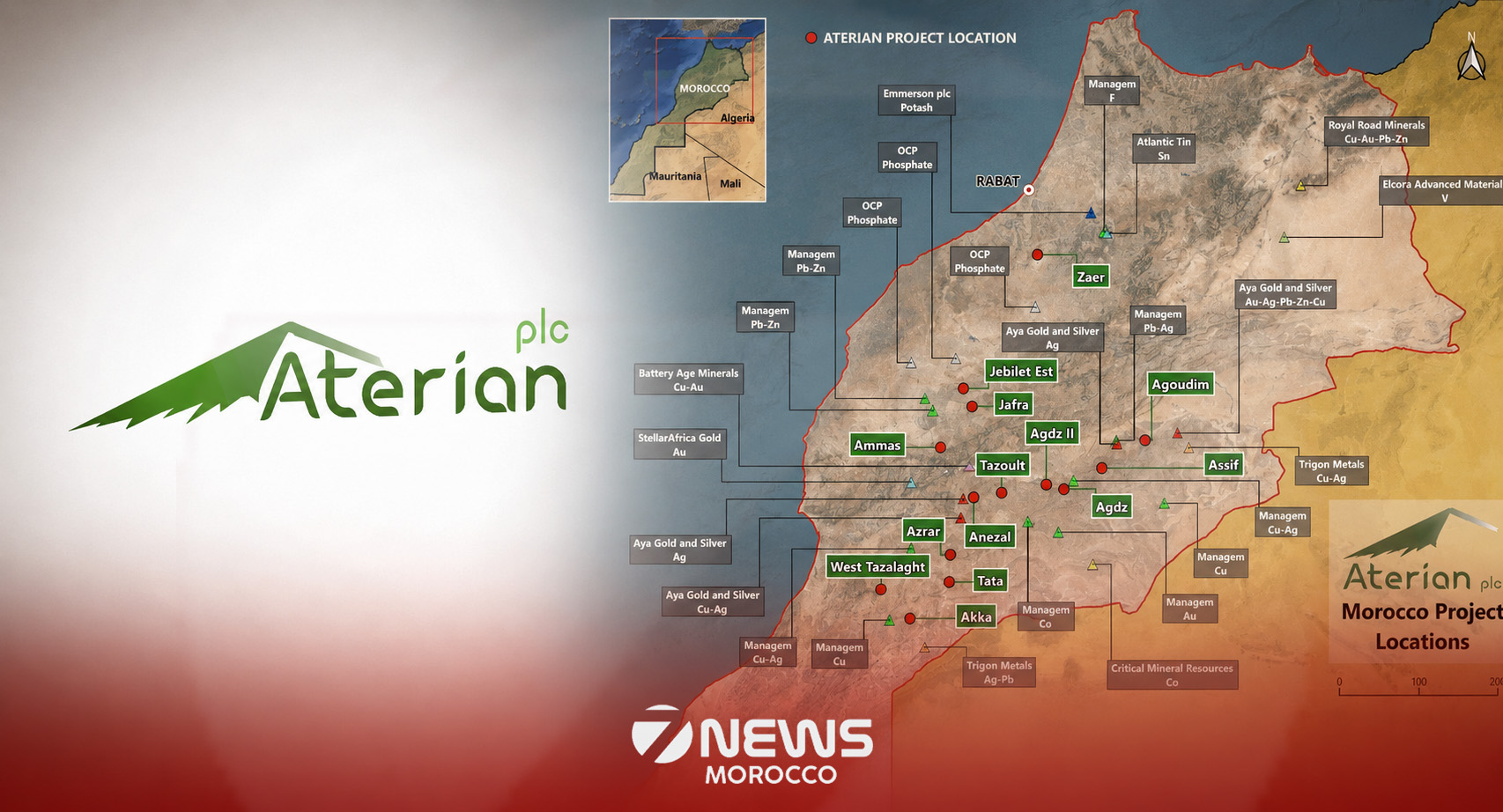
British mining company Aterian has identified several new copper and silver exploration targets at its Agdz project in the eastern Anti-Atlas Copper Belt after reviewing high-resolution ground magnetic survey data. The study identified fault structures that may have helped copper- and silver-rich fluids move through the rocks and form mineral deposits. Several of these structures are close to known copper showings, hydrothermally altered rocks and fault zones that stretch for several kilometres.
Executive Chairman Charles Bray said the new findings are an important step for the project. “This has taken us beyond simply identifying magnetic anomalies and has given us a much clearer understanding of the structural controls on mineralisation.”
The company said the priority targets match historical results of up to 3.47% copper and 136 grams of silver per tonne.
Aterian also increased the area covered by its geophysical survey by around 140%, although it did not say how many extra square kilometres were surveyed.
Bray said the larger survey area provides “a significantly larger and more compelling exploration opportunity.”
The company said the newly identified fault structures are similar to those at the nearby Bou Skour polymetallic mining district, which has an estimated resource of 53 million tonnes. The comparison is based on the direction of the fault systems and how they may have carried copper- and silver-rich fluids. Aterian said this does not mean Agdz contains a deposit of the same size or grade because the new areas are still exploration targets.
Ground magnetometry measures changes in the magnetic properties of rocks to detect buried geological structures. Aterian is combining these results with historical exploration data, hyperspectral imaging and artificial intelligence tools from Lithosquare to identify the most promising areas.
The company has already started trenching work on the priority targets. It expects to release the first results before the end of the third quarter of 2026.
The work will check whether the fault systems continue at the surface, collect rock samples and confirm whether the magnetic anomalies are linked to copper and silver mineralisation.
The exploration programme also includes detailed geological mapping, geochemical sampling, induced polarisation and resistivity surveys. These methods measure the electrical properties of underground rocks to help identify mineralised zones.
After combining the magnetic, hyperspectral, geochemical and digital data, Aterian plans to select drilling targets. The company will focus on areas where large fault corridors, known copper showings, hydrothermal alteration and electrical anomalies all overlap.


