
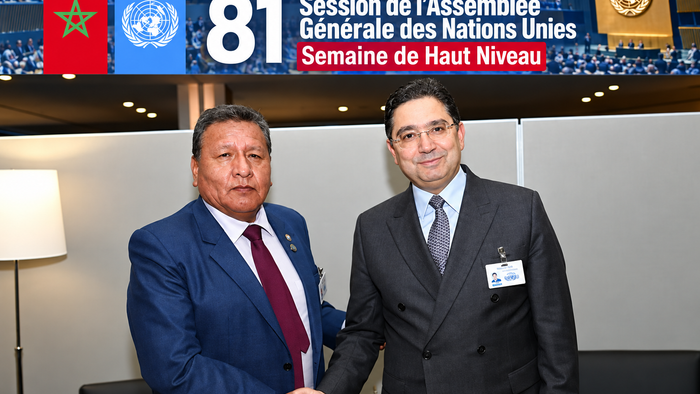
Bolivia is planning to open a diplomatic mission in Rabat and a trade office in Dakhla as it moves closer to Morocco and looks for new markets in Africa. The announcement came in New York, where Foreign Minister Nasser Bourita met his Bolivian counterpart, Héctor Francisco Huanca Gutiérrez, during the UN General Assembly.
The two ministers signed a joint communiqué covering diplomatic, political and economic cooperation. Bolivia also took note of the autonomy plan for Sahara presented by Morocco in 2007. The plan “can constitute a path allowing progress in negotiations with a view to a fair, lasting political solution acceptable to the parties.”
The two countries also agreed to respect each other’s sovereignty and territorial integrity and not interfere in each other’s internal affairs.
A separate agreement will remove visa requirements for holders of diplomatic, official, service and special passports. The two countries also signed a memorandum between their diplomatic academies.
The ministers agreed to hold the first meeting of a bilateral political consultation mechanism created in 1999. They also committed to closer high-level political dialogue based on “political pragmatism, mutual respect, solidarity, and reciprocal interests.”
The planned trade office in Dakhla is linked to a major port project being built north of the city.
The Dakhla Atlantic port covers 1,650 hectares, about 40km north of Dakhla. Construction began at the end of 2021 and has a planned cost of 12.5bn dirhams. The SGTM-Somagec Sud consortium is building the port.
The port is designed to handle 2.2m tonnes of cargo and 950,000 tonnes of seafood products in its first years. Construction is due to finish at the end of 2028, with operations planned for 2029.
Bolivia has no coastline. The country lost its Pacific coast during the War of the Pacific and now sends most of its exports through ports in Chile and Peru.
A commercial base in Dakhla could give Bolivian companies a new route towards African markets.
Bolivia already has a significant fertilizer business in South America.
State-owned Yacimientos Petrolíferos Fiscales Bolivianos (YPFB) produces granulated urea at the Bulo Bulo ammonia and urea plant.
YPFB sold 250,400 tonnes of urea between January and July 2026, generating $102.7m in export revenue. Sales were 21% higher than during the same period in 2025. Brazil was the biggest buyer, followed by Argentina, Paraguay, Peru and Chile.
Urea exports reached 507,324 tonnes in 2024 and generated more than $127m. Brazil, Argentina, Paraguay, Peru and Chile bought 96% of exported production.
Bolivian urea supplies about 85% of the Paraguayan market, between 15% and 20% of the Argentine market, and between 5% and 7% of the Brazilian market.
The fertilizer industries in the two countries are different. Bolivia mainly produces nitrogen-based fertilizers such as urea. Morocco has a major phosphate-based fertilizer industry. The products therefore do not directly compete in the same markets.
Bolivia suspended diplomatic relations with the Sahrawi Arab Democratic Republic (SADR) on 24 February 2026 and ended all official contact with it.
The decision followed a telephone call between Bourita and then-Bolivian Foreign Minister Fernando Aramayo. Bolivia said the SADR was not recognised as a UN member state and linked its new position to UN Security Council Resolution 2797, adopted on 31 October 2025.
The change reversed a position dating back to 1982, when Bolivia recognised the SADR under President Hernán Siles Zuazo. His vice-president was Jaime Paz Zamora, the father of current President Rodrigo Paz.
Bolivia’s policy has changed before. President Jeanine Áñez’s government suspended recognition in 2020, but President Luis Arce later restored the previous position.
Former President Evo Morales criticised the latest decision as “unilaterally” taken and said it went against “the principles of our Constitution and to Bolivia’s democratic and anti-colonial tradition.”
President Rodrigo Paz took office in November 2025. His government has since moved to restore relations with Rabat and expand cooperation in agriculture, food security, fertilizers and security.
The latest agreements now add a resident diplomatic presence in Rabat and a planned commercial presence in Dakhla.
More support during UN General Assembly
The Bolivia agreement comes as Morocco builds more economic and diplomatic ties with Latin American and Caribbean countries.
Chile signed terms of reference with Morocco on 21 September to start negotiations for a free-trade agreement. Chile also committed to promoting economic and commercial cooperation in the Sahara region, as the two countries marked 65 years of diplomatic relations.
Jamaica expressed support for the 2007 autonomy proposal on 23 September and referred to UN Security Council Resolution 2797.
The agreements with Bolivia give the planned Dakhla port another potential link to international trade. For Bolivia, the focus is clear: create another route for its exports and find new markets beyond South America.