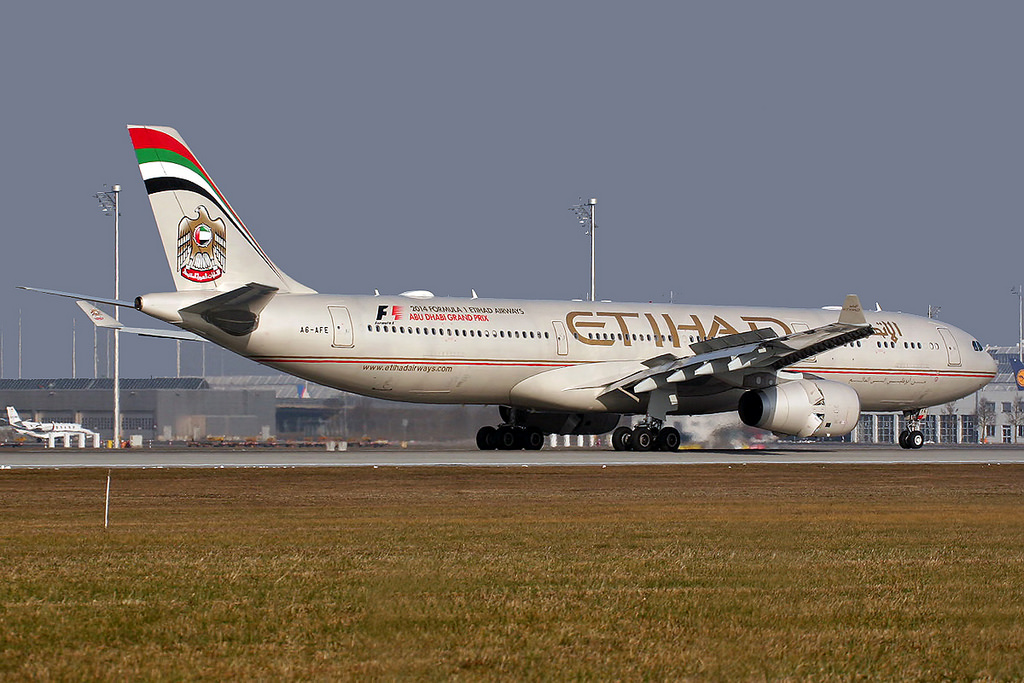
Passengers flying between Casablanca and Abu Dhabi will have fewer options in February, as Etihad Airways cuts its services on the route from seven to five flights a week. The change will take effect on 8 February 2027 and last until 8 March. The airline will drop Tuesday and Sunday flights in both directions, according to booking data published by aviation schedule tracker AeroRoutes on 12 November.
The revised timetable means passengers will be able to fly with Etihad on Mondays, Wednesdays, Thursdays, Fridays and Saturdays. The airline is cutting its weekly services by two, or nearly 29%.
Etihad will also replace the Boeing 777-300ER with the smaller Boeing 787-9 Dreamliner. The aircraft change, combined with fewer flights, will significantly reduce the number of seats available on the route.
Flight EY757 will leave Abu Dhabi at 02:10 and arrive at Casablanca’s Mohammed V Airport at 06:35. The return service, EY758, will depart Casablanca at 08:20 and reach Abu Dhabi at 19:40. All times are local.
The four-week reduction means eight fewer return journeys, or 16 individual flights. Etihad will operate 20 departures in each direction instead of 28.
The capacity reduction could be even greater than the cut in flights suggests. Etihad’s standard two-class Boeing 777-300ER carries 402 passengers, while its two-class Boeing 787-9 accommodates 290.
That is 112 fewer seats on every flight, a reduction of nearly 28%.
Based on these aircraft configurations, the number of seats available in each direction over the four weeks will fall from 11,256 to 5,800. That amounts to 5,456 fewer seats, or a 48.5% reduction.
Across both directions, the estimated loss is 10,912 seats.
The final figures will depend on the aircraft configuration used. Etihad also operates a three-class Boeing 787-9 with 231 seats and a three-class Boeing 777-300ER with 328 seats. Depending on the combination, the reduction in directional capacity could range from 36.85% to 49.70%.
Another change to the Casablanca route
The February adjustment follows several aircraft changes on the Abu Dhabi-Casablanca route over recent months.
Etihad introduced the Airbus A350-1000 on 1 July 2026, replacing the Boeing 787-9. The 371-seat aircraft has 44 Business Class suites and 327 Economy seats, bringing a newer Business cabin to the route.
The airline then scheduled the return of the Boeing 777-300ER from 25 October 2026 until 31 January 2027, maintaining daily flights between the two cities.
The aircraft was available in two configurations: a two-class version with 402 seats and a three-class version with 328 seats, including First Class.
The February timetable will bring back the Boeing 787-9 while reducing the service to five days a week.
Etihad first launched direct flights between Abu Dhabi and Casablanca in June 2006. The route was suspended during the Covid-19 pandemic before returning to daily operations.
Gulf carriers compete for passengers
Etihad is not the only airline connecting Casablanca with the Gulf. Emirates, Qatar Airways and Royal Air Maroc also serve routes linking the region with the Moroccan city.
Emirates operates daily flights between Dubai and Casablanca using Airbus A380 aircraft. Depending on the configuration, each aircraft carries between 484 and 517 passengers.
That gives Emirates an estimated 3,388 to 3,619 seats in each direction every week, or between 13,552 and 14,476 over four weeks.
Qatar Airways also operates daily flights between Doha and Casablanca, using Boeing 777 and 787 aircraft. Its estimated weekly capacity ranges from 1,778 to 2,478 seats in each direction.
Royal Air Maroc connects Casablanca with Dubai using Boeing 787-8 and 787-9 Dreamliners. Its frequency varies between four and seven flights a week, depending on the season, with an estimated 1,096 to 2,114 seats in each direction weekly.
Etihad also carries passengers travelling beyond Abu Dhabi to destinations in South and Southeast Asia and Australia. These include Manila, Bangkok, Jakarta, Mumbai and Sydney.
The airline’s Abu Dhabi hub allows passengers from Casablanca to connect to these destinations without flying directly from Morocco.
Ramadan and the wider aviation picture
The four-week reduction coincides with the expected start of Ramadan in 2027. The fasting month is projected to begin around 8 February and end around 9 March, although the dates depend on the sighting of the moon.
Airlines serving Gulf-Maghreb routes often adjust capacity to reflect seasonal changes in travel demand. However, Etihad has not publicly stated that Ramadan is the reason for this particular reduction.
The airline has also faced wider operational challenges linked to instability in the Middle East. Previous regional tensions and airspace closures over Iran and the Levant have forced Gulf carriers to change flight paths, extend journey times and adjust aircraft deployment.
The Abu Dhabi-Casablanca route is part of a wider travel and business corridor between the United Arab Emirates and Morocco. The two countries have strong investment, tourism and business links, including cooperation in renewable energy, green hydrogen, water desalination and high-speed rail.
The United Arab Emirates is among the largest foreign investors in Morocco. Bilateral investment agreements signed in December 2023 reinforced economic cooperation between the two countries.
Casablanca’s Mohammed V Airport, operated by the state-owned National Airports Office (ONDA), is the country’s main international gateway and a major hub for Royal Air Maroc.
The airport is also part of the Airports 2030 development strategy, which aims to double national airport handling capacity ahead of the 2030 FIFA World Cup, co-hosted by Morocco, Spain and Portugal.
Etihad is wholly owned by ADQ, an Abu Dhabi sovereign wealth company, following its transfer in October 2022. Under chief executive Antonoaldo Neves, the airline’s Journey 2030 strategy aims to expand its fleet to more than 160 aircraft and carry 33 million passengers annually by the end of the decade.
The airline has not confirmed whether the five-flight weekly schedule will continue beyond 8 March 2027. Its timetables for the rest of the month are still being updated.
The next major timetable change is expected with the start of the IATA summer season on 28 March 2027.