

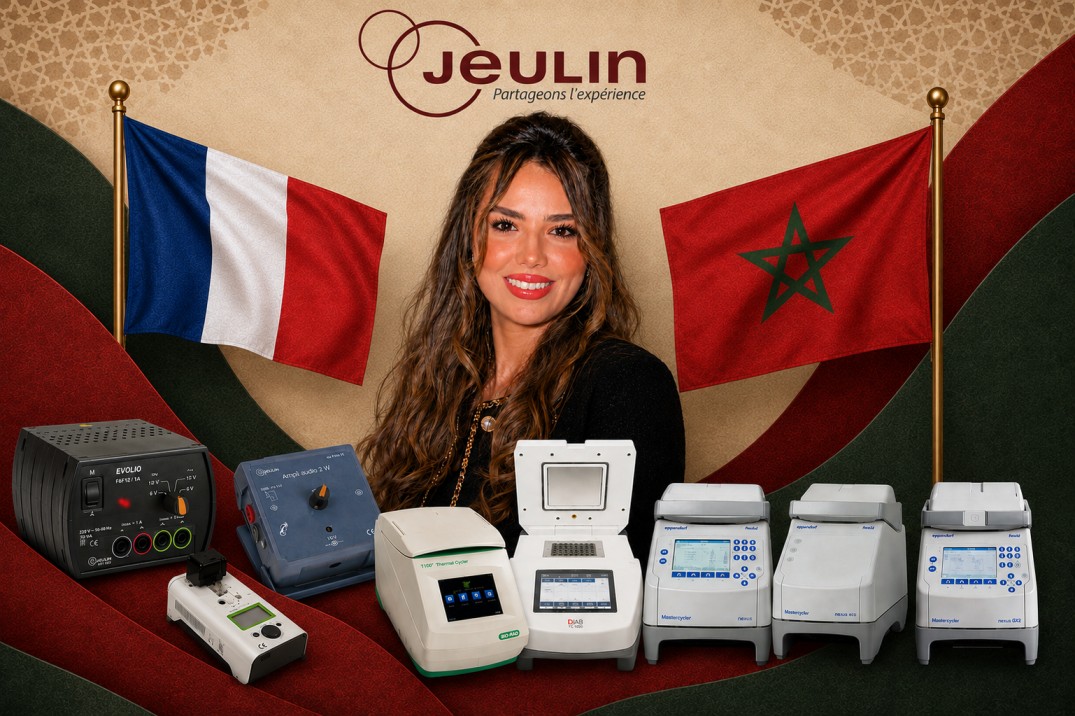
French educational technology company Jeulin is expanding into Morocco to supply schools, engineering colleges and universities with science equipment and laboratory solutions. The company has more than 100 years of experience supplying European laboratories with teaching equipment, practical tools and experiment kits. Hajar Hassine is Jeulin’s official representative in Morocco.
Jeulin will hold an education forum in November 2026. University leaders, engineering lecturers, researchers and laboratory managers will attend the event to see new teaching equipment and discuss practical teaching methods used in European institutions. The forum will also give participants a chance to share ideas on improving hands-on science teaching.
Jeulin makes laboratory equipment, software and furniture for different scientific fields.
Its computer-assisted experimentation (CAEx) range includes the Foxy and AirNeXT systems, as well as Redy wireless Bluetooth sensors. These tools measure temperature, pH, pressure, voltage, conductivity, carbon dioxide (CO2) and dissolved oxygen in real time.
The company also offers physics equipment such as Ovio optical benches for light experiments, air tables for motion studies, and teaching kits for laser optics, interferometry, polarimetry and electromagnetism.
For life sciences, Jeulin supplies the PhorEasy electrophoresis system, which separates DNA samples in less than 15 minutes. Its product range also includes PCR thermocyclers for genetics lessons, binocular stereomicroscopes and thin-section rock collections for geology classes.
The company also provides robotics and automation tools, including the Groomy controller and educational platforms from Makeblock and Thymio. Teachers and students can also carry out virtual experiments through the plateformenum.jeulin.fr platform alongside practical laboratory work.
Education authorities in Morocco have increased their focus on practical science teaching in recent years. Programmes such as the MicroLab ExAO initiative have introduced computer-assisted experiments into schools and universities.
Field studies show that more than 58% of surveyed high schools in the country now have CAEx acquisition interfaces and sensors. Demand continues to grow for laboratory equipment, sensor upgrades, maintenance services and teacher training.


