

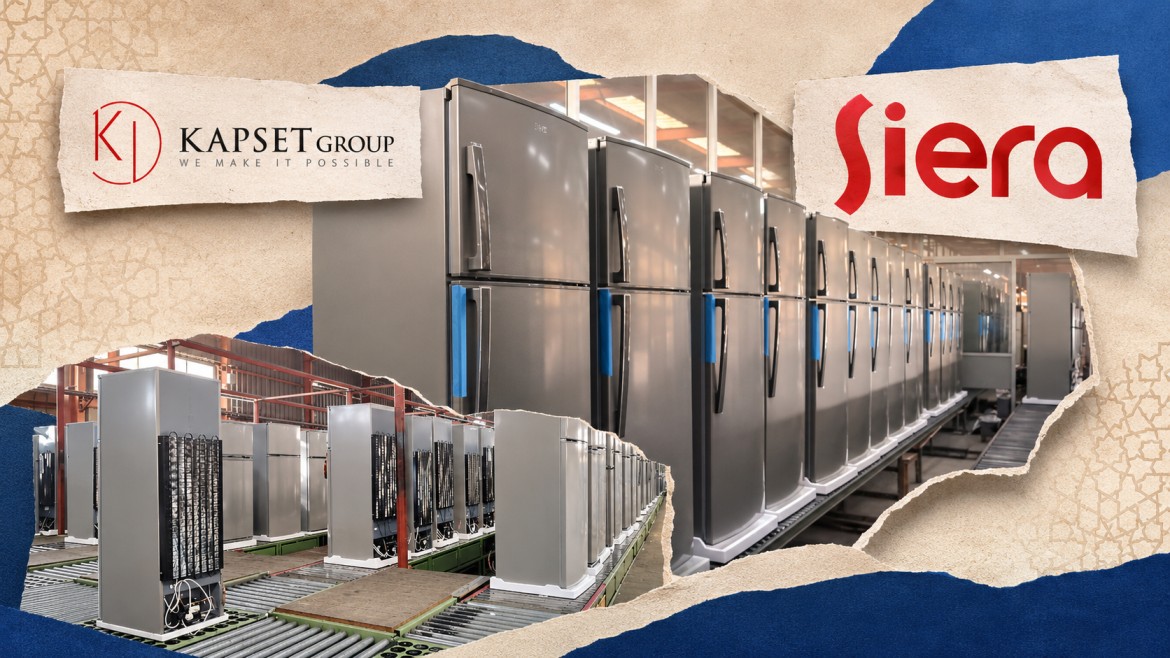
A familiar name in Moroccan homes could be entering a new chapter after property developer KAPSET Group agreed to buy household appliance maker Manar and its Siera brand.
The deal, announced on Thursday, 12 November 2026, marks KAPSET’s first move into industrial manufacturing after 14 years in real estate development and asset management.
The agreement has been submitted to the Competition Council for approval. The acquisition will be handled through KAPSET Industries, a newly created subsidiary set up to oversee the group’s industrial investments.
The purchase price, financing arrangements and planned investment in Manar’s factories have not been disclosed. The deal cannot be completed until the regulator gives its approval.
Manar, formally known as Manufacture Marocaine d’Appareils Électroménagers, is described by KAPSET as the country’s only domestic manufacturer of household appliances. Its Siera brand has been sold in Morocco for decades, with products including refrigerators, freezers, washing machines, cookers and televisions.
The company has kept its manufacturing base in Casablanca despite several ownership changes and restructuring operations over the past two decades.
Founded in 2012, KAPSET Group has built its business around commercial property, logistics parks, hospitality and residential development.
Through its subsidiaries, Al Arsat Immobilier and KAPSET Properties, the group has developed several major projects, including Seven Square Anfa in Casablanca, Seven Plaza Zenata shopping centre and Seven Park Ouled Saleh logistics platform.
Its tenants include professional services firm Deloitte, retailers Carrefour and BIM, lender Crédit du Maroc and hotel operator Eurostars Hotels.
The acquisition could allow KAPSET to use its existing property and commercial relationships to support Manar. Seven Park Ouled Saleh, for example, could help with appliance storage, spare-parts distribution and transport. Its relationships with Carrefour and BIM could also offer potential sales opportunities for Siera products.
Hypermarkets and discount retailers are important sales channels for affordable and mid-range household appliances in Morocco.
KAPSET’s move also reflects a wider trend among Moroccan property developers seeking to diversify beyond real estate. Some groups have expanded into logistics, healthcare, education and light manufacturing to develop new sources of income.
The acquisition comes as domestic appliance manufacturers face strong competition from international brands. European companies such as BSH, Whirlpool and Groupe SEB compete alongside Turkish producers Arçelik-Beko and Vestel, as well as Asian manufacturers Samsung, LG, Haier and Midea.
Imported products supply the overwhelming majority of household appliances sold in Morocco.
Local production is largely focused on assembling products and making basic components through metal stamping and plastic moulding. Factories remain dependent on imported compressors, electronic control boards and specialised steel.
Morocco’s appliance industry developed behind high import barriers during the 1970s and 1980s. But trade agreements later exposed local manufacturers to greater foreign competition.
The association agreement with the European Union was phased in between 2000 and 2012, while a free trade agreement with Turkey came into force in 2006. Both arrangements allow qualifying European and Turkish products to enter the Moroccan market without customs duties.
The increased competition forced several local assembly plants to close or reduce operations. Manar survived several rounds of restructuring while keeping the Siera brand active in retail outlets.
The acquisition comes as the government seeks to reduce dependence on imported consumer goods and expand domestic manufacturing through its Made in Morocco industrial strategy.
Customs duties on some finished consumer products imported from countries without preferential trade agreements have risen to between 30% and 40% under recent Finance Laws. By comparison, duties on some industrial components are generally between 2.5% and 10%.
This difference can give manufacturers assembling products locally a price advantage over finished appliances imported from countries such as China.
However, qualifying products from the European Union and Turkey can still enter duty-free under existing trade agreements.
Industrial investors can also benefit from the New Investment Charter, introduced under Framework Law 03-22. Eligible projects involving industrial modernisation and job creation can receive government grants covering up to 30% of qualifying investment costs.
For every 100m dirhams invested in eligible factory upgrades or expansion, a company could receive up to 30m dirhams in state support, leaving 70m dirhams to be financed privately.
The Competition Council, chaired by Ahmed Rahhou, must examine the transaction before ownership can change.
The regulator reviews mergers under Law 104-12 on Freedom of Prices and Competition, as amended by Law 40-21.
Companies must seek approval when a transaction meets at least one of three thresholds: combined worldwide annual turnover exceeding 1.2bn dirhams; combined annual turnover in Morocco of more than 400m dirhams for at least two companies involved; or a combined market share exceeding 40% in a relevant national market.
The standard initial review takes up to 60 calendar days. The period can be extended by 20 days if companies offer commitments to address competition concerns. A more detailed investigation can add another 90 days.
Based on the 12 November filing date, a standard review could finish by 11 January 2027. If the additional review periods are used, the process could extend until 1 May 2027.
The regulator is also expected to publish a public notice of the proposed acquisition, giving third parties 10 days to submit comments before the initial assessment is completed.
The move into manufacturing will expose KAPSET to financial pressures different from those of property development. Appliance production generally involves tight profit margins and significant working-capital requirements, as manufacturers must pay for components, production and stock before receiving payments from retailers and distributors.
Manar will also remain exposed to exchange-rate movements because many imported components are priced in euros and US dollars. The Moroccan dirham’s exchange-rate basket is made up of 60% euros and 40% dollars.
KAPSET is privately held, so its audited revenue and net profit figures are not publicly available. Manar’s financial performance and the value of the acquisition have also not been disclosed.
The challenge facing KAPSET is not unique to Morocco. Across North Africa and the Middle East, business groups have used income from property, retail and trading to expand into manufacturing.
Turkey offers an example of what a developed domestic appliance industry can achieve. Companies such as Arçelik, which owns Beko, and Vestel produce millions of appliances each year and benefit from established local supply chains for steel, motors and electronic components.
Egypt has taken a different route. Manufacturers such as El Araby Group and Fresh Electric have expanded through partnerships with international brands, access to foreign technology and a domestic market of more than 110 million people.
Tunisia has a smaller market of about 12 million people. Its appliance industry is more focused on final assembly and electrical subcontracting, with links to European supply chains.
These examples highlight the importance of production scale, local suppliers and access to export markets.
For Manar, the immediate challenge will be to compete with international brands while reducing its dependence on imported components. KAPSET’s logistics assets and retail relationships could help, but the company will still need to invest in factories, technology and production capacity.
The acquisition is therefore a test of whether Moroccan property capital can help revive domestic manufacturing in a market where imported products remain dominant.


