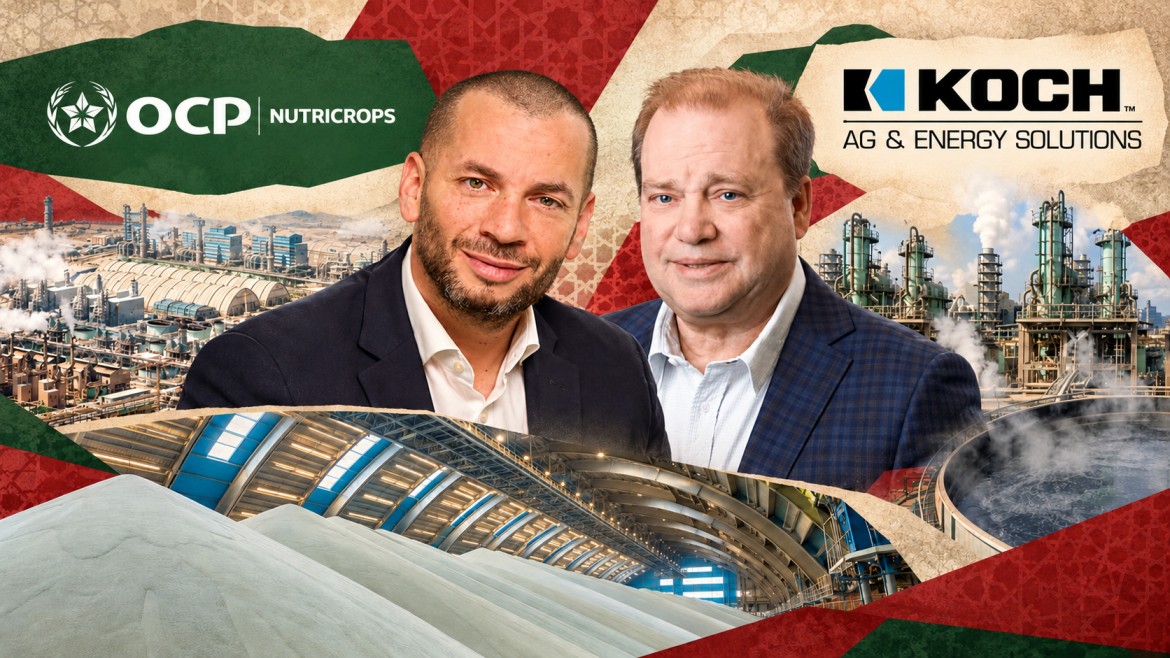
Farmers in the United States could gain another source of phosphate fertilisers as US industrial group Koch moves closer to taking a 50% stake in a major fertiliser plant in Morocco. The European Commission has approved the deal, which will give Koch joint control of Jorf Fertilizers Company I (JFC1), an OCP Nutricrops subsidiary based at the Jorf Lasfar industrial complex in north-western Morocco.
The plant can produce up to 1.2 million tonnes of phosphate fertilisers a year. Once the deal is completed, Koch and OCP Nutricrops will each own half of the company and share control of its operations.
The European Commission announced its approval on Friday, 30 October, under case number M.12624. It said the deal would not raise competition concerns because the planned joint venture would have a negligible presence in the European Economic Area.
The approval removes one regulatory obstacle, but it does not mean the transfer of shares has been completed. The remaining contractual and legal conditions must still be met.
The two groups announced the agreement on 17 July 2026. They have not disclosed how much Koch will pay, JFC1’s total value or how the acquisition will be financed.
JFC1 was established on 9 December 2014 and began operating in April 2015. Its facilities turn phosphate resources into fertilisers used by farmers around the world.
The plant produces sulphuric acid and phosphoric acid, before processing the latter into phosphate fertilisers. Its main products include diammonium phosphate (DAP) and monoammonium phosphate (MAP).
JFC1 has an annual capacity of 1.2 million tonnes of phosphate fertilisers. OCP’s 2025 reference document also lists a capacity of 1.1 million tonnes for DAP alone. The figures cover different product categories and are not contradictory.
The company’s fertiliser sales rose sharply in 2025. It sold 857,600 tonnes, compared with 291,000 tonnes in 2024, an increase of nearly 195%. Sales in 2023 stood at just 14,000 tonnes.
These figures represent sales recorded under JFC1’s accounts, not necessarily the amount produced by the plant during each year.
Koch’s planned entry comes as JFC1 prepares for a major change to its share capital.
The company’s capital stood at 3.25bn dirhams in OCP’s 2025 reference document. An extraordinary general meeting on 21 September authorised the possible buyback and cancellation of 27.5 million shares, each with a nominal value of 100 dirhams, according to financial information published on 20 October.
If all the shares are cancelled, JFC1’s capital would fall by a maximum of 2.75bn dirhams, leaving it at 500m dirhams.
That would represent an 84.6% reduction in its original share capital. It would not, however, mean the company had lost 2.75bn dirhams or that the shareholder would automatically receive that amount.
The reduction remains subject to the required legal procedures, including safeguards for creditors. The full minutes of the shareholders’ meeting and confirmation that the operation has been completed have not been published.
There is also no available document linking the proposed capital reduction to the price Koch will pay for its stake.
Second partnership between Koch and OCP
The JFC1 deal follows an earlier partnership between the two groups at the same industrial complex.
Koch completed the purchase of a 50% stake in Jorf Fertilizers Company III in June 2022. The company was later renamed Kofert and has an annual phosphate fertiliser capacity of around 1.3 million tonnes.
The purchase price was not disclosed.
Kofert sold 1.16 million tonnes of fertilisers in 2025, compared with 950,000 tonnes in 2024 and 879,000 tonnes in 2023. Its sales increased by 22% in 2025.
Together, Kofert and JFC1 sold just over 2.02 million tonnes of fertilisers in 2025.
Once the new deal is completed, Koch and OCP will jointly control two plants with a combined annual production capacity of around 2.5 million tonnes.
This figure represents the plants’ combined capacity, not a commitment to produce or export that amount. The agreement does not specify how much each shareholder can sell through its own distribution network or detail any related raw material supply contracts.
The partnership also gives the two groups an opportunity to expand their business in North America.
Koch Ag & Energy Solutions, part of privately owned US conglomerate Koch Inc., operates in fertilisers, energy, chemicals and commodity trading. Its businesses include Koch Fertilizer, which produces, supplies and distributes fertilisers.
Koch Inc. reports annual revenue of more than $125bn (over 1.15 trillion dirhams) and employs around 130,000 people worldwide. These figures cover the entire group, not just its fertiliser operations or its Moroccan joint ventures.
Under the July agreement, JFC1’s fertilisers can be sold internationally, including in North America. The arrangement builds on cooperation established in 2022, which also covers fertiliser distribution and the supply of key raw materials, particularly ammonia and sulphur.
Koch brings its international sales and distribution networks, while OCP provides the industrial capacity and phosphate resources.
Speaking when the deal was announced, Koch Fertilizer president Scott McGinn said: “This investment is based on the successful cooperation” established through Kofert.
OCP Nutricrops chief executive Faris Derrij described Koch as “a major player in the North American market” and said the partnership would help supply farmers in the region.
US temporarily suspends duties on Moroccan fertilisers
The US market has become particularly important following a decision by President Donald Trump to ease trade restrictions on Moroccan phosphate fertilisers.
On 29 June 2026, Trump declared an emergency over US phosphate fertiliser supplies and authorised the temporary suspension of certain countervailing duties on imports from Morocco.
The suspension can last for up to eight months, although it could end earlier if the emergency is lifted. The duties, introduced in 2021, have not been permanently removed.
The White House said US domestic production was not enough to meet the country’s full demand once exports by American producers were taken into account. It identified Moroccan phosphate fertilisers as one source that could help fill the gap.
The decision came 18 days before Koch and OCP announced their agreement on 17 July.
The timing highlights the commercial opportunity for the partnership, although there is no evidence of a direct contractual or institutional link between the US decision and the acquisition.
Both companies referred to the temporary suspension of duties in their July announcement, describing it as a positive development for supplying American farmers.
OCP sold around 858,000 tonnes of fertilisers in North America in 2025, down from 1.02 million tonnes in 2024, a fall of nearly 16%.
North America accounted for 6.6% of the group’s total fertiliser sales in 2025, compared with 8.3% a year earlier. These figures cover all OCP sales in the region and do not distinguish between JFC1 and Kofert.
OCP North America announced another development on 17 August, when a shipment of around 54,000 tonnes of triple superphosphate from Morocco arrived at the port of New Orleans.
The subsidiary said it had obtained the necessary customs clarifications before resuming the shipments. The cargo was part of OCP’s wider commercial activity, not sales by the planned JFC1 joint venture.
Ukraine approved the deal a day earlier
The acquisition has also gone through regulatory checks outside the European Union.
Ukraine’s Antimonopoly Committee approved the joint control of JFC1 by KAES Phosphate Holdings and OCP Nutricrops on Thursday, 29 October.
The application was filed on 18 September under reference number 15-01/790-ЕКк. The Ukrainian decision came one day before the European Commission’s approval.
The European Commission had received notification of the transaction on 7 October and published an initial notice in the Official Journal of the European Union on 19 October.
The notification identified KAES Phosphate Holdings as the buyer and confirmed that it would acquire shares in JFC1 to establish joint control with OCP Nutricrops.
The European Commission examined the deal under its simplified merger review procedure. It concluded that the transaction would not significantly affect competition in the European Economic Area because the future joint venture’s activities there would be negligible.
Ukraine had also fined two Koch companies on 20 October over a separate regulatory breach involving the earlier Kofert acquisition.
KAES Phosphate Holdings and Koch Ag & Energy Solutions were each fined 51,000 Ukrainian hryvnias, equivalent to around 11,000 dirhams, for completing that transaction without the required Ukrainian competition approval.
Those fines relate to the Kofert deal completed in 2022, not the proposed acquisition of JFC1.
The European Commission’s approval on 30 October marks another important step towards Koch’s second joint venture with OCP at Jorf Lasfar. The transfer of the shares, however, remains subject to the completion of the outstanding legal and contractual requirements.