

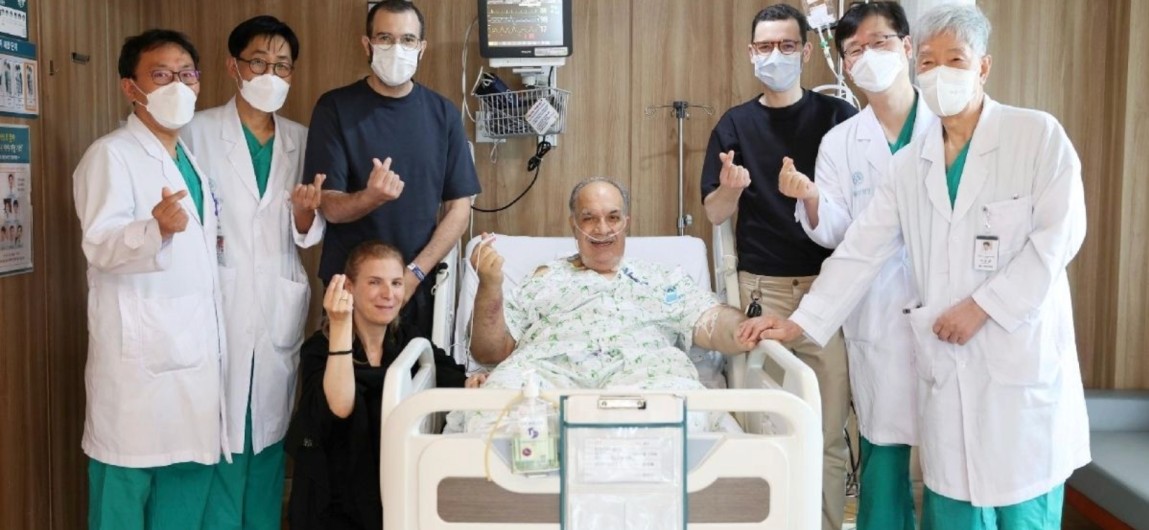
For 64-year-old Mohamed El Kettani, a liver transplant in France was no longer an option. His cancer had grown, and doctors removed him from the transplant waiting list. His two sons then looked for another way to save their father. They took him to Asan Medical Center in Seoul, South Korea, where doctors used part of each son’s liver for the transplant.
The operation took 17 hours and involved three operating rooms working at the same time.
El Kettani had lived with the effects of hepatitis C for years. The disease had caused cirrhosis and eventually liver failure.
Doctors found liver cancer in late 2025 while he was being assessed for a transplant in France. A 6cm tumour was found in February 2026, with the cancer also affecting the portal vein.
His condition meant he could no longer receive a transplant through the French system.
His sons, Hicham and Omar El Kettani, then turned to Asan Medical Center. Omar is a cardiac surgeon in France.
Their father weighed about 135kg. He needed a large liver graft, but taking enough liver from one donor would have put that person’s health at too much risk.
Doctors therefore took a smaller piece of liver from each son.
The surgery was carried out on 22 May. One of the sons also had a different blood type from his father, adding another challenge for the medical team.
Three operating rooms were used during the procedure. Doctors removed the patient’s damaged liver while other teams prepared the two donor grafts.
There was also not enough space under the diaphragm for one of the new liver sections. Surgeons moved the right kidney and adrenal gland to create more room.
The patient and both donors recovered well. El Kettani left hospital in August.
Asan Medical Center carried out the world’s first dual living donor liver transplant in 2000. The hospital has now performed more than 660 of these operations.
The procedure allows two people to donate smaller parts of their livers instead of one person giving a larger portion.
That can be important for heavier patients who need more liver tissue. Doctors usually need a graft equal to at least 0.8% to 1% of a patient’s body weight.
A single living donor cannot safely give an unlimited amount of liver. Using two donors can provide enough tissue while reducing the amount taken from each person.
Asan Medical Center says its living-donor liver transplant programme has a one-year graft survival rate of more than 97%.
El Kettani’s case also shows how transplant options can differ between countries. Some transplant systems have strict rules for patients with advanced liver cancer, especially when a tumour has reached a major blood vessel.
Specialist centres in Asia can sometimes use living-donor procedures for patients who no longer qualify for standard transplant programmes.
South Korea has become a major destination for patients seeking complex medical treatment, including living-donor liver transplants.


