

Morocco was the biggest buyer of Chinese tea in February 2026, taking 15% of China’s total exports that month, according to Chinese customs data. Japan and the United States followed, while Mauritania and Ivory Coast each took 7%. Germany imported 5%, and Russia just over 3%, with the value of its imports rising by 40% to $3.5 million compared with the previous month.
China exported around 419,000 tonnes of tea in 2025, helped by production in major provinces including Zhejiang, Anhui, Hunan, Hubei, Fujian, Jiangxi, Henan, Yunnan, Guizhou, and Sichuan. Zhejiang led the way, sending 185,000 tonnes valued at $560 million, followed by Anhui and Hunan. The total value of exports in 2025 reached $1.55 billion, up 8.9% on the year, while the volume of tea sent abroad rose by 11.9%.
For the year, Morocco was the top buyer of Chinese tea, followed by Senegal, Malaysia, Mauritania, Ghana, Ivory Coast, the United States, Japan, Uzbekistan, and Algeria. Together, these countries accounted for 60.5% of China’s tea export value. Morocco alone imported $280 million worth of tea in 2025, up nearly 15% from the previous year, including $10 million in December.
China also imported $1.8 billion worth of tea in 2025, mainly from Sri Lanka, India, Vietnam, Kenya, Taiwan, Thailand, Poland, Burundi, Uganda, and Myanmar, which together made up more than 90% of its tea import value.
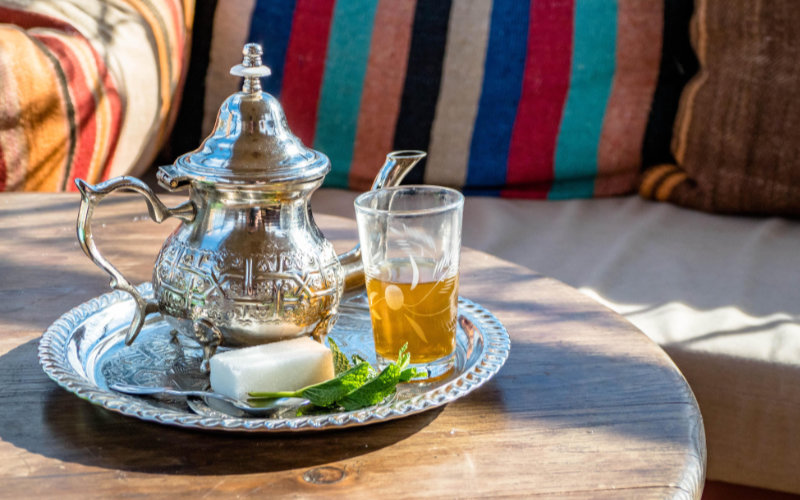
Morocco’s position as the world’s top Chinese tea buyer reflects a long history between the two countries. Chinese green teas, especially Gunpowder and Chun Mee, are at the heart of Moroccan mint tea, which is a key part of daily life and culture.
Tea first reached Morocco in the 18th century as a gift from European monarchs to Sultan Moulay Ismail. At first it was a rare luxury for the royal court, but in the mid-19th century, during the Crimean War, English merchants redirected surplus Chinese tea to Moroccan ports. Prices dropped, and tea quickly spread across Moroccan society.
Moroccans adapted the tea to their own taste, adding sugar and mint, creating the ritual of atai. Serving tea became a symbol of hospitality, with multiple rounds offered to guests. During the French and Spanish colonial periods, tea drinking also became a sign of cultural resistance.
Moroccan tastes are very specific. Gunpowder tea, rolled into small pellets, is strong and makes thick foam. It is popular in the north and south where it is boiled for a long time over coals. Chun Mee, with its thinner, softer leaves, is preferred in cities for its gentle flavour and light aroma. These teas mix perfectly with Moroccan mint and sugar, creating the golden-red colour that is the hallmark of atai.
Today, Morocco still relies almost entirely on Chinese green tea, consuming more than 70,000 tonnes every year. Many Moroccan companies now run processing and packaging units in China to ensure quality and keep prices stable. Meanwhile, China imports black tea from countries like Sri Lanka and Kenya to meet its own needs.