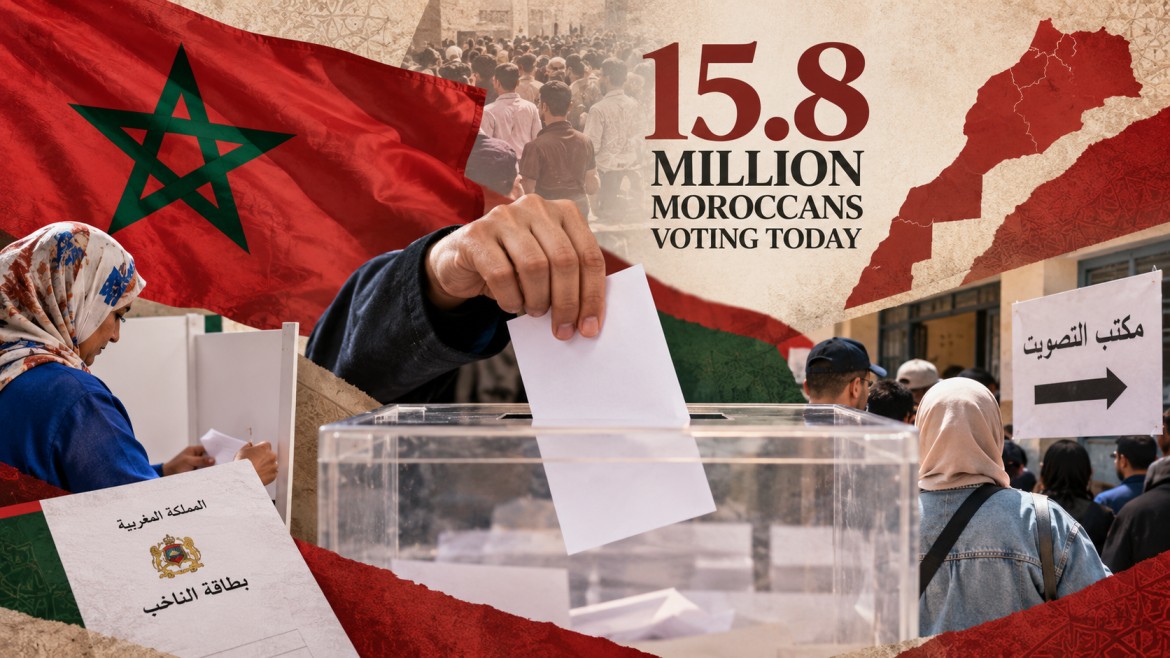
More than 15.8 million Moroccans are voting today, Wednesday 23 September, to choose the 395 members of the House of Representatives.
A total of 15,801,162 voters are registered for the country’s 12th parliamentary election since independence. They will choose between 7,288 candidates from 28 political parties, including an alliance created for this election, as well as two independent lists.
The candidates are running on 1,850 lists, with more than 18 candidates competing for each seat on average.
Voting is taking place at around 40,700 polling stations across the country.
The results will decide the new balance of power between political parties. They will also start the process of forming the next government.
Article 47 of the Constitution says the King appoints the head of government from the party that comes first in the House of Representatives election, based on the results.
The winning party will then have to negotiate with other parties to build a parliamentary majority.
The next government will face a long list of issues, including the 2027 budget, jobs, the cost of living, education, healthcare, water and major projects linked to the 2030 agenda.
Wednesday’s vote is different from the 2021 election.
In 2021, parliamentary, regional and local elections were held on the same day. This time, voters are choosing only members of the House of Representatives. Local and regional councils will remain in place.
The three levels have different responsibilities.
Local councils deal with services such as urban public transport, street lighting, waste collection and parking. Regional councils work on development and planning in their areas. MPs work at national level in parliament.
The difference will make voter turnout an important figure to watch. Voters in 2021 were choosing representatives at three levels. This year, only the parliamentary election is on the ballot.
Women make up 46% of registered voters, while men account for 54%.
Urban voters represent 55% of the electorate and rural voters 45%.
The age breakdown is more striking. Voters aged 18 to 24 make up only 4% of registered voters. Those aged 25 to 34 account for 15%. People aged 60 and over represent more than 29%.
Youth issues have been a major part of campaign programmes, including jobs, housing, training, entrepreneurship and political participation.
Women also account for a significant share of the candidates.
There are 2,658 female candidates, or 36.47% of all candidates. A total of 1,783 women are running on regional lists and 875 are running in local constituencies.
Women lead 121 of the local lists.
The election will also show how much parliament changes. A total of 227 sitting MPs are running again. Thousands of other candidates are trying to enter parliament or return after previously serving as MPs.
A total of 3,006 accredited observers are monitoring the election.
They come from national institutions, Moroccan associations and international organisations.
An International Republican Institute delegation is also observing the vote. The delegation is co-led by David Schenker, a former US assistant secretary of state, and Tami Longaberger.
The group will operate in areas including Dakhla-Oued Eddahab and Laayoune-Sakia El Hamra.
The election will decide who sits in the 395-seat House of Representatives for the next five years.
The next stage will be the formation of a parliamentary majority and a new government.
King Mohammed VI told MPs at the start of the final year of the current parliamentary term: “You are the representatives of the citizens.”