
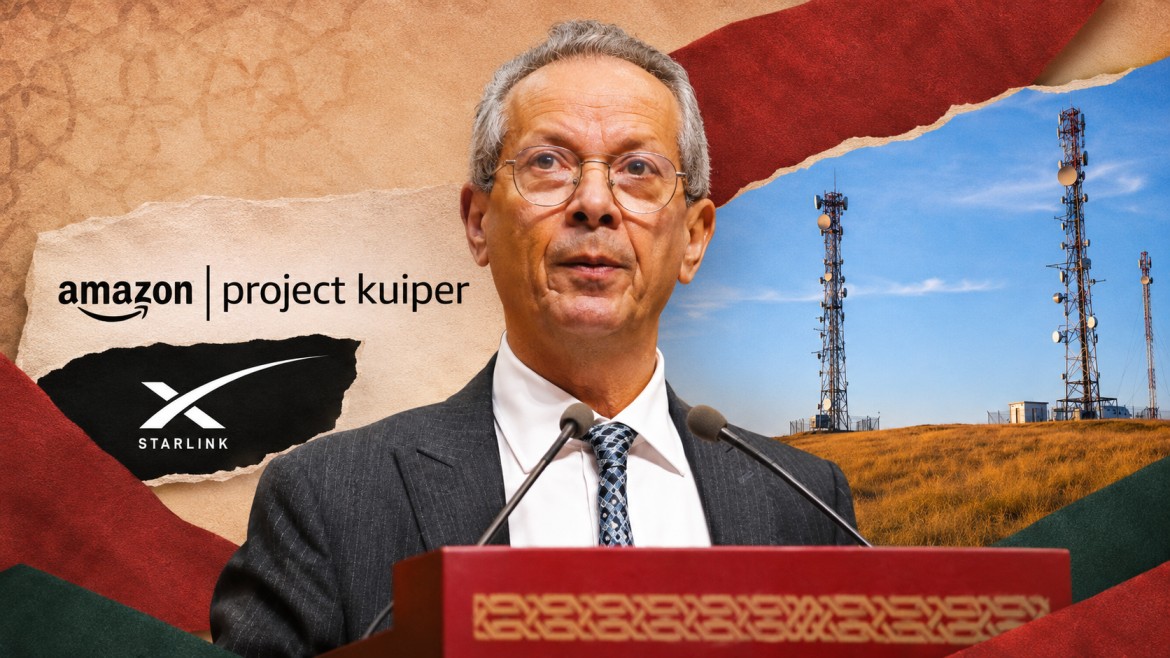
Imagine living in a village where your phone shows no signal, even though another mobile operator has a working network nearby. The government wants to change that by allowing customers to switch automatically between networks, while also exploring satellite internet to reach communities cut off from reliable connections. Artificial Intelligence, Digital Transformation and Administration Reform Minister Ahmed Rahhou says the government is considering new measures to improve mobile coverage and accelerate the digitisation of public services.
The proposals include a national roaming system that would allow subscribers to use another operator’s network when their own provider has no coverage, without paying extra or changing their existing tariff.
The government is also studying the use of satellite internet services, including Starlink and Amazon’s Project Kuiper, to connect remote areas where building traditional telecommunications infrastructure is too expensive.
Speaking during a weekly question session in the House of Representatives, Rahhou acknowledged that progress in digitising public administration and simplifying administrative procedures had not met expectations. He said the ministry was preparing a series of measures to speed up the process, including changes to the legal framework, wider use of digital identity and better information-sharing between government departments.
Mobile customers could switch between operators automatically
The proposed national roaming system would allow customers of Maroc Telecom, Orange Maroc and Inwi to connect to whichever network is available in an area, even if it belongs to a rival company.
For example, an Inwi customer travelling through a village where only Maroc Telecom has coverage could automatically use its network without changing their subscription or paying additional charges.
The system could also cover major roads and transport corridors, where uninterrupted mobile connections are important for motorists and passengers.
The ministry is studying a mechanism that would allow phones to switch automatically to an available network without requiring users to take any action.
The proposal addresses a problem in areas where the cost of building separate infrastructure makes it difficult for all three operators to provide coverage.
A mobile tower in difficult mountainous terrain can cost between $120,000 and $250,000 to build, including power and network connections. Yet rural customers typically generate only $4 to $6 in monthly revenue for operators.
This makes it difficult to justify building three separate networks in villages with small populations.
The government is therefore considering requiring the operator that already has infrastructure in an area to open its network to customers of competing companies.
The National Telecommunications Regulatory Agency (ANRT) is involved in examining the proposal. The financial arrangements between operators, however, have yet to be announced.
Around 2,000 areas face coverage problems
Rahhou said the ministry was reviewing a programme covering around 2,000 locations with poor or non-existent telecommunications coverage.
The assessment will examine three main problems: areas with weak internet speeds, places with no network coverage and communities served by only one mobile operator.
The minister said the ministry was ready to consider proposals from parliamentarians about areas facing these problems and could change the programme’s priorities following a field assessment.
The initiative follows earlier efforts to expand broadband access in rural areas.
The first phase of the National Broadband Plan targeted 10,740 rural locations. Its second phase focused on around 1,800 to 2,000 remaining areas where access to telecommunications services was still limited.
The latest review would reassess those locations and identify where improvements are most urgently needed.
The scale of the problem is not reflected in national subscription figures alone. The country has more than 55 million mobile subscriptions for a population of around 37 million, giving it a mobile penetration rate of more than 150%.
This does not mean that every person has a mobile connection. Many people have more than one SIM card, while some rural communities still struggle to get a reliable signal.
Internet penetration exceeds 90%, but access to fast connections remains uneven.
Fibre-optic broadband and 4G and 5G services are concentrated mainly along the Tangier-Casablanca-Marrakech-Agadir economic corridor. Parts of the High Atlas, Middle Atlas and Rif mountains, as well as remote southeastern areas, continue to experience weak 2G or 3G coverage or complete signal blackouts.
Starlink and Amazon satellites could reach isolated communities
Satellite internet is another option being considered for areas where conventional mobile networks are difficult or too expensive to build.
The ministry is examining possible cooperation involving Starlink, operated by SpaceX, and Amazon’s Project Kuiper.
Both services use networks of satellites orbiting relatively close to Earth to deliver internet access without relying entirely on ground-based cables and mobile towers.
The technology could help connect so-called white zones, areas where telecommunications companies have little financial incentive to invest.
The government has not announced any agreements with either company. Both services remain under consideration, and any deployment would require regulatory approval.
Satellite internet could be used to connect schools, health centres and community internet access points rather than relying on individual households to pay for the service.
It could also provide the connection between local mobile towers and the wider internet in areas where conventional infrastructure is unavailable.
The commercial cost remains an important consideration. Standard Starlink residential equipment is estimated to cost between $350 and $600, while monthly subscriptions range from $50 to $120 in international markets.
These prices could be beyond the reach of many rural households.
A government-supported system connecting schools, clinics and community Wi-Fi points could offer a more affordable alternative.
The ministry is examining these options in coordination with the ANRT.
Government acknowledges delays in digital administration
The telecommunications proposals come as the government seeks to make public services easier to access online.
Rahhou acknowledged that the digitisation of public administration and the simplification of administrative procedures remained below expectations.
The ministry plans to complete the legal framework governing digital administration by issuing the implementing decrees for Law 55.19, which concerns the simplification of administrative procedures.
It is also preparing a separate draft law on the digitisation of administrative services.
Law 55.19 was adopted in March 2020 and entered into force in September of that year. It was designed to reduce paperwork, set deadlines for government responses and prevent public administrations from asking citizens for documents already held by another government department.
Under the law, silence from an administration is treated as approval in certain cases.
The legislation also gave public administrations five years, until September 2025, to digitise their procedures.
The minister’s latest announcement indicates that the legal and practical work remains incomplete more than a year after that deadline.
The government now plans to help public administrations simplify and digitise priority services by providing financial support, technical assistance and guidance.
It also intends to continue developing shared digital platforms, including the Idarati portal and the National Directory of Digital Public Services.
The Idarati portal, launched in 2021, provides information about administrative procedures. The government wants to expand the system so that more services can be completed online rather than simply providing information about them.
Citizens could get help accessing online services
The government is also considering a new model called Dar Al Mouwatin, or Citizen’s House, to help people who struggle to use digital services.
The idea is to establish local service points where citizens can receive assistance with online administrative procedures.
The ministry is considering partnerships with payment institutions that already operate branches in towns and neighbourhoods across the country.
Potential partners include Cash Plus, Wafacash, Barid Cash and Damane Cash.
These networks could serve as local access points for government services, particularly for people who lack digital skills, reliable internet access or the necessary equipment.
The proposal remains at the planning and partnership-design stage. The government has not disclosed how the service would be financed or whether citizens would have to pay transaction or assistance fees.
The ministry also wants to improve the exchange of information between public administrations.
Better connections between government databases would allow officials to retrieve documents and information directly instead of asking citizens to visit several offices to obtain them.
The plans include expanding digital identity and electronic payments.
However, sharing personal information between government departments must comply with Law 09-08 on personal data protection and the rules overseen by the National Commission for the Control of Personal Data Protection (CNDP).
Training public employees and businesses
The ministry plans to organise training courses to help public-sector employees develop digital skills and adapt to changes in the way government services operate.
The courses will be organised through the Raed network, which focuses on digital training and change management.
The government also intends to expand the Digital Academy platform, which provides digital training for public administrations and small and medium-sized businesses.
These initiatives form part of the wider Maroc Digital 2030 strategy, launched in September 2024.
The programme has an allocated budget of 11bn dirhams, equivalent to about $1.1bn, for the 2024-2026 period.
Its objectives include placing the country among the world’s top 50 in e-government, training 100,000 digital specialists each year and expanding fibre-optic and 5G infrastructure.
Earlier national digital strategies included e-Maroc 2010, Maroc Numeric 2013 and Maroc Digital 2020.
However, successive programmes have faced similar problems, including poor coordination between government departments, delays in implementing regulations and difficulties connecting separate administrative databases.
Telecom regulator has previously fined Maroc Telecom
The proposed network-sharing system could have implications for the country’s three mobile operators.
Maroc Telecom, also known as Itissalat Al-Maghrib, is majority-owned by the UAE-based e& group, which holds 53%. The Moroccan state owns 22%, while the remaining 25% is publicly traded on the Casablanca and Paris stock exchanges.
The company operates an extensive network of mobile towers and fixed telecommunications infrastructure.
Orange Maroc is 49% owned by France’s Orange Group. The remaining 51% is divided equally between Moroccan investors FinanceCom and the state-owned Caisse de Dépôt et de Gestion (CDG).
Inwi is majority-owned by Al Mada, a pan-African investment fund controlled by the Moroccan royal holding company.
The ANRT has previously taken action over infrastructure-sharing disputes involving Maroc Telecom.
The regulator imposed a fine of 3.3bn dirhams in January 2020 over the company’s abuse of its dominant position in the local telecommunications market. It