

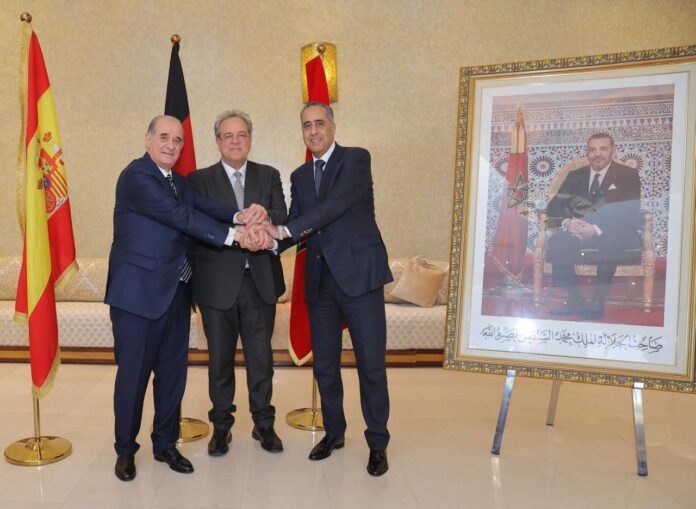
Top security officials from Morocco, Spain, and Germany gathered in Rabat on Thursday, January 8, for a high-level meeting aimed at strengthening trilateral cooperation on a range of cross-border security challenges. The summit marked a continuation of discussions first launched in Madrid in January 2025, underscoring the growing importance of coordinated action among the three nations.
Abdellatif Hammouchi, Morocco’s Director General of National Security and Territorial Surveillance, hosted his Spanish and German counterparts—Francisco Pardo Piqueras, head of Spain’s National Police, and Dieter Romann, Director of Germany’s Federal Police. Over the course of several meetings held from January 7 to 9, the officials assessed the current status of their collaboration and explored ways to deepen ties in the face of evolving security threats.
At the heart of the discussions were key issues such as counterterrorism, illegal migration, transnational trafficking, cybercrime, and the protection of major sporting events. The trio also examined the shifting security landscape in the Sahel-Sahara region and its ripple effects across the Euro-Mediterranean zone, highlighting the need for a unified response to shared risks.
One of the central outcomes of the talks was the reinforcement of coordination mechanisms, particularly through improved sharing of technical and operational intelligence. The delegations also explored opportunities to broaden the scope of their partnership, with special attention given to joint preparations for the 2030 World Cup, which Morocco will co-host alongside Spain and Portugal.
The meeting’s sports security component included a visit to the Prince Moulay Abdellah Complex, where participants were given an in-depth look at the infrastructure and safety protocols being developed for the 2025 Africa Cup of Nations. The tour featured demonstrations of advanced surveillance systems, crowd management strategies, and tactical deployment techniques used by Moroccan security forces.
Spanish and German officials were also welcomed at the African Police Cooperation Center in Rabat. There, they observed the center’s digital tools and intervention capabilities designed to support African and international liaison officers assigned to major sporting events.
This renewed momentum reflects a shared commitment to building stronger cross-border partnerships in law enforcement, with a focus on collective action and a harmonized approach to emerging threats.