
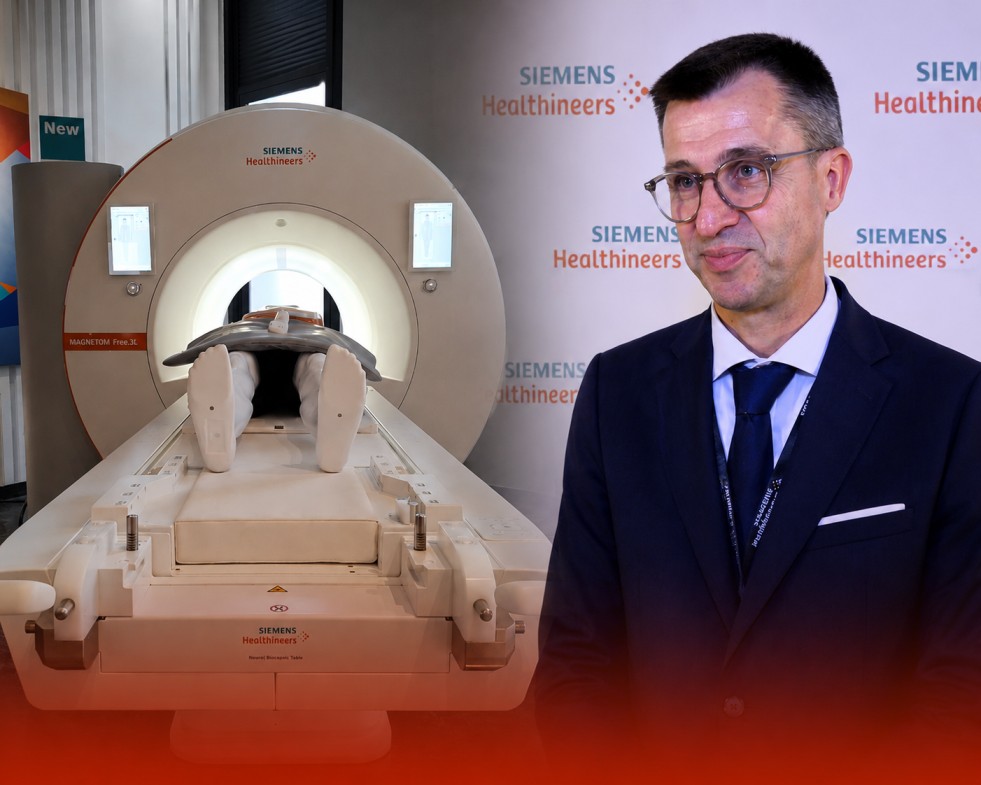
Imagine a doctor treating a tumour while watching live images from inside the patient’s body and without exposing anyone to radiation. That is the future Siemens Healthineers says is becoming possible through a new generation of MRI technology.
The technology was one of the main topics at Siemens Healthineers Morocco’s second Innovation Day in Casablanca, which brought together healthcare professionals from Morocco and experts from Germany, France, Saudi Arabia and the United Arab Emirates.
One of the event’s key presentations was delivered by Vincent Le Couls, an MRI specialist at Siemens Healthineers who works closely with radiologists and research partners to help bring new imaging technologies into everyday clinical use.
Le Couls focused on interventional MRI, a field that moves MRI beyond diagnosis and turns it into a tool that can help guide treatment in real time.
Today, MRI scanners are mainly used to detect and assess disease before a patient undergoes surgery or another procedure. With interventional MRI, doctors can perform procedures while watching live MRI images.
This allows them to guide a needle into a tumour, take a biopsy or carry out minimally invasive treatments while seeing exactly where their instruments are and what is happening inside the body.
One major benefit is that MRI does not use radiation, unlike CT scans and many conventional image-guided procedures. This reduces radiation exposure for both patients and medical teams.
MRI also provides a much clearer view of soft tissues than many other imaging methods. Doctors can more easily distinguish healthy tissue from diseased tissue and target treatment more accurately.
Another important feature is MR thermometry, which acts like a real-time thermometer inside the body. If a doctor is destroying a tumour using heat or cold, they can see temperature changes live on screen and stop treatment as soon as the target area has been treated, helping avoid damage to nearby organs and nerves.
During his presentation, Le Couls talked about Siemens Healthineers’ Deep Resolve technology. The AI-powered software uses deep learning and advanced neural networks to reconstruct MRI images from raw data.
According to the company, the technology can reduce brain MRI scan times by up to 70% while maintaining image quality. Faster image reconstruction is especially important during interventional procedures, where doctors need immediate visual feedback while carrying out a treatment.
Le Couls also discussed BioMatrix technology, which automatically adapts MRI scans to each patient’s body and physiology.
The system includes tools such as the BioMatrix Beat Sensor, which can automatically synchronise scans with a patient’s heartbeat without requiring ECG leads. Other BioMatrix features help improve image consistency in more challenging parts of the body.
Another focus was Siemens Healthineers’ MAGNETOM Free.Max scanner, part of the company’s High-V MRI platform.
Unlike traditional MRI systems that operate at 1.5 Tesla or 3 Tesla, the MAGNETOM Free.Max runs at 0.55 Tesla. While lower magnetic field strengths have historically meant lower image quality, Siemens Healthineers uses Deep Resolve AI to maintain high-quality images.
The scanner features an 80-centimetre patient opening, which the company says is the widest of its kind. This gives doctors more room to access and treat patients during procedures.
The lower magnetic field also reduces image distortions caused by needles, catheters and metallic implants, making it easier for doctors to see where their instruments are during treatment.
The system also uses DryCool technology and requires only 0.7 litres of sealed helium. This removes the need for complex helium venting infrastructure and can simplify installation in hospitals.
According to Siemens Healthineers, these technologies could support a range of applications including cancer treatment, brain procedures and heart interventions.
Beyond MRI, the event explored the growing role of artificial intelligence in healthcare and other imaging technologies.
Participants were introduced to the Naeotom Alpha photon-counting CT scanner, which uses QuantaMax detectors to count individual X-ray photons and provide highly detailed images while reducing radiation doses.
The company also marked 25 years of innovation in PET/CT imaging and showcased its latest digital systems, including the Biograph Trinion platform.