

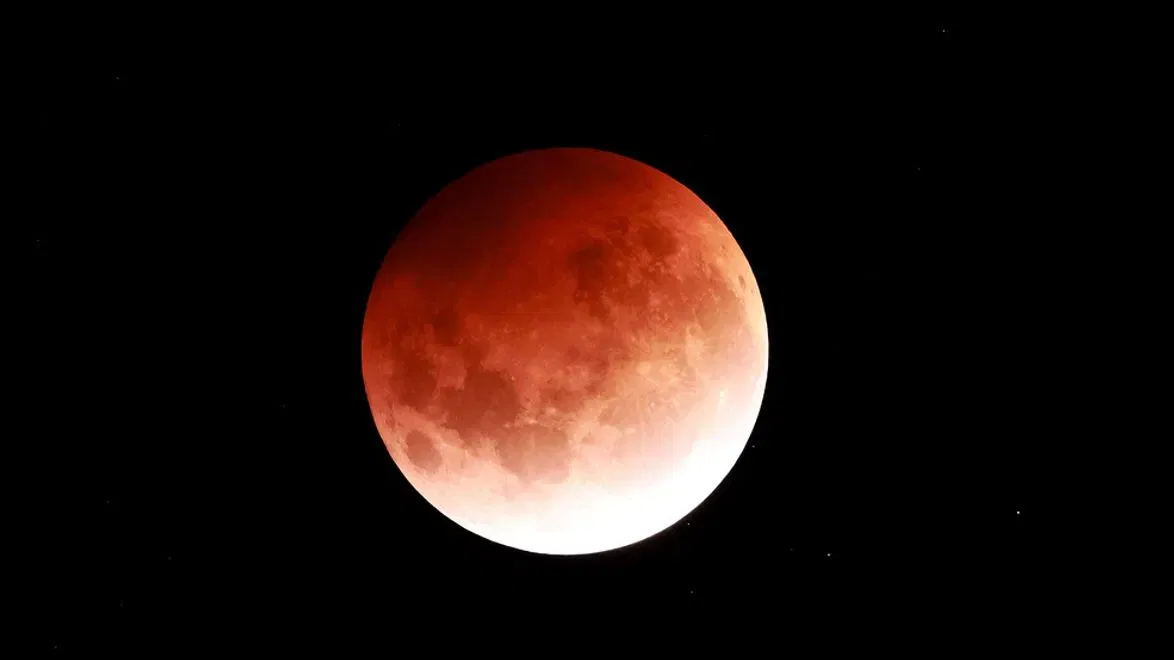
A partial lunar eclipse will be visible across Morocco early on Friday, with almost 94% of the Moon expected to pass through Earth’s shadow at the height of the event. The eclipse will begin with a penumbral phase at about 02:23 local time, when the Moon will start to appear slightly darker.
The partial phase will begin at around 03:33, as Earth’s shadow becomes clearly visible across the lunar surface.
The eclipse will reach its peak at about 05:12, when 93% to 94% of the Moon’s diameter will be inside Earth’s central shadow.
The partial phase will end at around 06:51, although the Moon will already be very low on the horizon in many parts of the country.
The event will be visible from several Moroccan cities, including Agadir, Casablanca, El Jadida, Fès, Marrakech, Rabat and Tangier.
Visibility will depend partly on local moonset times and weather conditions. In Casablanca, the Moon is expected to set at about 07:10, while it will set at around 07:13 in Marrakech, 07:00 in Tangier and 07:21 in Agadir.
Safe to watch
Unlike a solar eclipse, a lunar eclipse can be watched safely with the naked eye. Nasa says no special eye protection is needed because the light from an eclipsed Moon is not intense enough to damage the eyes. Binoculars or a telescope can be used to see the different stages in greater detail.
The eclipse will also be visible from parts of Africa, Europe and the Americas, according to Nasa visibility maps.
The reddish colour that can appear on the Moon during the eclipse is caused by Earth’s atmosphere. Blue light is scattered more strongly, while red light is refracted into the area of Earth’s shadow.
Morocco’s role in astronomy
The eclipse comes as Morocco continues to develop its role in astronomical research.
The Oukaïmeden Observatory, located at an altitude of about 2,750 metres in the High Atlas, is operated by Cadi Ayyad University in Marrakech. It hosts the robotic Morocco Oukaïmeden Sky Survey, known as MOSS.
The observatory has reported several discoveries in 2026, including near-Earth objects 2026 LS, 2026 GU2 and 2026 GW3.
According to the figures provided, the observatory has catalogued more than 4,762 celestial objects and sent 1.5 million astrometric measurements to the Minor Planet Center.
It also works with the UK-based SpaceFlux project to use artificial intelligence to track space debris that could pose risks to satellites.
Astronomy is also becoming a growing part of the tourism industry. Global stargazing tourism was valued at about $4.2bn in 2026, according to industry research cited by Dataintelo.
Guided stargazing tours account for the largest share of the market, followed by self-guided experiences, astronomy festivals and astrophotography packages.
“Formal dark sky certifications legitimize destinations and attract international visitor flows, validating stargazing tourism as a sustainable economic development pathway,” recent industry research by Dataintelo said.


