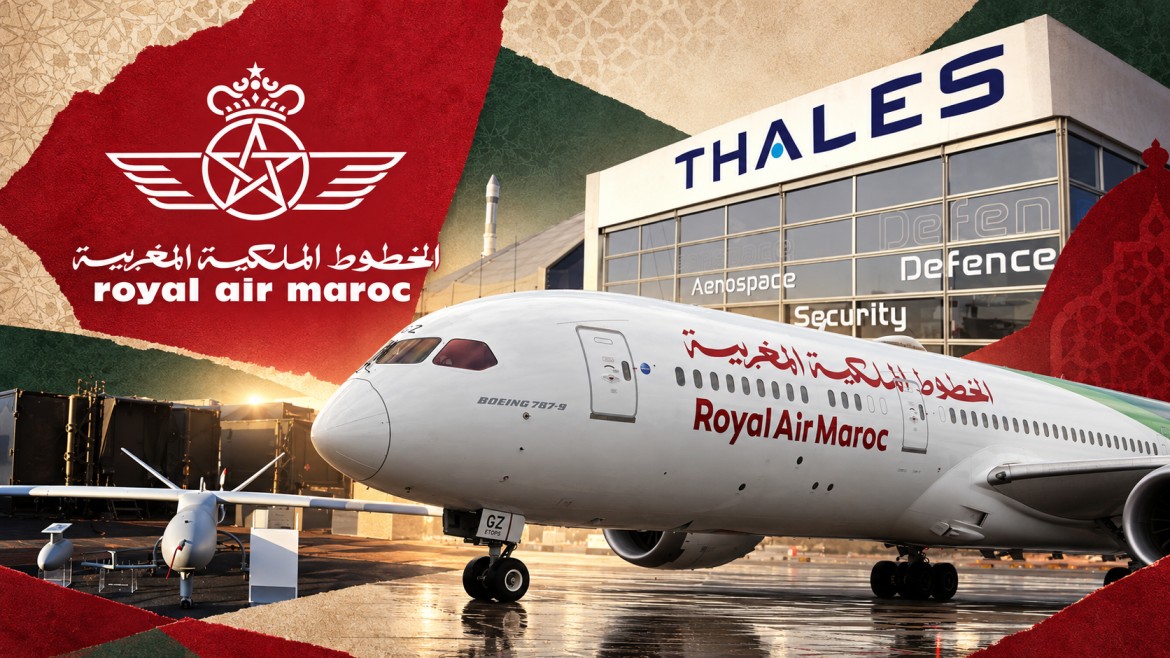
Royal Air Maroc is preparing for a much bigger fleet, and it is turning to digital technology to help manage the expansion. The national airline has signed a five-year agreement with French technology group Thales to replace paper-based cockpit procedures with digital tools, as it plans to increase its fleet to 200 aircraft by 2037.
The deal was announced on 8 October at the Marrakech Air Show 2026, held at the Royal Moroccan Air Force base in Marrakech.
Under the agreement, pilots will use AvioBook Flight, an electronic flight bag application developed by Thales subsidiary AvioBook. The software replaces paper flight documents with digital tools that help pilots plan flights, access weather information and calculate aircraft performance.
The system is designed to help planes spend less time on the ground between flights, improve operational efficiency and reduce fuel consumption.
Royal Air Maroc currently operates around 70 aircraft, although estimates put its fleet at between 50 and 70. Its long-term target is to reach 200 aircraft by 2037, nearly three times its current size based on the higher estimate. The expansion is part of a government-backed programme, with the airline expected to add an average of 15 aircraft a year through procurement plans in the coming years.
“We are proud to supply Royal Air Maroc with our flagship software solutions, perfectly aligned with the airline’s digitalisation and expansion ambitions as it plans to increase its fleet to 200 aircraft by 2037,” said Frédéric Dru, chief executive of AvioBook.
“We look forward to supporting its evolution by placing cutting-edge technology at the heart of its development,” he added.
Yan Levy, chief executive of Thales in Morocco, said the agreement reflected the company’s long-standing commitment to the country.
“This agreement demonstrates Thales’s long-standing commitment to Morocco and its support for the Kingdom’s ambitions,” he said.
“As Royal Air Maroc continues its fleet expansion and strengthens its role as a leading airline, we are proud to contribute to this momentum through scalable digital solutions that enhance competitiveness, operational excellence, and sustainability.”
“Through innovation and our local commitment, Thales remains fully aligned with Morocco’s vision for a modern, resilient, and globally connected aviation sector,” Levy added.
The deal builds on an existing partnership between the two companies. Thales already provides Royal Air Maroc with in-flight entertainment, maintenance and cybersecurity services.
Preparing for more passengers
The airline’s expansion is part of a wider effort to increase air travel capacity as the country prepares for more tourists and the 2030 FIFA World Cup, which it will co-host with Spain and Portugal.
The country aims to welcome 26 million tourists a year by 2030, compared with 17.4 million in 2024. It also wants to handle 31.6 million air passengers annually by 2037.
A $4.2bn programme to upgrade aviation infrastructure includes a $1.5bn expansion of Casablanca Mohammed V International Airport. The project aims to raise the airport’s annual passenger capacity from 10.5 million to 35 million by 2029.
Royal Air Maroc, which is based in Casablanca, operates Boeing 737 aircraft, Boeing 787 Dreamliners for long-haul routes and Embraer E190 regional jets.
Thales, a French group specialising in aerospace, defence and cybersecurity, reported sales of €22.1bn in 2025 and employs more than 85,000 people worldwide. It acquired AvioBook in 2017.
The digital system is intended to help the airline manage more aircraft and flights while cutting delays on the ground and reducing fuel use. These changes will become increasingly important as the airline expands its routes across Africa, Europe and the Atlantic.