
The dust hasn’t settled since Senegal clinched victory over Morocco in the 2025 Africa Cup of Nations final on January 18 in Rabat, a match defined less by its result than by the controversy that followed. While Senegal’s triumph should have been the headline, the real storm has come in the wake of the disciplinary decisions handed down by the Confederation of African Football (CAF), which many in Morocco view as biased, inconsistent, and politically motivated.
In the early hours of January 29, CAF announced its rulings, hitting Morocco with a raft of penalties that many observers describe as excessive. The Royal Moroccan Football Federation was fined $200,000 for what CAF called minor infractions, including an incident involving ball boys allegedly attempting to retrieve the towel of Senegalese goalkeeper Édouard Mendy. On top of that, another $100,000 fine was issued for supposed interference with VAR operations and unauthorized presence of Moroccan staff in the video review area.
Moroccan players Ismaël Saibari and Achraf Hakimi were handed three and two-match suspensions respectively, with no possibility for appeal. These heavy penalties come despite the chaotic circumstances surrounding the final, in which fault appeared to be shared by both teams.
But what has truly sparked outrage isn’t just what CAF chose to penalize; it’s what it chose to ignore.
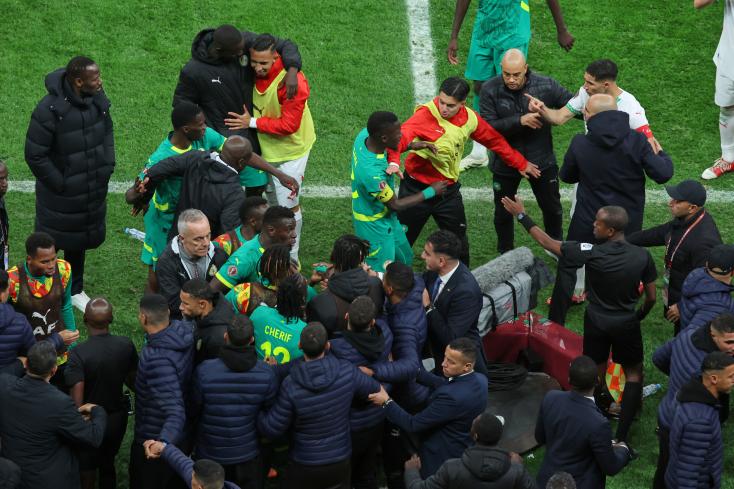
Central to the controversy is Senegal’s conduct during the match. At one point, the Senegalese team walked off the pitch, leading to a prolonged interruption. Such a move is highly irregular and, under CAF’s own rules, should have led to significant disciplinary consequences. Yet, CAF made no mention of the walk-off in its report, nor did it consider the act as match abandonment; a decision many believe sets a dangerous precedent.
For the first time in African football history, a team that left the field during a continental final has gone on to be crowned champion without any scrutiny of the game’s legitimacy. Critics warn this could embolden other teams to walk off in protest of refereeing decisions, knowing the punishment might only amount to minor fines or symbolic suspensions. By failing to firmly address the incident, CAF risks turning high-stakes football into a game of brinkmanship, where pressure tactics replace rules, and credibility erodes under the weight of political maneuvering.
Senegal’s head coach, Pape Bouna Thiaw, who reportedly encouraged his players to leave the pitch and fueled fan unrest, received a mere five-match suspension for “unsportsmanlike conduct.” Two Senegalese players, Iliman Ndiaye and Ismaïla Sarr, were also suspended (just two games each) for verbally attacking the referee. There was no mention of official match abandonment, no legal classification of the walk-off. The heart of the issue was effectively swept aside.
Moroccan media outlets have responded with uniform indignation. Le Matin described the sanctions as “incomprehensible,” while journalist Maama Maoulainine of Medi1TV said the CAF’s decision “hurt more than the defeat itself.” Former beIN Sports broadcaster Mohammed Ammor pointed out the stark imbalance: a Moroccan player gets three games for chasing a towel, while a coach who walked out of a final gets just five.
The idea that politics played a role in the verdict is gaining ground. Le360 accused CAF of deliberately avoiding the central question (the Senegalese team’s mid-match departure) in order to protect the tournament winner’s reputation while giving the illusion of fairness. According to them, CAF chose to focus on peripheral issues to distract from the core transgression.
Adding to the frustration is the perception that CAF artificially expanded Morocco’s share of the blame in order to create a sense of balance. Despite widespread praise for Morocco’s organization of the tournament, the country has become the main target of sanctions. Observers say the line between genuine misconduct and logistical or emotional outbursts has been blurred, with Morocco paying the price for keeping the event running smoothly.
Another unresolved question fueling the outrage: why didn’t CAF refer these disciplinary actions to FIFA for potential extensions to other competitions? As it stands, Senegalese players will still be eligible for the next World Cup qualifiers. This decision further cements the perception of preferential treatment and a system that punishes disproportionately.
From the stands to the press rooms to social media platforms, frustration is boiling over. For many, the real issue now is the legitimacy of CAF itself. Already criticized for a lack of transparency and unclear decision-making, the body has once again exposed itself to doubts. Its regulations (clear on paper when it comes to match abandonment) now appear open to selective interpretation.
Across Rabat, Casablanca, and the wider African football world, one unsettling question remains: what becomes of sporting justice when image, politics, and perception interfere with the rule of law? The 2025 AFCON was supposed to showcase the best of African football. Instead, it has left behind the bitter taste of a tournament overshadowed by opaque rulings and a crisis of credibility at the very top of the sport.