Spanish companies are doing more than moving production to Morocco to save money. They are now using the country to manufacture goods, reach European and African markets, and take part in major infrastructure projects. An analysis by Spanish risk and intelligence consultancy ACK3, published in an interview with Diario AS, describes a growing change in the way Spanish companies invest in Morocco. Lower production costs remain important, but companies are also looking at factories, transport links, suppliers, export routes and access to new markets.
More than 350 Spanish companies have direct operations in Morocco, according to Spanish government figures. Their investments are worth nearly €2bn and have created 27,655 direct jobs.
Spain and Morocco trade more than €22.5bn worth of goods and services each year. Spain is Morocco’s largest trading partner worldwide and its biggest trading partner in Africa. Morocco is also Spain’s third-largest trading partner outside the EU, after the United States and the United Kingdom.
The automotive industry is one of the strongest links between the two economies.
Companies such as Gestamp, Grupo Antolín, CIE Automotive and Ficosa operate in Morocco. More than 90 companies from the Basque automotive industry also supply Moroccan factories.
Spanish companies produce metal body structures, chassis parts, vehicle interiors, wiring, seats, lighting and vision systems. They supply factories linked to major carmakers, including Renault in Tangier and Stellantis in Kenitra.
Spain exports more than €1.4bn worth of automotive equipment and components to Morocco every year. Morocco exports about €658m worth of automotive products to Spain.
Automotive products and vehicles now make up a major part of Moroccan exports. The sector accounts for 32.9% of total exports, compared with 21.3% for phosphates and 18.5% for agri-food products.
The business relationship is also moving into transport.
Spain and Morocco signed a financial protocol worth more than €750m in February 2025. The agreement provides financing for Morocco to buy intercity and regional trains.
Spanish manufacturer CAF won a contract worth about €600m to supply 40 intercity trains. The trains can reach speeds of up to 200km/h and will be used by Morocco’s national railway operator, ONCF.
The deal is CAF’s first major project in Morocco and comes as the country expands and upgrades its railway network.
Spanish companies are also targeting the logistics sector.
Spain was the official country of honour at the Logismed trade fair in Casablanca from 12 to 14 May 2026. Spain’s trade and investment agency ICEX brought 27 Spanish logistics and port companies to the event.
The companies were looking to build business links along the shipping routes connecting Spanish ports such as Algeciras, Valencia and Barcelona with Moroccan ports including Tanger Med and the developing Nador West Med.
The logistics sector is part of a wider effort to bring European production closer to European markets and reduce dependence on supply chains in Asia.
Agriculture and food processing are another important area.
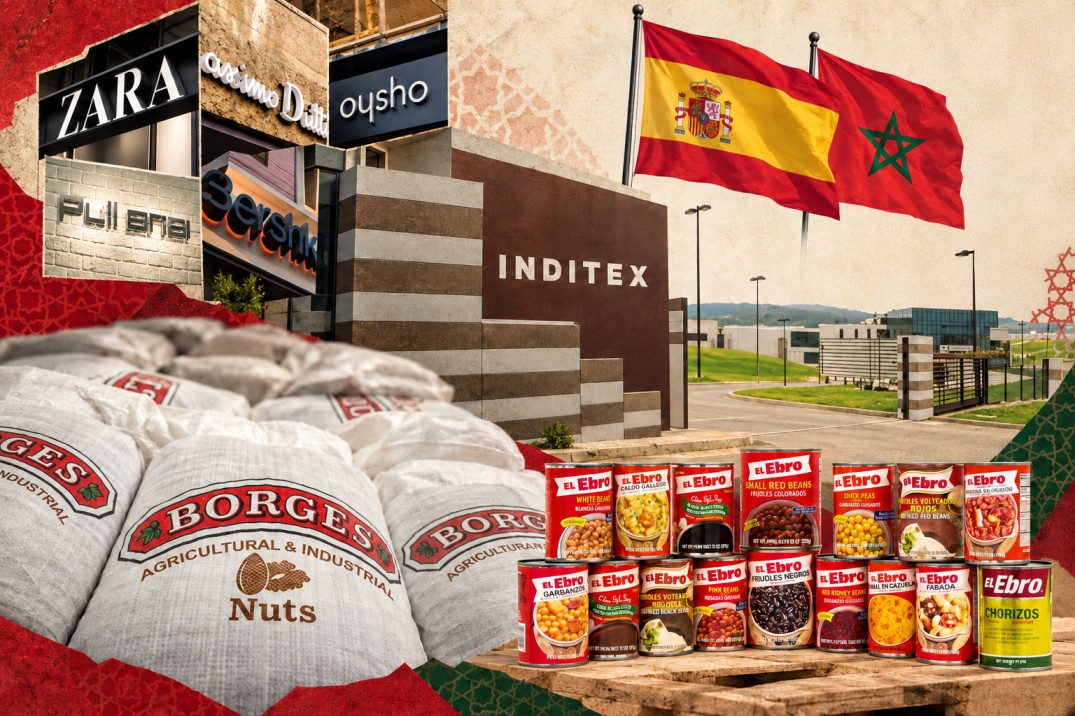
Around 10% of Spanish companies operating in Morocco work in agri-food, according to the information provided. Spanish companies produce and process rice, nuts, olive oil, canned vegetables, citrus fruit, strawberries, blueberries and aquaculture products.
Companies such as Ebro Foods, Borges Agricultural & Industrial Nuts and specialised greenhouse operators have production activities in Morocco. More than 35 major Spanish agri-food groups have land concessions or processing plants in the country.
Spanish companies use Morocco to serve local consumers as well as European and wider African markets. The climate, production costs and irrigation infrastructure are among the factors attracting investment.
The textile industry has followed a similar path.
Morocco has become an important nearshoring base for Spanish fashion companies. Inditex, which owns Zara, Pull&Bear and Massimo Dutti, as well as Mango and Tendam, use Moroccan suppliers and factories to produce clothing, denim, technical textiles and footwear.
Spain imports more than €1bn in clothing and finished textiles from Morocco each year. Inditex works with dozens of Moroccan suppliers and factories, helping the company maintain short production cycles of around 15 days from design to store.
Energy and water are also attracting Spanish investment.
Spanish companies including Acciona, Iberdrola, Abengoa and Elecnor work on renewable energy, water and other infrastructure projects. Their activities include solar power, wind energy, green hydrogen projects and desalination.
Acciona built the Agadir desalination plant, which can produce 275,000 cubic metres of water a day for drinking and agriculture.
Spanish renewable energy companies are also taking part in Morocco’s plan to increase renewable power capacity to 52%.
Transport is another growing area. Spanish company Alsa operates urban bus networks in Casablanca, Rabat and Tangier and carries more than 300 million passengers a year.
The 2030 FIFA World Cup is expected to create more business opportunities.
Morocco, Spain and Portugal will jointly host the tournament. The preparations are creating projects involving roads, railways, ports, airports, water systems, energy and urban development.
Spanish companies are seeking contracts in these areas, as well as opportunities in digital services and construction.
The wider investment trend is also visible in foreign direct investment. UNCTAD’s World Investment Report 2026 puts Morocco’s FDI inflows at $3.3bn, compared with $1.5bn for Algeria.
The figures point to a wider change in the economic relationship.
Spanish companies are no longer looking at Morocco mainly as a place for cheap production. They are building factories, buying from local suppliers, using transport links, selling to local customers and exporting products to other markets.
That makes Morocco part of the wider production chain rather than simply a place where Spanish companies outsource work.