

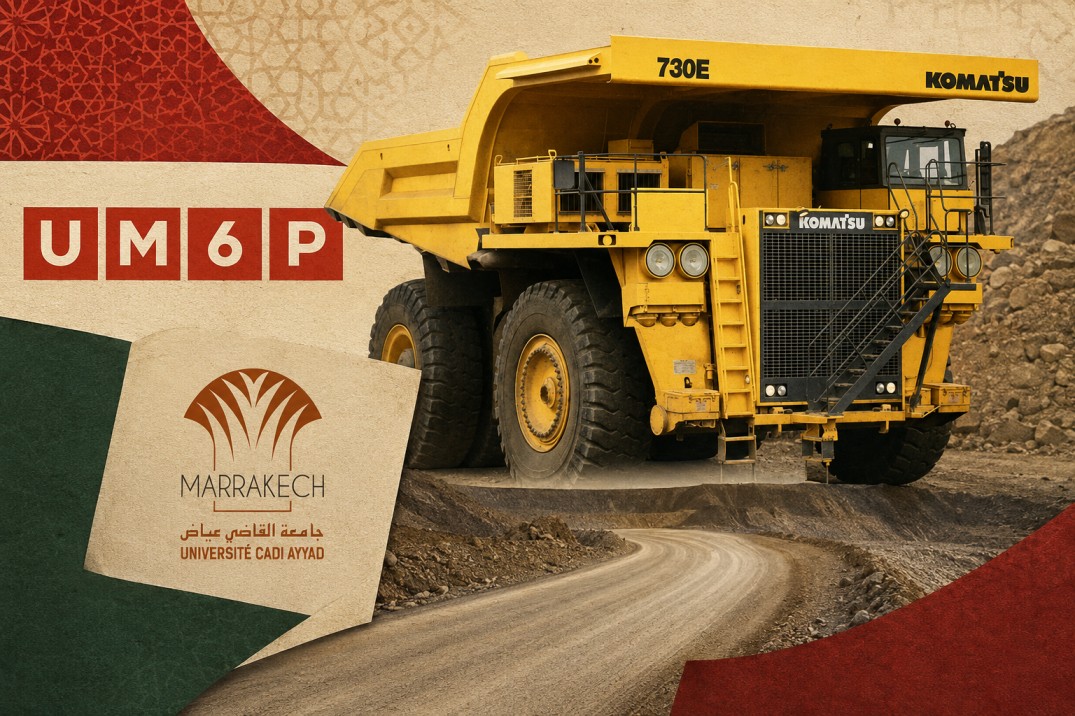
A team of researchers in Benguérir has built a mine haul road using only phosphate waste rock. Tests showed the road cut dust by 91%, let trucks drive twice as fast and needed no major maintenance for two years.
Researchers from Mohammed VI Polytechnic University (UM6P) and Cadi Ayyad University developed the road and tested it at the Benguérir mine. The study was published in the scientific journal Mining.
The project shows that phosphate mining waste can be turned into strong haul roads without increasing costs.
Dust levels dropped by about 91%, beating the mine’s original target of 80%. Haul trucks also travelled at around twice their usual speed. The road stayed in good condition throughout a 24-month warranty period without major repairs.
The road is 67cm thick and has three layers.
The bottom layer is 35cm of crushed phosphate waste rock with pieces measuring 0-100mm. The middle layer is 25cm of crushed waste rock sized 0-63mm. The top layer is 7cm of asphalt concrete made with phosphatic chert and modified 35/50 bitumen.
Researchers used phosphatic chert because it is very hard and dense. The material is collected from rock layers after blasting at the mine.
The road also uses large, angular stones with only a small amount of fine particles. This helps the stones lock together and spread the weight of heavy trucks across the road.
Engineers tested the road with a Komatsu 730E haul truck, which can weigh up to 340 tonnes when fully loaded.
The truck carried out an emergency stop at about 40km/h, around twice the normal speed on mine roads. The braking force reached about 850kN. The test found no visible damage, including no tearing, rutting or separation between the road layers.
Building the road costs about €23.97 per square metre. The estimate assumes a crushing plant is within 5km of the site and an asphalt plant is within 25km.
An internal OCP review after 15 months estimated that using the roads across its operations could increase productivity by 15% each year.
Faster truck journeys, less wear on tyres and wheel motors, longer equipment life and lower road maintenance costs are expected to drive the gains. Lower dust levels also improve working conditions for drivers.
The project is part of OCP Group’s plan to reuse industrial and mining waste. The company produces millions of tonnes of waste rock and phosphogypsum every year and is looking for ways to use these materials in infrastructure instead of sending them to waste.
The work also supports projects backed by the International Finance Corporation (IFC) to reuse mining waste in agriculture, civil engineering and road construction.
UM6P is also researching other uses for phosphate byproducts, including recovering rare earth elements, extracting phosphorus from sludge and developing low-carbon building materials.


