
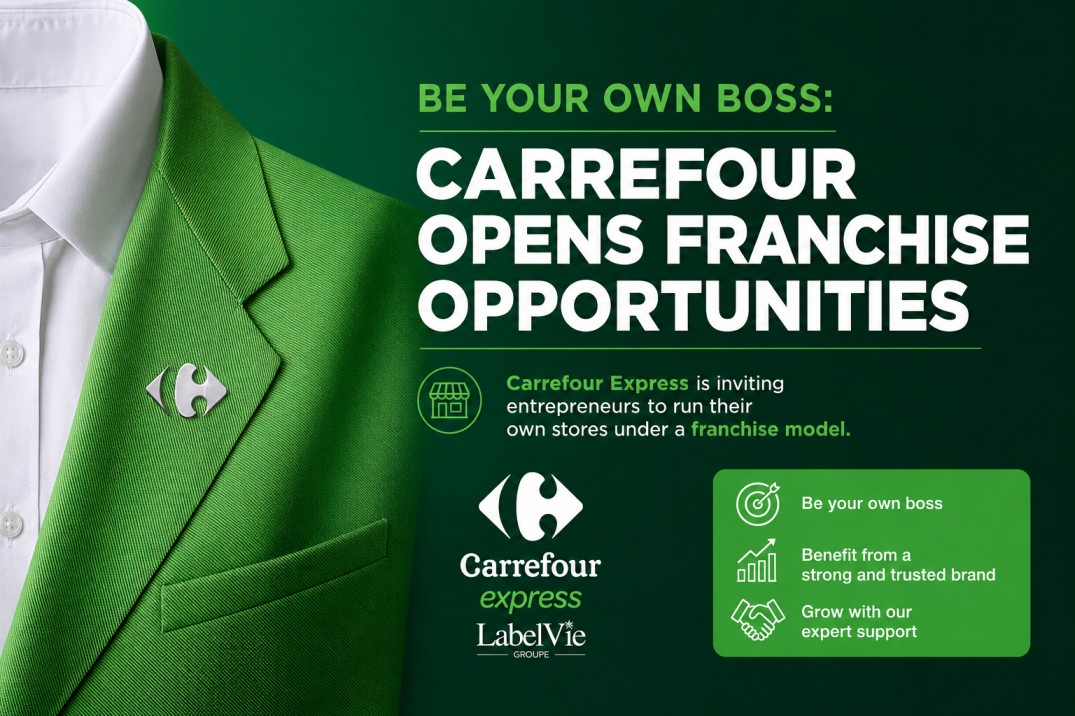
Moroccans who want to run their own neighbourhood supermarket can now do so under the Carrefour Express brand after retail group LabelVie opened the convenience store chain to franchise owners. Entrepreneurs will be able to open and manage Carrefour Express stores while receiving support from LabelVie, one of Morocco’s biggest retail groups.
The Carrefour Express format focuses on everyday shopping and is aimed at neighbourhoods and residential areas where customers want quick and easy access to groceries and household products.
Under the franchise model, store owners will run their businesses independently but will benefit from LabelVie’s experience, operating systems and brand recognition.
LabelVie said the model gives entrepreneurs access to a business concept that has already been tested in the market, helping reduce some of the risks that come with starting a new business from scratch.
The move comes as shopping habits in Morocco continue to change.
While traditional grocery shops, or hanouts, still dominate the market, modern retail chains are expanding across the country. Industry estimates show that modern retail accounts for around 15% to 20% of Morocco’s grocery market, while traditional stores still make up more than 80%.
LabelVie currently operates more than 150 stores across Morocco, including hypermarkets, supermarkets and convenience stores. Franchising could help the company open new locations more quickly without taking on all the costs itself.
Competition in the neighbourhood store market has also grown in recent years. Turkish discount retailer Bim now operates more than 600 stores across Morocco, pushing larger retail groups to strengthen their presence closer to where people live.
The trend is being driven partly by urban growth. More than 64% of Moroccans now live in cities, where many consumers prefer to shop several times a week at nearby stores instead of making one large monthly trip to a hypermarket.
The franchise sector is also growing. Industry figures show that franchising in Morocco has been expanding by nearly 10% a year, with grocery retail becoming one of the latest sectors to adopt the model.