

As the head of the Spanish Football Federation, Rafael Lozano, confidently declares that the 2030 World Cup final “will be played in Spain,” the race to host the tournament’s biggest match has taken a sudden, political turn. But behind Lozano’s bold assertion lies a very different reality-one that increasingly points to Morocco as the strongest and most credible contender to host the event.
Lozano’s statement came as a surprise to many, especially considering that no official decision has been made by FIFA or the organizing committees responsible for selecting the final’s host city. His announcement came well ahead of any formal meetings or deliberations, and before FIFA has named a stadium or even a country for the final of the tournament, which will be co-hosted by Spain, Portugal, and Morocco.
His remarks, widely circulated in the Spanish media, simply stated that “the final will take place in Spain”—with no mention of which stadium or city. This solo declaration coincides with efforts by some Spanish figures to cast doubt on Morocco’s readiness, using isolated incidents from the recent Africa Cup of Nations final between Morocco and Senegal as ammunition. However, those disruptions, attributed to a small group of Senegalese players and fans, were far from representative of Morocco’s overall hosting performance.
Lozano framed the events as damaging to the sport’s image, ignoring the broader context and the praise Morocco received for its exceptional organization throughout the tournament. In fact, the North African nation was widely applauded internationally for its safety measures, smooth logistics, and high-quality infrastructure. Critics say Lozano’s comments are an attempt to politicize a minor incident in order to weaken Morocco’s position—a move that comes across as both opportunistic and misleading.
What makes this posture even more questionable is the current state of Spanish football, which is grappling with serious internal issues. The Spanish federation has been marred by governance scandals, internal divisions, and a troubling surge in racist incidents within stadiums. In October 2024, FIFA issued an official warning to Spain, even suggesting that it could reconsider the country’s hosting role in the 2030 World Cup if improvements weren’t made.
Spain’s stadiums have seen repeated security lapses in recent years, from violent clashes in the stands to fans throwing objects at players and teams. One particularly troubling incident involved rocks being hurled at FC Barcelona’s team bus. Matches have been interrupted, and the authorities have struggled to maintain order in key fixtures.
And this is not just a Spanish problem. Europe’s organizational credibility took a hit during the 2022 Champions League final in Paris, where chaos outside the Stade de France delayed the match by 40 minutes. Issues ranged from counterfeit tickets to overcrowding and heavy police intervention, revealing cracks in even the most seasoned European football systems.
While Lozano points fingers at Morocco for so-called image issues, he omits the series of racist incidents that have rocked Spanish football. Brazilian player Vinicius Junior has been repeatedly targeted-by Albacete fans in January 2026, in Valencia in 2024 (where three fans were sentenced to eight months in prison), in Valladolid in 2025 (with five fans receiving one-year sentences), and in 2023 when a grotesque act involving a hanging doll wearing his jersey made international headlines. Those responsible received jail time of up to 22 months. The global outcry was swift, and FIFA itself openly condemned these acts.
Then there’s the scandal that forced the resignation of former federation president Luis Rubiales. In February 2025, he was fined €10,800 after being convicted of sexual assault for his unwanted kiss on player Jenni Hermoso following the 2023 Women’s World Cup final. The incident led to his suspension and eventual resignation, further damaging Spain’s football reputation at a crucial time.
With all this in mind, the question isn’t just where the final should be held, but which country has earned the right to host it. Based on recent performances, infrastructure, safety standards, and international reputation, Morocco is fast emerging as the most deserving and capable host for the 2030 World Cup final-despite the noise coming from its European counterparts.
Though Madrid’s iconic Santiago Bernabéu has recently undergone major renovations, the stadium has already become the subject of mounting criticism. Spanish media outlets have reported water leaks inside the venue during early autumn rains, with entire sections meant for fans and VIP guests affected. Real Madrid itself is said to have raised concerns about construction flaws, particularly related to waterproofing issues that appeared as early as fall 2025.
Adding to the doubts surrounding Madrid’s readiness, the city was recently shaken by a tragic train accident that claimed around 50 lives. The catastrophe has once again highlighted concerns about whether the city’s aging infrastructure could handle the enormous pressure of hosting a global event of this scale.
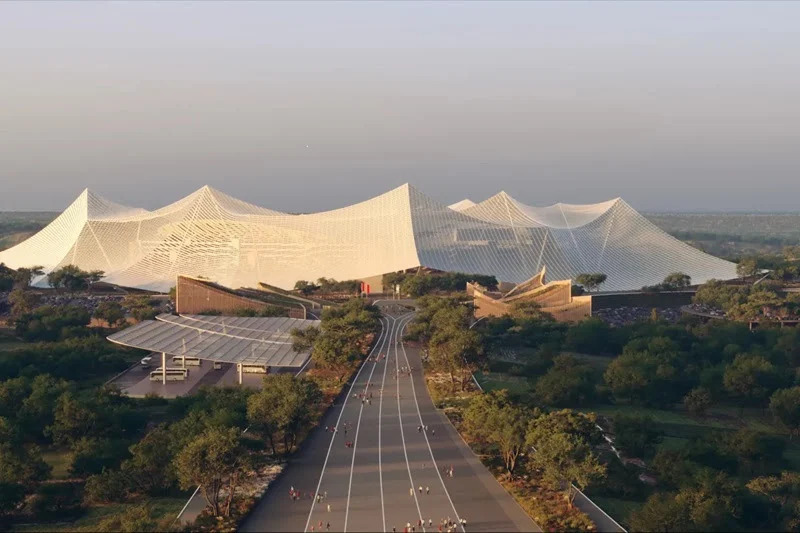
In contrast, Morocco has been making a much stronger case. The country is currently building what will become the largest stadium on the planet in Ben Slimane, a cutting-edge facility designed from the ground up to meet FIFA’s highest standards in terms of safety, technology, and capacity. This comes on the heels of Morocco’s widely praised hosting of the 2025 Africa Cup of Nations, during which the country showcased its growing organizational prowess and world-class infrastructure.
Even when issues arose during that tournament – namely, the controversial end to the final; none of the blame was placed on the Moroccan authorities or their logistics. The disruption stemmed from a voluntary withdrawal by the Senegalese players, not from any structural or operational failure on Morocco’s part.
In terms of performance, Morocco’s stadiums stood up impressively to the challenges posed by extreme weather. Despite heavy rains in recent weeks, none of the pitches flooded, and no matches were postponed or rescheduled due to weather – something that can’t be said for several European stadiums, including those in Spain, where rainfall often results in serious degradation and delays. Observers across the football world took note of Morocco’s resilient infrastructure, especially the Prince Moulay Abdallah Stadium, which delivered flawless pitch conditions throughout the tournament.
But Morocco’s strengths go beyond logistics. Geographically, the country offers a strategic bridge between Africa, Europe, and the Arab world – an ideal setting for a global final meant to unite continents. Africa has hosted the World Cup only once, in 2010 in South Africa, and after a 16-year wait, many feel the time has come to bring the final back to African soil. In the unique tripartite arrangement between Spain, Portugal, and Morocco, holding the final in Africa would offer the most balanced and symbolically powerful choice.
While declarations from national federations make headlines, the ultimate decision rests with FIFA. Yet when all key factors are weighed, state-of-the-art facilities, proven organizational capacity, safety, political stability, and historical symbolism; Morocco emerges not just as a viable option, but as the most compelling candidate to host the 2030 World Cup final.