

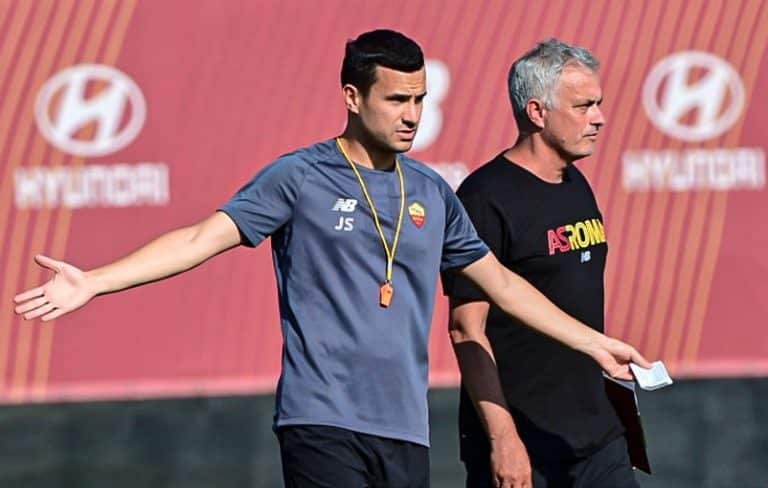
Morocco national football team have appointed João Sacramento as assistant coach to new head coach Mohamed Ouahbi, the federation has confirmed. The move was announced on 5 March during a press conference at the Complexe Mohammed VI.
Experienced tactician joins staff
Sacramento, 37, is a Portuguese coach who built his career as an analyst and assistant known for detailed tactical work. He was born on 31 January 1989 in Barcelos, Portugal.
He has worked at several top clubs across Europe, including LOSC Lille, Tottenham Hotspur, AS Roma, Paris Saint-Germain and Al-Duhail SC. He also served as head coach of LASK in 2025, before leaving the role in September by mutual agreement.
Earlier in his career, he worked with managers including Leonardo Jardim and Christophe Galtier.
A shift in style
Sacramento’s arrival suggests a move towards a faster and more direct approach. The focus is likely to be on vertical passing, quick transitions and structured pressing, rather than slow sideways build-up play.
Under this model, the team would try to move the ball from defence to attack in a matter of seconds, especially after winning possession.
Formation flexibility
He is known for systems that can switch during matches.
A base shape of 4-3-3 could turn into a 3-4-3 in possession. One fullback may push high, while the other moves inside to form a temporary back three. This creates balance, allowing the team to attack with numbers without becoming exposed at the back.
This structure would suit attacking fullbacks such as Achraf Hakimi and Noussair Mazraoui, giving them freedom to join attacks while keeping cover behind them.
Overload and switch play
One key idea is building play on one side of the pitch to draw opponents across, then quickly switching the ball to the opposite flank.
This can isolate a fullback in space, creating one-on-one situations. It also helps create clear passing lanes for quick attacks down the wing.
Pressing structure
Sacramento often uses a mid-block press. Instead of pressing constantly, the team waits for clear triggers such as a poor first touch or a backwards pass.
Once the trigger appears, players press together in a coordinated way. The aim is to win the ball high and attack immediately.
This suits energetic midfielders who can close space quickly and turn defence into attack.
Midfield roles
His preferred midfield structure often includes:
• One deep holding player to protect the defence
• Two advanced midfielders operating in the half spaces
The deep player anchors the team, while the other two support attacks and press high. This balance allows creative players to operate closer to goal while maintaining defensive stability.
The half-turn principle
Midfielders are encouraged to receive the ball already facing forward. This reduces delays and increases attacking speed.
The aim is to avoid safe sideways passes and instead look for forward movement as the first option.
Set pieces
Sacramento has a strong focus on dead-ball situations. Using data, he designs routines to exploit weaknesses in opponent marking systems.
Corners and free kicks are likely to be structured with clear blocking movements and targeted runs.
Training methods
Training sessions are expected to include:
- Restricted pitch zones to control passing patterns
- Tactical drills combined with physical work
- Scenario-based exercises that simulate match situations
The focus is on repetition, organisation and clear decision-making.
Overall impact
The combination of Ouahbi’s attacking approach and Sacramento’s tactical detail suggests a more aggressive, structured and data driven team.
If implemented successfully, Morocco would aim to control matches through speed, pressing and vertical play, while keeping defensive stability through planned structure rather than caution.
Further details about the coaching structure are expected in the coming weeks.