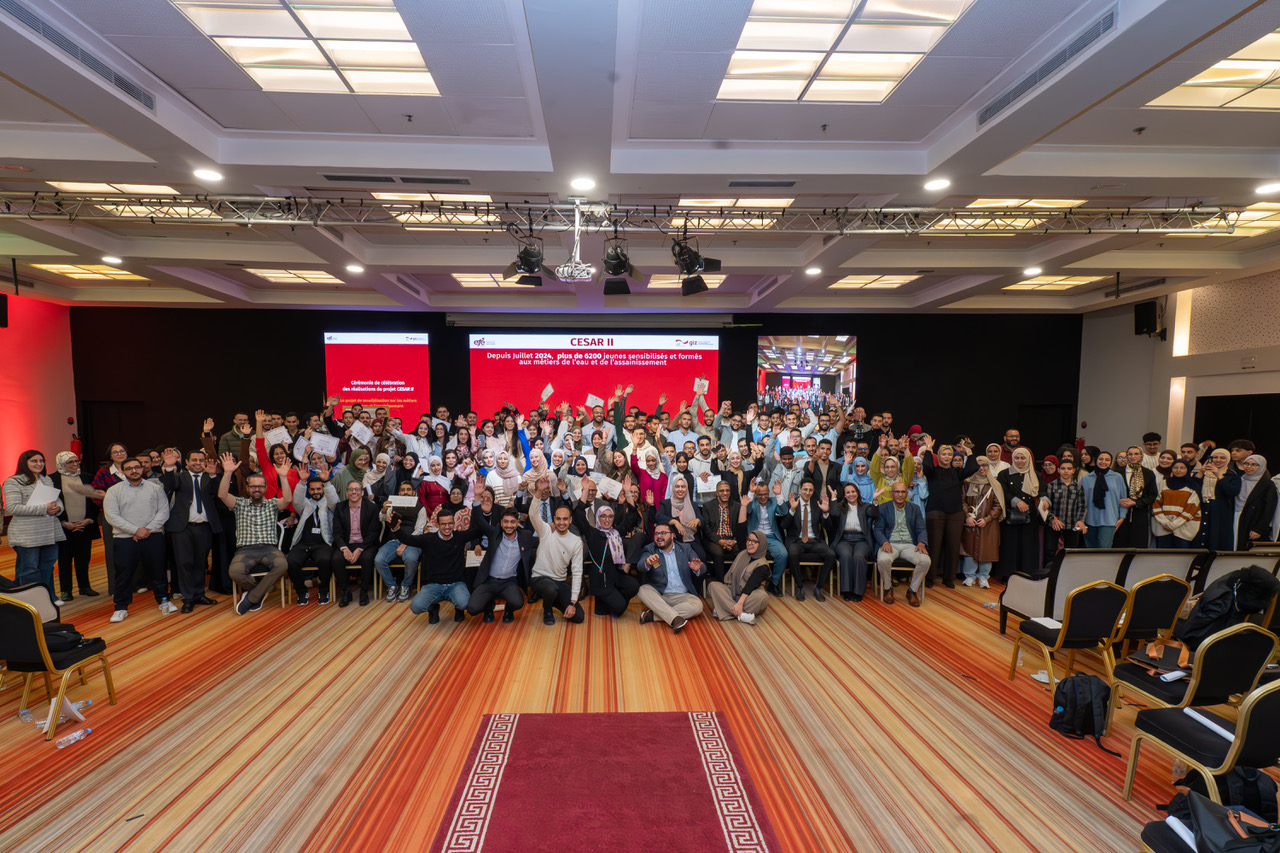
Morocco has celebrated the end of the CESAR II programme, which helped young people get ready for work in the water and sanitation sector. Closing events were held in Marrakech and Agadir to mark nearly two years of training and outreach.
The programme started in July 2024 and was run by the Moroccan Foundation for Education for Employment (EFE-Maroc) with support from Germany’s GIZ. Its goal was to give young Moroccans both technical skills and workplace know-how needed for jobs in a sector going through big changes.

CESAR II reached over 6,200 young people across regions including Casablanca–Settat, Marrakech–Safi, Souss–Massa, and Tanger–Tétouan–Al Hoceima. Around 600 employees of the new Regional Multi-Service Companies, which are taking over from older municipal utilities, received training to help them settle into their roles. Job search workshops helped more than 885 young people, with women making up 56% of participants. Awareness campaigns, called the “Employment Caravan: Water and Sanitation,” reached over 4,600 youth, and a job fair connected about 200 participants with industry leaders.
The programme comes at a time when Morocco is facing its worst drought in decades. The government is investing in seawater desalination and wastewater reuse, which requires trained technicians and engineers. The new Regional Multi-Service Companies aim to standardise water, electricity, and sanitation services across regions, making the training of their staff crucial.
EFE-Maroc, founded in 2008, has trained nearly 90,000 young people and boasts an 83% job placement rate. GIZ’s support reflects Germany’s commitment to sustainable development and “green jobs,” bringing international training standards to Morocco.
CESAR II also made progress on gender inclusion, with more than half of the job search trainees being women. By combining technical training with soft skills like teamwork and communication, the programme helped bridge the gap between youth unemployment and the demand for qualified workers.