
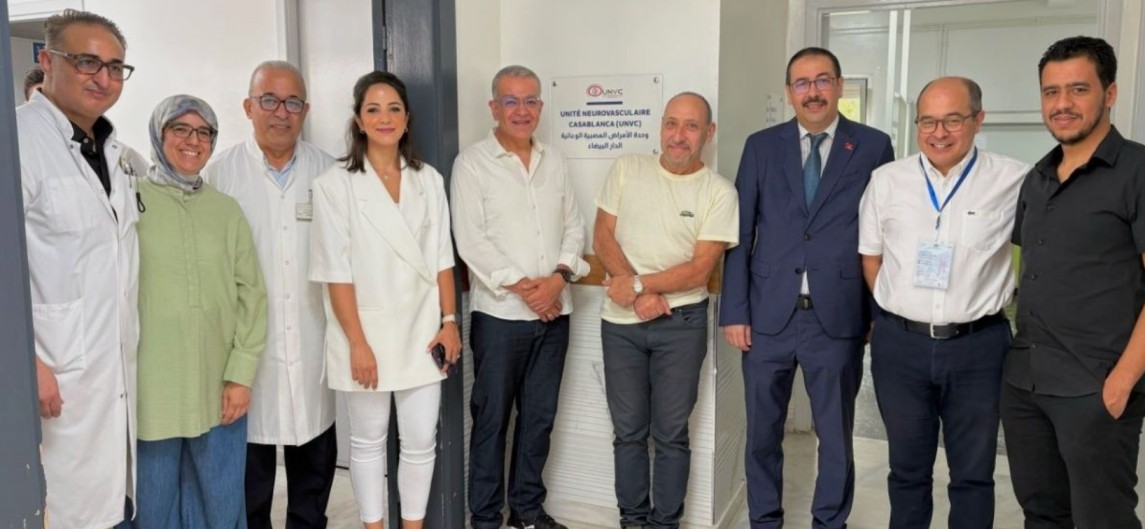
People who suffer a stroke in Casablanca can now receive faster specialist treatment after CHU Ibn Rochd opened a dedicated neurovascular unit at its neurology department. The new unit aims to cut treatment times and improve care by bringing together specialists trained to treat strokes. It was inaugurated in the presence of Professor Moulay Hicham Afif, Director General of the Casablanca-Settat Territorial Health Grouping (GST), Professor Mohammed Benghanem Gharbi, Director of CHU Ibn Rochd, Professor Didier Smadja, Doctor Kalsoum Erwah, and staff from the neurology department.
Neurologist Professor Hajar Khattab said the opening was the result of years of work by hospital teams. “This is the culmination of several years of collective effort by the medical and paramedical teams at the institution.”
Stroke is a medical emergency. About 85% of strokes are caused by a blocked blood vessel in the brain, while 15% are caused by bleeding. Doctors estimate that 1.9 million brain cells die every minute treatment is delayed during an ischaemic stroke.
Doctors can give clot-busting medicine, known as thrombolysis, within 4.5 hours of symptoms starting. Some patients can also undergo mechanical thrombectomy, a procedure that removes the clot, within 6 to 24 hours.
The new unit brings together neurologists, neuroradiologists, specialist nurses, physiotherapists and speech therapists in one place. Studies show patients treated in dedicated stroke units are about 20% more likely to survive and remain independent a year later than those treated in general hospital wards. Specialist units also reduce complications such as pneumonia, deep vein thrombosis and pressure ulcers.
Stroke is one of the leading causes of death and the main cause of acquired physical disability among adults in the country. Health experts estimate tens of thousands of new stroke cases are recorded every year, driven by high rates of high blood pressure, diabetes, smoking and obesity.
The Casablanca-Settat region is home to more than seven million people, making the new unit an important addition to emergency neurological care in the region.