
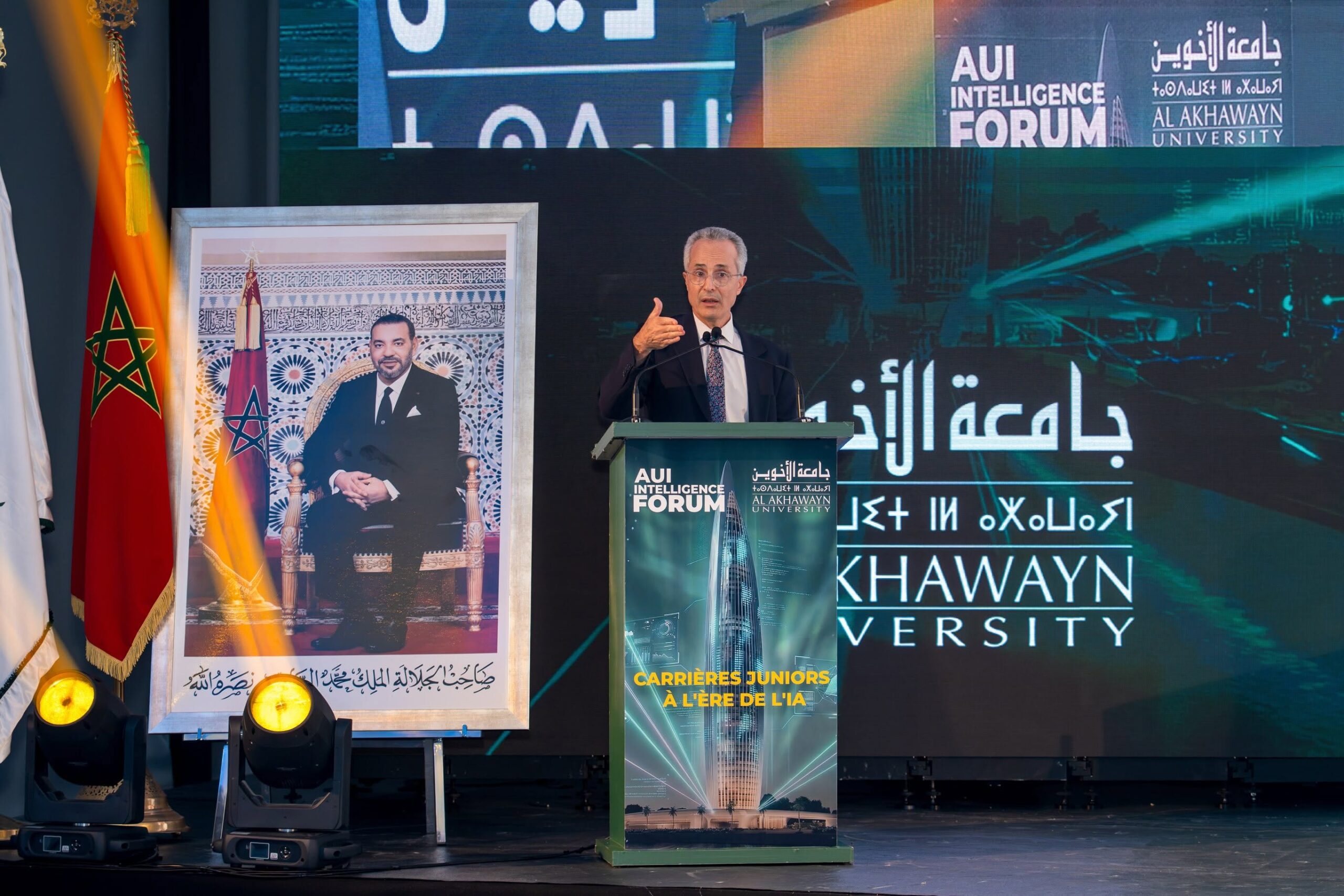
Artificial intelligence is changing the way people work, but it is not taking their jobs in Morocco, business leaders, government officials and academics said at Al Akhawayn University’s Intelligence Forum. They agreed that the country still has time to prepare young people for an AI-powered job market.
The event brought together Higher Education Minister Azzedine El Midaoui, CGEM President Mehdi Tazi, HPS founder and CEO Mohamed Horani, Vocational Training Secretary General Wafaa Asri, former minister Awatef Hayar, DecisiveAI founder and former Digital Transition Minister Ghita Mezzour, École Centrale Casablanca Director General and Mohammed VI Polytechnic University Executive Dean Jalal Charaf, and Al Akhawayn University President Amine Bensaid.
Most speakers said AI is changing tasks inside existing jobs instead of replacing workers.
“As a business leader, I do not yet see AI replacing people, either in my companies or in those of my colleagues,” Tazi said. “More than 90% of jobs are not directly affected today.”
Studies by the OECD and the World Economic Forum show the same trend, Asri said. AI is changing tasks within jobs, especially those given to new graduates, rather than making entire professions disappear.
Companies are already using AI to stay competitive.
“AI is irreversible,” Horani said. HPS has added AI to its internal operations and its products. Companies now expect graduates to have AI skills before they enter the workplace.
That gives the country a chance to prepare, but speakers warned that the window will not stay open for long.
International studies discussed at the forum show that countries which adopted AI faster have seen graduate employment become more difficult. Between 33% and 48% of recent graduates in the United States are still looking for work, while 53% of companies say they cannot find people with AI skills.
Current figures show an average wait of 33 months for a first job in Morocco, while one in four young graduates is unemployed.
“Both scenarios can coexist. It all depends on the choices we make today,” Asri said.
Bensaid said the university organised the forum because it wanted to act instead of waiting to see what would happen.
“We were not prepared to wait and simply observe what would happen. We decided to act,” he said. “This is a good time, and it is certainly not too late.”
El Midaoui urged universities to become “creators of wealth.”
Speakers said AI should help people do more, not replace them.
“We are not talking about replacement; we are talking about becoming a better version of ourselves with AI,” Tazi said.
Charaf said Mohammed VI Polytechnic University is training graduates who can manage AI agents that multiply their productivity.
Bensaid said AI-trained graduates can help create new businesses, economic growth and jobs if employers and universities work together.
“There is real hope: talent enhanced by artificial intelligence can create added value that becomes an additional driver of growth and job creation. That is the challenge of new forms of collaboration between employers and universities: making AI a boost for young people’s employability rather than a threat,” he said.