When the first Renault cars rolled off the production line in Tangier, Morocco was still better known for phosphates, farming and tourism than for factories. Today, vehicles built in the kingdom are shipped across Europe and Africa, aircraft engine components leave Casablanca for global manufacturers, and ministers speak less about attracting investors than about climbing the industrial value chain.
As Morocco marks the 27th anniversary of King Mohammed VI’s accession to the throne on 30 July, the country’s economic story is increasingly one of industrial policy. Over nearly three decades, Morocco has sought to turn geography into a competitive advantage, using its proximity to Europe, extensive trade agreements and modern infrastructure to build an export-oriented manufacturing base.
The strategy has evolved. The objective is no longer simply to persuade multinational firms to open factories. It is to ensure that more of each product is designed, sourced and assembled in Morocco, creating skilled jobs, transferring technology and reducing dependence on imported components.
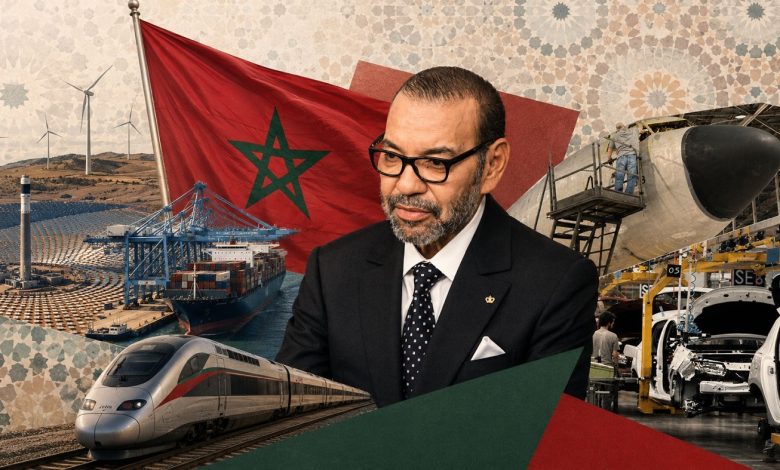
The automotive industry best illustrates that ambition. Morocco is now Africa’s largest passenger-car producer, with annual manufacturing capacity exceeding 700,000 vehicles. Renault operates its flagship factory in Tanger Automotive City, while Stellantis manufactures vehicles in Kenitra. Around them has grown a dense supplier network that includes Aptiv, Yazaki, Sumitomo, Lear, Valeo and Denso.
That ecosystem has steadily increased local integration. Between 65% and 69% of a vehicle’s value is now produced domestically, with the government targeting more than 80%. Moroccan factories manufacture everything from wiring harnesses and seats to glass, electronics and powertrain components. Renault builds models including the Dacia Sandero and Jogger, while Stellantis produces the Peugeot 208, Citroën Ami and Fiat Topolino electric vehicles.
The industry’s next challenge is electrification. Morocco is positioning itself as part of Europe’s future electric-vehicle supply chain through investments in battery materials, cathode production and critical mineral processing. Its phosphate reserves, controlled by OCP Group, are expected to play an important role in producing lithium iron phosphate (LFP) battery materials as Europe prepares to end sales of new petrol and diesel cars by 2035.
A similar climb up the value chain is taking place in aerospace. More than 140 companies now operate in Morocco’s aerospace ecosystem, concentrated mainly around Midparc in Nouaceur near Casablanca. They manufacture aircraft structures, electrical wiring interconnection systems (EWIS), composite materials and precision-engineered components while also providing engineering and maintenance services.
That evolution reached a new stage in October 2025, when King Mohammed VI, accompanied by Crown Prince Moulay El Hassan, presided over the launch of Safran’s aircraft engine industrial complex in Nouaceur. Rather than producing only individual components, the facility assembles, tests and services complete LEAP-1A and LEAP-1B aircraft engines used on Airbus A320neo and Boeing 737 MAX aircraft. It marks Morocco’s move into one of aerospace manufacturing’s most technically demanding segments.
Industrial expansion has been matched by policy reform. Framework Law No. 03.22, better known as the Investment Charter, overhauled Morocco’s investment framework with a clear objective: to make private investment account for two-thirds of national investment by 2035, reversing the country’s traditional reliance on public spending.
The law offers financial incentives tied to job creation, gender equality and sustainable development. Additional grants of between 10% and 15% are available for projects in less-developed regions, while strategic sectors such as automotive, aerospace, biotechnology and green technology receive targeted support. Projects worth more than MAD 500m or creating over 150 permanent jobs can qualify for customised incentive packages.
Recent shocks have reinforced the logic behind that strategy. The Covid-19 pandemic exposed the fragility of global supply chains, prompting Morocco to expand domestic production of pharmaceuticals, food products and other strategic goods while investing more heavily in renewable energy and advanced manufacturing.
Those investments increasingly point towards green industries. More than 40% of Morocco’s installed electricity generation capacity already comes from renewable sources, with a target of 52% by 2030. Under its “Morocco Offer” initiative, the government has earmarked land in phases totalling up to one million hectares for projects producing green hydrogen, green ammonia and synthetic fuels powered by solar and wind energy.
The country’s logistics network has become an equally important asset. Tanger Med, with capacity exceeding nine million TEUs annually, ranks among the world’s busiest container ports and connects Moroccan manufacturers directly to markets in Europe, North America and West Africa.
Financing has also become more structured. The Mohammed VI Investment Fund was established with initial state capital of MAD 15bn and is intended to mobilise as much as MAD 45bn through public and private investment. It finances projects across manufacturing, infrastructure, tourism, agriculture and renewable energy using equity, quasi-equity and debt instruments.
Morocco’s industrial strategy has also become more geographically ambitious. New industrial zones are spreading beyond the Casablanca-Rabat corridor as policymakers seek to attract investment into other regions and narrow economic disparities across the country.
The real test, however, lies ahead. Building factories is easier than building globally competitive industries. Morocco must continue raising local value added, developing skilled workers and moving into more advanced technologies if it is to capture a larger share of global manufacturing.