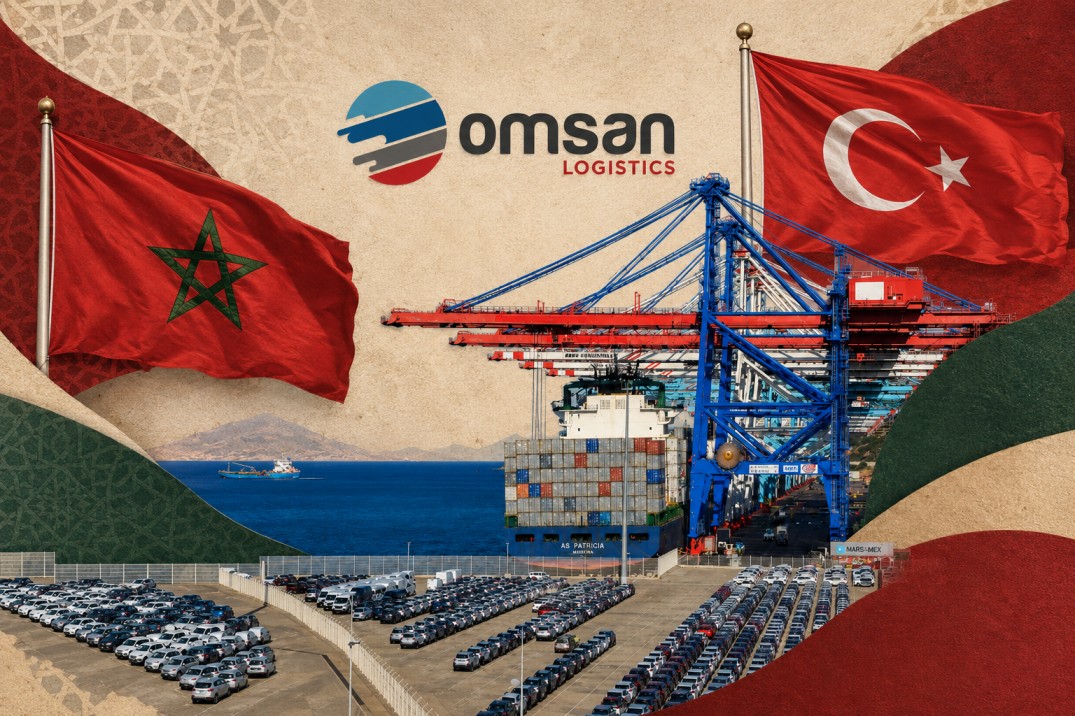
Tanger Med is becoming the main base for Turkish industrial group Oyak as it grows its business across Africa. The group’s logistics company, Omsan, says it is using the Moroccan port to move vehicles and other goods across the continent while also serving European markets.
Omsan President Ergün Arıburnu called Morocco “one of the key African countries” for reaching African markets.
The company says it was “the first logistics company to establish itself and open warehouses in the port” and now has “a clear lead in automotive logistics in Morocco and across Africa.”
Tanger Med is one of the world’s biggest container ports. It can handle more than 9 million TEUs (twenty-foot equivalent units) every year. The port also has dedicated Roll-on/Roll-off (Ro-Ro) terminals for vehicles and handles millions of vehicles and tonnes of cargo annually.
Omsan uses warehouses, shipping services and vehicle logistics from Tanger Med instead of running all its operations from Turkey.
“Our vision is to have a global presence,” Arıburnu said. “We increased our investments in Morocco to reach the African market from Morocco.”
The company is also benefiting from Morocco’s growing car industry, led by Renault’s factory in Tangier and Stellantis’ plant in Kénitra. Tanger Med allows Omsan to store, handle and ship finished vehicles and spare parts between Europe, Turkey and West Africa.
About 90% of global trade moves by sea, according to Arıburnu. He said recent conflicts have made businesses look for safer supply routes.
“Trade is seeking, first and foremost, a safe haven,” he said.
“Today it is the Strait of Hormuz, tomorrow it could be the Suez or Panama canals.”
Turkey is building new transport links to reduce the risks of relying only on sea routes. These include the Middle Corridor, which connects China to Europe through Central Asia and Turkey, the proposed Zangezur Corridor, the revival of the Hejaz Railway, and the Dörtyol-Hassa rail and road tunnel project, linking Turkey’s industrial centres to the Mediterranean Port of İskenderun.
The plan is to move cargo overland to Turkish ports before shipping it to Tanger Med. From there, goods can be distributed across North and West Africa while staying close to European markets.
Arıburnu said trade linked to these transport networks, now worth more than $1bn, could double over the next 10 years. He said that depends on completing rail, tunnel and port projects already under construction.
“These investments sometimes benefit the next generation,” he said.
Arıburnu said Turkey’s skilled workforce remains one of its biggest advantages but warned that losing qualified workers would weaken the country’s position.
“Turkey can serve not only this region, but also Europe, the Caucasus, Turkic nations, and the Asia-Pacific,” he said.