Royal Air Maroc (RAM) has received government approval to open a new aviation training company called Moroccan Academy of Aeronautics SA. The government signed the decree on 23 July. Head of Government Aziz Akhannouch and Economy and Finance Minister Nadia Fettah approved the creation of the company, which will be fully owned by the national airline. It will start with a capital of MAD 300,000.
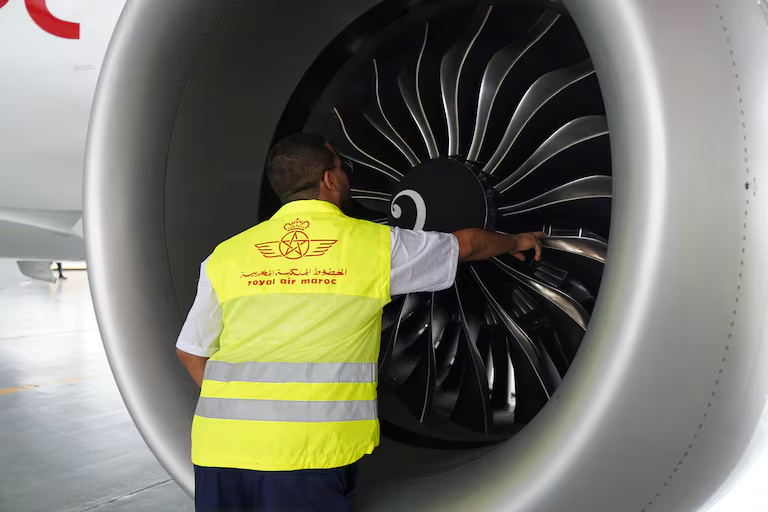
The academy will train people in aircraft maintenance, airline operations and ground handling. It plans to produce more than 550 maintenance, repair and overhaul (MRO) technicians every year.
The project follows two agreements signed in December 2025 to strengthen vocational training in aircraft maintenance and airport logistics. RAM’s board approved the plan on 7 May 2026 before it received a favourable opinion from the National Agency for Strategic Management of State Holdings (ANGSPE).
The academy is part of RAM’s 2023-2037 programme contract with the government. The airline is preparing for rapid growth as the country gets ready to co-host the 2030 FIFA World Cup and aims to welcome 21 million tourists a year by 2037.
RAM plans to increase its fleet from about 50-60 aircraft to 200 by 2037. The airline expects to receive up to 15 new aircraft a year from 2028.
The expansion also includes growing the route network from 99 destinations in 44 countries to 143 international destinations. Passenger numbers are expected to reach 31.6 million a year.
Annual revenue is projected to rise from MAD 16.5 billion to MAD 94 billion by 2037.
The airline also expects its workforce to grow from 3,500 employees to more than 11,000. Aviation industry estimates suggest about 55 employees are needed for every aircraft, creating strong demand for qualified engineers, technicians and flight crews.
RAM operates Boeing 737 MAX 8 aircraft, Boeing 787 Dreamliners and regional jets. Safran Aircraft Engine Services Morocco (SAESM), a joint venture near Casablanca’s Mohammed V Airport, maintains CFM56 and next-generation LEAP engines used by the airline.
RAM also wants to make Casablanca a larger connecting hub for flights between Africa, Europe, the Middle East and North America.
The academy joins several aviation training centres already operating in the country.
The Institut des Métiers de l’Aéronautique (IMA), based in the Midparc aerospace zone in Nouaceur, trains workers for aerospace manufacturing and assembly. Between 80% and 90% of its graduates find jobs in the sector.
The Académie Internationale Mohammed VI de l’Aviation Civile (AIAC), created in Casablanca in 2000 under the National Airports Authority (ONDA), trains air traffic controllers, avionics engineers and civil aviation managers. It is part of a higher education system that produces about 23,000 engineers every year, including around 400 aerospace engineers.
The Morocco Aviation Private Academy (MAPA), based at Benslimane Airport, offers commercial pilot training and European Union Aviation Safety Agency (EASA) Part 147-approved aircraft maintenance courses with international partners, including Airways Aviation.
The aerospace industry has become one of the country’s fastest-growing manufacturing sectors. Exports are worth more than MAD 30 billion, or about $2.6 billion.
More than 150 international aerospace companies operate in the country, including Boeing, Safran, Spirit AeroSystems and Hexcel.
The sector employs more than 26,000 skilled workers. Women make up nearly 40% of the technical manufacturing workforce.