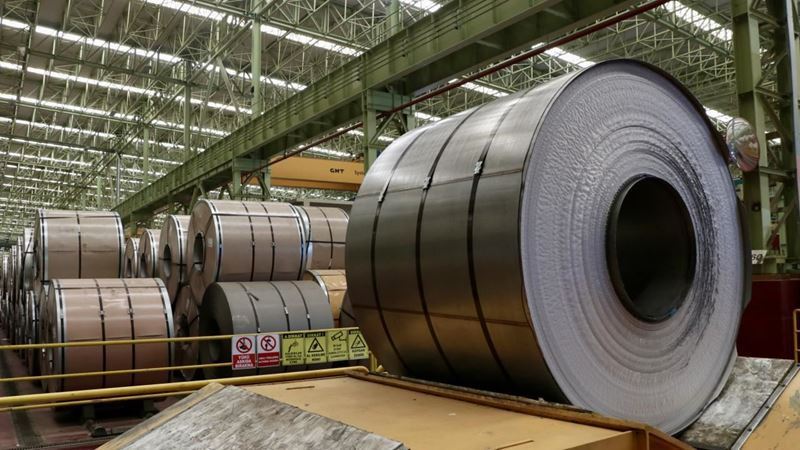
Steel use in Morocco is growing. Demand is expected to rise by 7% to 8% in 2026, reaching between 2.75m and 2.82m tonnes. Demand is then expected to pass 3m tonnes in 2027 for the first time.
Construction and infrastructure projects will drive much of the growth. The car industry, wind power projects and preparations for the 2030 World Cup will also push demand higher. Morocco will host the tournament with Spain and Portugal.
Local steel industry
Local steelmakers have a strong position in the domestic market, even though the country still imports large amounts of steel.
The industry benefits from investment support, customs protection and other measures that favour local producers.
Steel production mainly uses scrap in electric arc furnaces. There are no traditional blast furnaces in the country.
Rolling mills can produce more steel products than local steelmakers can supply. This means producers need to import semi-finished steel.
Long products such as rebar, wire rod and structural sections make up about 65% to 70% of production. Flat steel accounts for the rest.
Steel and rolled-product production stayed largely stable between 2021 and 2025. Riva Industries added new production capacity in 2024.
That extra capacity helped offset production problems at Univers Acier, which has faced difficulties since 2024.
The main producers are Sonasid, Maghreb Steel, Univers Acier and Riva Industries.
Sonasid focuses on long steel products. Maghreb Steel is the country’s only flat-steel producer.
The Investment Charter allows companies to receive direct support of up to 30% of investment costs. Extra incentives are available for green technologies and job creation.
Some imported steel products also face additional duties. These include hot-rolled steel coils.
Anti-dumping duties apply to some cold-rolled steel and galvanised wire imports.
Foreign suppliers can also face delays when getting some steel products certified under Moroccan standards. This makes it harder for some imported products to enter the market and encourages construction companies to buy locally produced steel.
Spain leads steel imports
Morocco is one of Africa’s biggest steel importers.
Semi-finished products account for 45% to 50% of total steel imports. Hot-rolled and cold-rolled coils and special steel products make up most of the rest.
Spain was the biggest supplier in 2024, with steel exports to Morocco worth $511m.
Turkey followed with $341m, then the UK with $217m and China with $189m.
Higher steel prices pushed up import values in 2022. Preparations for the 2030 World Cup helped increase imports again in 2025.
Steel exports from Morocco mainly consist of rolled products for special uses and rebar.
Canada was the biggest destination in 2024, with exports worth $28m. The Netherlands followed with $23.5m, Oman with $17.2m, Egypt with $10.4m and Spain with $9.4m.
Exports fell in 2025 as more steel was sold inside the country to meet construction demand.
Car industry adds to demand
The car industry has become another major source of steel demand.
Morocco came close to South Africa in total vehicle production in 2025 and produced more passenger cars than the continent’s former leader.
Tax incentives and government support have helped attract major carmakers and suppliers.
Renault and Stellantis operate plants in the country. More than 250 companies supply the car industry.
Local parts account for between 65% and 69% of the value of vehicles made in the country.
About 90% of cars assembled in Morocco are exported, mainly to the European Union.
Car exports increased by 15.9% during the first five months of 2026 to $8.2bn.
Finished-car exports rose by 20.7%.
Renault Group’s Moroccan factories increased production by 13.7% between January and June 2026 compared with the same period in 2025.
Production growth in Morocco was faster than at Renault’s plants in Turkey, Mexico and Brazil during the same period.
Stellantis is expanding its plant in Kenitra. Annual production capacity is expected to reach 535,000 cars.
New assembly lines are due to start operating in early 2027.
Vehicle production could pass 700,000 cars a year once the expansion is complete, according to Sernauto, the Spanish Association of Automotive Suppliers.
Wind power
Wind energy is another source of demand for flat steel.
Morocco is Africa’s second-largest wind-energy producer. Wind speeds along some parts of the coast reach 10 to 11 metres per second.
Installed wind capacity is expected to increase by 1.1GW in 2026.
A 900MW project is planned in Dakhla and a 200MW project in Midelt.
The National Electricity Regulatory Authority has also allocated 4.175GW of guaranteed wind capacity under its 2025-2029 grid plan.
Construction remains key
Construction companies account for 60% to 65% of demand for finished steel.
Rebar, wire rod and structural sections make up 65% to 70% of steel used in construction.
Residential construction picked up in 2024 and 2025 after the government introduced a direct housing-support programme.
The programme started on 1 January 2024 and will run until 1 January 2029.
It has annual funding of about $1.02bn.
Buyers can receive $7,480 or $10,686, depending on the price of the home.
Construction permits issued in 2024 and 2025 were twice the 2021 level.
Homes bought through the programme were worth more than $4.38bn. The state contributed $850m.
Another $850m worth of transactions could receive support during 2026.
Large infrastructure projects need even more steel.
The Nador West Med port is one of the biggest projects. It has a total cost of $5.6bn.
The first phase will handle between 3m and 5m TEUs a year. Capacity could eventually reach 12m TEUs.
The liquid and bulk terminals will handle up to 7m tonnes of coal and 25m tonnes of petroleum products each year.
An 800-hectare free economic zone is being developed next to the port. The zone could eventually grow to 5,000 hectares.
Breakwaters, quays and the desalination plant have been completed. Crane installation is under way.
World Cup projects
The 2030 World Cup is also speeding up infrastructure work.
ONCF launched several railway projects in 2024 and 2025.
They include a 3.3km underground tunnel between Rabat and Salé, the Casablanca-South station and the reconstruction of the 210km Sidi El Aïdi-Marrakech railway line.
Several existing stations are also being upgraded.
A 430km high-speed railway linking Kenitra, Rabat, Casablanca and Marrakech is being prepared.
Another 230km high-speed line is planned between Marrakech and Agadir.
Both projects are expected to create demand for steel structures and other steel products.
Water and gas projects
Water projects are also creating new demand for steel.
The Water Highway is designed to move water from wetter northern areas to central and southern regions where water is less available.
A 66.7km Sebou-Bouregreg section has been completed using steel pipes imported from Turkey. The pipes have a diameter of 3.2 metres.
Work continues on the 300km Sebou-Oum Er-Rbia section. There are also plans to extend the project towards Marrakech.
A 120km gas pipeline is also being developed between the Tendrara gas field and the existing Maghreb-Europe gas pipeline.
The existing pipeline has a capacity of 280m cubic metres a year.
Preparatory work is under way.
Outlook
The European economic slowdown could affect car production in Morocco.
Factories may not be able to operate at full capacity if demand in Europe remains weak.
Production and exports are still expected to remain stable. Duty-free access to the European market under the free-trade agreement will continue to support the industry.